


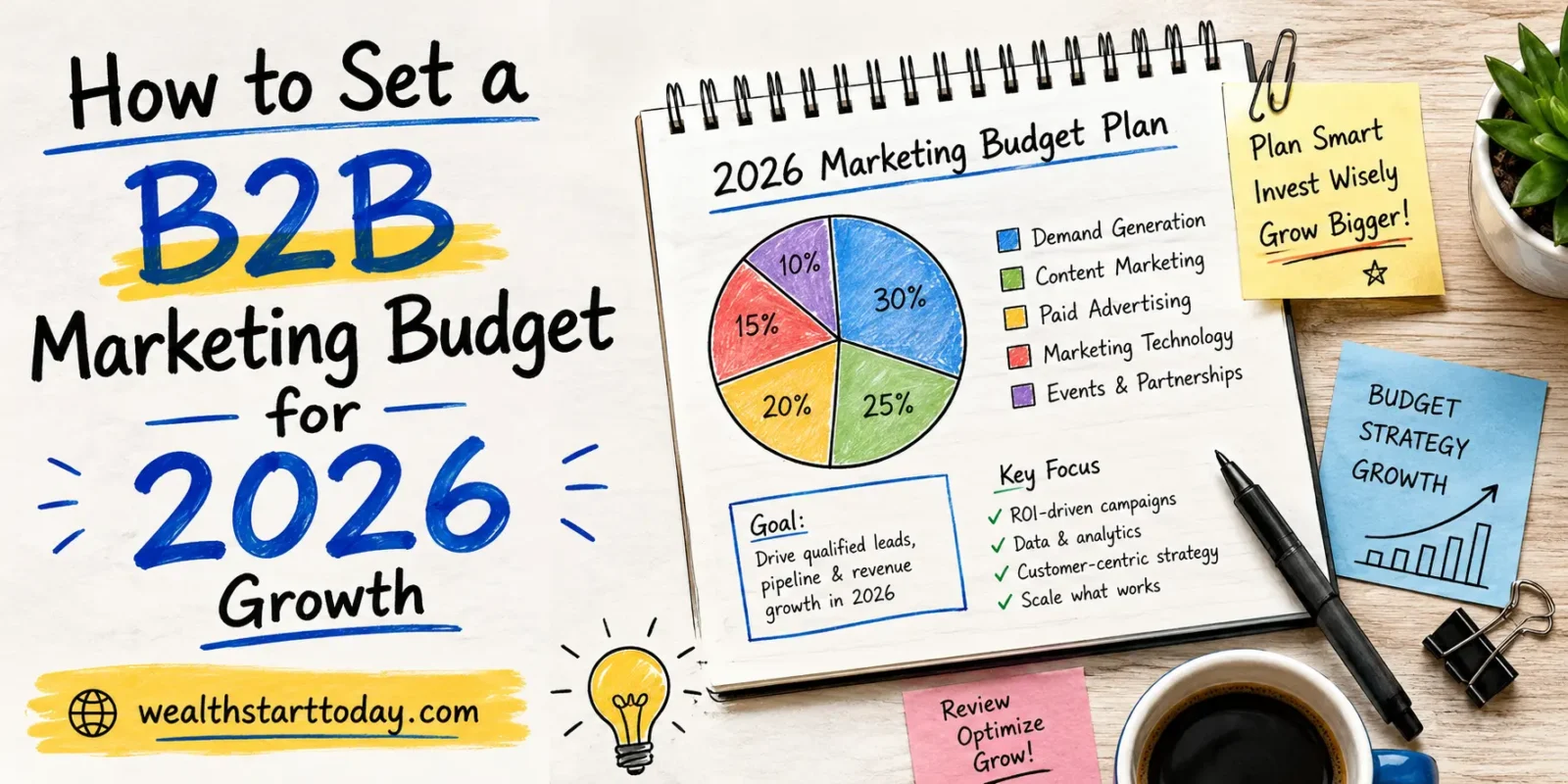
A well-organized marketing budget is the silent motor that powers every prosperous B2B business. However, one of the most frequent errors made by business executives is either completely underfunding marketing initiatives or overspending without a defined plan. If you want to grow your company, get more customers, and outperform your rivals, you must understand how to set a B2B marketing budget that works strategically — not just on paper, but in the real world.
Choosing a random percentage of your revenue and crossing your fingers is not the way to set a B2B marketing budget. It involves comprehending your company’s objectives, identifying your target market, calculating ROI, and allocating resources to the appropriate channels at the appropriate times. This thorough guide helps you make every dollar matter by guiding you through every stage of the process, from basic ideas to sophisticated allocation techniques.
This guide is designed for you, whether you are an established business trying to improve your competitive edge or a startup trying to get off the ground. At Wealth Start Today, we believe that smart financial planning is the backbone of any successful business — and marketing budgets are no exception. Explore our Budgeting category for more resources on building financially sound business strategies.
What Is a B2B Marketing Budget and Why Does It Matter?
Understanding the Purpose of a B2B Marketing Budget
At how to set a B2B marketing budget, A business-to-business (B2B) marketing budget is a financial plan that specifies how much money will be spent on marketing initiatives over a given time frame, typically quarterly or annually. It includes anything from event sponsorships, CRM software, and sales enablement tools to content production and paid advertising.
B2B marketing concentrates on lengthy sales cycles, relationship building, and high-value accounts, in contrast to B2C marketing, where campaigns frequently target instant consumer purchases. Because of the increased stakes, it is even more important to have a targeted, data-driven budget.
Why Setting a B2B Marketing Budget Correctly Drives Business Success
When you know how to set a B2B marketing budget the right way, you gain the ability to:
- Align marketing investments with overall business objectives
- Avoid over-spending on low-return channels
- Plan campaigns around predictable revenue targets
- Justify marketing spend to leadership and stakeholders
- Build long-term brand equity while generating short-term leads
Businesses with strategic budgets routinely outperform those with careless marketing expenditures. Industry data indicates that B2B businesses who allocate 6–12% of their yearly revenue on marketing typically see faster growth than those that don’t.
How to Set a B2B Marketing Budget: Step-by-Step Framework
Step 1: Define Your Business Goals Before Setting a B2B Marketing Budget
Clearly defining your business goals is the most crucial thing you should do before spending a single dollar. Consider this:
- Are you trying to generate more leads or improve lead quality?
- Do you want to expand into a new market or geographic region?
- Are you focusing on customer retention and upselling existing clients?
- Is brand awareness your primary objective this year?
Your answers will determine how to set a B2B marketing budget that aligns with what you actually want to achieve. For instance, you might devote more funds to sponsored search and content syndication if your objective is aggressive lead generation. More money should be spent on account-based marketing (ABM), email automation, and customer success content if your goal is retention.
Step 2: Review Your Historical Marketing Performance Data
Before you can look forward, you must look back. Pull together your historical marketing data and ask:
- Which channels generated the most qualified leads?
- What was your cost-per-lead (CPL) from each channel?
- Which campaigns produced the highest ROI?
- Where did you overspend without seeing meaningful results?
Your next budget should be determined by your data if it consistently demonstrates that LinkedIn ads outperform display ads. The most accurate indicator of future productivity is past performance, which enables you to establish a B2B marketing budget based on facts rather than conjecture.
Step 3: Calculate Your Total Available Marketing Budget Using the Right Model
At how to set a B2B marketing budget, To determine how much to spend on B2B marketing, a number of popular models are utilized:
The Percentage of Revenue Model
The most popular method is this one. Typically, B2B businesses devote 5% to 12% of their yearly income to marketing. While mature businesses often maintain around 5-7%, early-stage organizations looking for aggressive expansion may go as high as 15-20%.
- Startup (aggressive growth): 10–20% of revenue
- Growth-stage company: 7–12% of revenue
- Established enterprise: 5–7% of revenue
The Goal-Based Budgeting Model
This model begins with your objectives rather than revenue. To find the overall spend, you must figure out how much it will cost to accomplish each objective, like producing 500 qualified leads per month. Budgets created using this technique are typically more precise and goal-oriented.
The Competitive Parity Model
At how to set a B2B marketing budget, Some businesses compare their marketing budgets to those of their rivals in the same industry. Although this approach has advantages for maintaining competitiveness, it lacks the accuracy of goal-based planning and may result in wasteful spending.
Step 4: Allocate Your B2B Marketing Budget Across the Right Channels
Once you have determined your total budget, the next challenge is channel allocation. Knowing how to set a B2B marketing budget by channel is where most companies make critical mistakes. Here is a practical allocation framework for most B2B businesses:
Content Marketing and SEO (20–25% of Budget)
In B2B marketing, content is still king. You may increase your organic search rankings, establish authority, and draw in high-intent customers with blog articles, whitepapers, case studies, and video material. Long-term ROI that accumulates over time is a constant result of content marketing investments.
Since SEO and content are closely related, they shouldn’t be treated as distinct costs. This category should include link-building initiatives, technical SEO, and keyword research.
Paid Advertising and PPC (20–30% of Budget)
At how to set a B2B marketing budget, When organic channels are still gaining traction, paid channels like Google Ads, LinkedIn Ads, and programmatic display can speed up results. For B2B audiences, LinkedIn in particular offers outstanding targeting based on industry, job title, and firm size.
Paid advertising, however, needs to be closely watched. Your budget may rapidly deplete with little return on investment if it is not properly tracked and optimized. Prior to starting any advertising campaign, establish certain CPA (cost per acquisition) goals.
Email Marketing and Marketing Automation (10–15% of Budget)
Out of all B2B channels, email marketing continues to yield one of the greatest ROIs. Email automation tools are a valuable investment whether you are delivering personalized content, managing drip campaigns, or nurturing leads through the sales funnel.
Set aside money for content production, copywriting, and campaign planning in addition to the platform itself (e.g., HubSpot, Marketo, or ActiveCampaign).
Events and Webinars (10–15% of Budget)
Industry conferences, trade exhibits, and online webinars are essential for fostering relationships and providing thought leadership for many B2B businesses. Although these channels are more expensive, they frequently produce high-quality leads and substantial brand visibility.
Carefully consider the investment. Think about whether it would be less expensive to host your own webinar series rather than go to major trade exhibitions.
Account-Based Marketing (ABM) (15–20% of Budget)
At how to set a B2B marketing budget, For commercial and mid-market B2B businesses, ABM has emerged as a key tactic. ABM concentrates all marketing efforts on a specific list of high-value target accounts rather than using a broad approach. Set aside money for direct outreach initiatives, targeted advertisements, and customized material for particular businesses and decision-makers.
Brand and PR (5–10% of Budget)
Although businesses with significant brand recognition close agreements more quickly and encounter less pricing resistance, B2B brand-building is frequently underappreciated. Set aside money for media placements, award applications, thought leadership content, and public relations.
Step 5: Factor in Technology and Tools When Setting a B2B Marketing Budget
A contemporary B2B marketing team makes extensive use of technology. Your spending plan has to include:
- CRM platform (e.g., Salesforce, HubSpot CRM)
- Marketing automation software
- SEO tools (e.g., Ahrefs, SEMrush)
- Analytics and reporting platforms
- Project management tools
- Design and creative software
At how to set a B2B marketing budget, In today’s digital-first world, technology costs are unavoidable. Missed opportunities and operational inefficiencies arise from not budgeting for these technologies. Software and technology typically make up 15–25% of a B2B marketing expenditure.
Step 6: Build in a Contingency Reserve for Your B2B Marketing Budget
No matter how carefully you prepare, unforeseen possibilities and difficulties will present themselves. Set aside five to ten percent of your entire marketing budget as a contingency fund. This keeps your overarching plan intact while enabling you to react swiftly to new market opportunities, explore new channels, or cover cost overruns.
Marketing Budget for B2B Companies: Learning from Previous Strategies
Building on What Works: A Reflection on the Marketing Budget for B2B Companies
In our previous content on marketing budget for B2B companies, we looked at the fundamental ideas underlying the importance of structured budgeting and how companies frequently find it difficult to match their marketing expenditures to their real revenue goals. We talked about B2B companies’ propensity to either underfund vital growth areas like SEO and ABM since there are unclear attribution models or overinvest in channels that feel comfortable but yield diminishing returns.
The main takeaway from the material was that a marketing budget is a strategic investment vehicle rather than just a cost center. A well-designed marketing budget for B2B businesses develops a competitive moat that is challenging for competitors to imitate when handled with discipline and data.
At how to set a B2B marketing budget, Building on previous experiences, this guide provides a comprehensive methodology that links every dollar to quantifiable business objectives and delves deeper into the practical implementation of budget planning. The fundamentals are still the same: identify your objectives, track your progress, and make wise choices that promote scalable, sustainable growth.
Common Mistakes to Avoid When Setting a B2B Marketing Budget
Mistake 1: Setting a B2B Marketing Budget Without Tying It to Revenue Goals
At how to set a B2B marketing budget, Treating the marketing budget as a set annual expense instead than a dynamic investment connected to revenue targets is one of the most detrimental errors. Whether it’s leads generated, pipeline influenced, or sales closed, each line item in your budget should have a corresponding intended consequence.
Mistake 2: Neglecting to Reassess Your B2B Marketing Budget Quarterly
At how to set a B2B marketing budget, The state of the market shifts. Rivals’ tactics change over time. There are new channels. By June, a budget that was flawlessly calibrated in January can be completely out of date. Make a commitment to conducting quarterly budget reviews in which you examine performance data, reallocate funds from channels that aren’t performing well, and focus more on what is.
Mistake 3: Underinvesting in Brand Awareness While Setting a B2B Marketing Budget
Many B2B businesses ignore the long-term brand equity that makes demand creation more effective and efficient over time in favor of concentrating only on lead acquisition and demand generation. No matter how much money you spend on sponsored advertisements, your conversion rates will suffer if no one knows about your business.
Mistake 4: Ignoring the Sales and Marketing Alignment in Your B2B Marketing Budget
There is more to your marketing budget than meets the eye. Sales and marketing must be closely coordinated for it to be successful. Set aside money for shared CRM infrastructure, collaborative planning meetings, and sales enablement tools to guarantee that marketing-generated leads are successfully converted by sales.
How to Measure ROI and Optimize Your B2B Marketing Budget
Key Metrics to Track When Managing a B2B Marketing Budget
Monitoring the appropriate KPIs at each level of the funnel is necessary to assess the effectiveness of your B2B marketing budget:
- Cost Per Lead (CPL): How much does it cost to generate one qualified lead?
- Customer Acquisition Cost (CAC): What is the total cost of acquiring one new customer?
- Marketing Influenced Pipeline: What percentage of your total sales pipeline was touched by marketing?
- Return on Marketing Investment (ROMI): For every dollar spent, how much revenue is generated?
- Lead-to-Close Rate: What percentage of marketing-generated leads convert to customers?
These indicators provide you with the information you need to make wise choices and consistently increase the effectiveness of your marketing expenditures.
How to Use Data to Refine Your B2B Marketing Budget Over Time
At how to set a B2B marketing budget, Optimizing the budget is a continuous task. Review your important indicators at the beginning of each quarter, determine which of your ROI channels are the highest and lowest, and then modify your allocation as necessary. Businesses that adopt a culture of continuous improvement—testing, monitoring, and iterating on everything—get the most out of their marketing dollars.
Wealth Start Today: Your Partner in Smart Financial and Marketing Planning
At Wealth Start Today, our mission is to empower business owners, entrepreneurs, and marketers with the financial knowledge and strategic insight they need to grow with confidence. Wealth Start Today’s Budgeting category is packed with actionable guides, frameworks, and tools specifically designed to help you make smarter money decisions — whether you are managing a personal budget, a startup’s finances, or a full-scale B2B marketing budget.
We believe that financial clarity is the foundation of business success. That is why we create content that bridges the gap between high-level financial strategy and real-world execution. If you are serious about understanding how to set a B2B marketing budget and scaling your business effectively, Wealth Start Today is your go-to resource for trusted, expert-backed guidance.
B2B Marketing Budget Template: A Simple Starter Framework
At the topic of how to set a B2B marketing budget, Here is a streamlined budget allocation template for a B2B business with a $200,000 yearly marketing budget to get you going right away:
| Marketing Channel | Allocation % | Budget Amount |
|---|---|---|
| Content Marketing & SEO | 22% | $44,000 |
| Paid Advertising (PPC/LinkedIn) | 25% | $50,000 |
| Email Marketing & Automation | 12% | $24,000 |
| Events & Webinars | 13% | $26,000 |
| Account-Based Marketing (ABM) | 15% | $30,000 |
| Brand & PR | 8% | $16,000 |
| Technology & Tools | 0% | Included above |
| Contingency Reserve | 5% | $10,000 |
| Total | 100% | $200,000 |
Adapt these percentages to your industry, business objectives, and each channel’s level of maturity for your target market.
FAQs: How to Set a B2B Marketing Budget
Q1: What percentage of revenue should a B2B company spend on marketing?
The majority of B2B businesses devote 5% to 12% of their yearly income to marketing. While established businesses usually spend 5–7%, startups in aggressive development phases may invest up to 15–20%. The ideal percentage is determined by your company’s stage of development, competitive environment, and growth objectives.
Q2: How often should I review and adjust my B2B marketing budget?
Your B2B marketing budget should, at the very least, be reviewed every three months. Even preferable are monthly check-ins, particularly for paid channels where expenses and performance can change quickly. You can reallocate spending to high-performing channels and reduce waste from underperforming ones by conducting regular assessments.
Q3: What is the most important factor when setting a B2B marketing budget?
Alignment with your business objectives is the most crucial component. Whether it’s lead generation, market expansion, brand exposure, or client retention, your budget should be based on your goals. Even a large budget will perform poorly if goals are not aligned.
Q4: Should small B2B companies invest in account-based marketing (ABM)?
Indeed, ABM may help even tiny B2B businesses, particularly if they cater to high-value customers with lengthy sales cycles. Implementing ABM doesn’t require a large budget; with the appropriate accounts, even a small investment in targeted content and personalized outreach can result in substantial returns.
Q5: How do I measure whether my B2B marketing budget is working?
Monitor important KPIs such as Return on Marketing Investment (ROMI), marketing-influenced pipeline, Cost Per Lead (CPL), and Customer Acquisition Cost (CAC). By providing you with a clear picture of which investments are profitable and which are not, these indicators enable you to continuously optimize your budget.
Q6: What is the biggest mistake companies make with their B2B marketing budget?
Treating marketing spending as a fixed expense instead than a strategic investment is the biggest error. Businesses with data-driven, goal-aligned budget plans routinely outperform those that do not link budget allocations to quantifiable results and do not conduct frequent performance evaluations.
Q7: Is content marketing worth the investment in a B2B marketing budget?
Of course. One of the B2B channels with the strongest long-term return on investment is content marketing. Building thought leadership and organic search rankings takes time, but over time, the compounding returns from quality content drastically lower your cost per lead when compared to paid channels.
Conclusion: Master How to Set a B2B Marketing Budget and Watch Your Business Grow
Understanding how to set a B2B marketing budget is one of the most impactful skills a business leader or marketer can develop. It is the difference between marketing that feels like a gamble and marketing that functions like a reliable growth engine.
You put your company in a position to develop precisely and confidently by clearly defining your goals, evaluating your past data, selecting the best budget model, distributing spending across tried-and-true channels, investing in the appropriate technology, and setting aside money for contingencies. Additionally, you make sure your budget changes as your firm does by closely monitoring your performance and making quarterly strategic adjustments.
Remember: a great B2B marketing budget is not about spending the most money. It is about spending the right money in the right places at the right time.
For more expert budgeting advice and financial strategies designed to help businesses thrive, visit Wealth Start Today and explore our full Budgeting resource library. Stay connected with us on Facebook and X.com for the latest insights and tips delivered straight to your feed.
Your growth journey starts with the right budget. Build it with purpose — and start today.














Leave a comment