


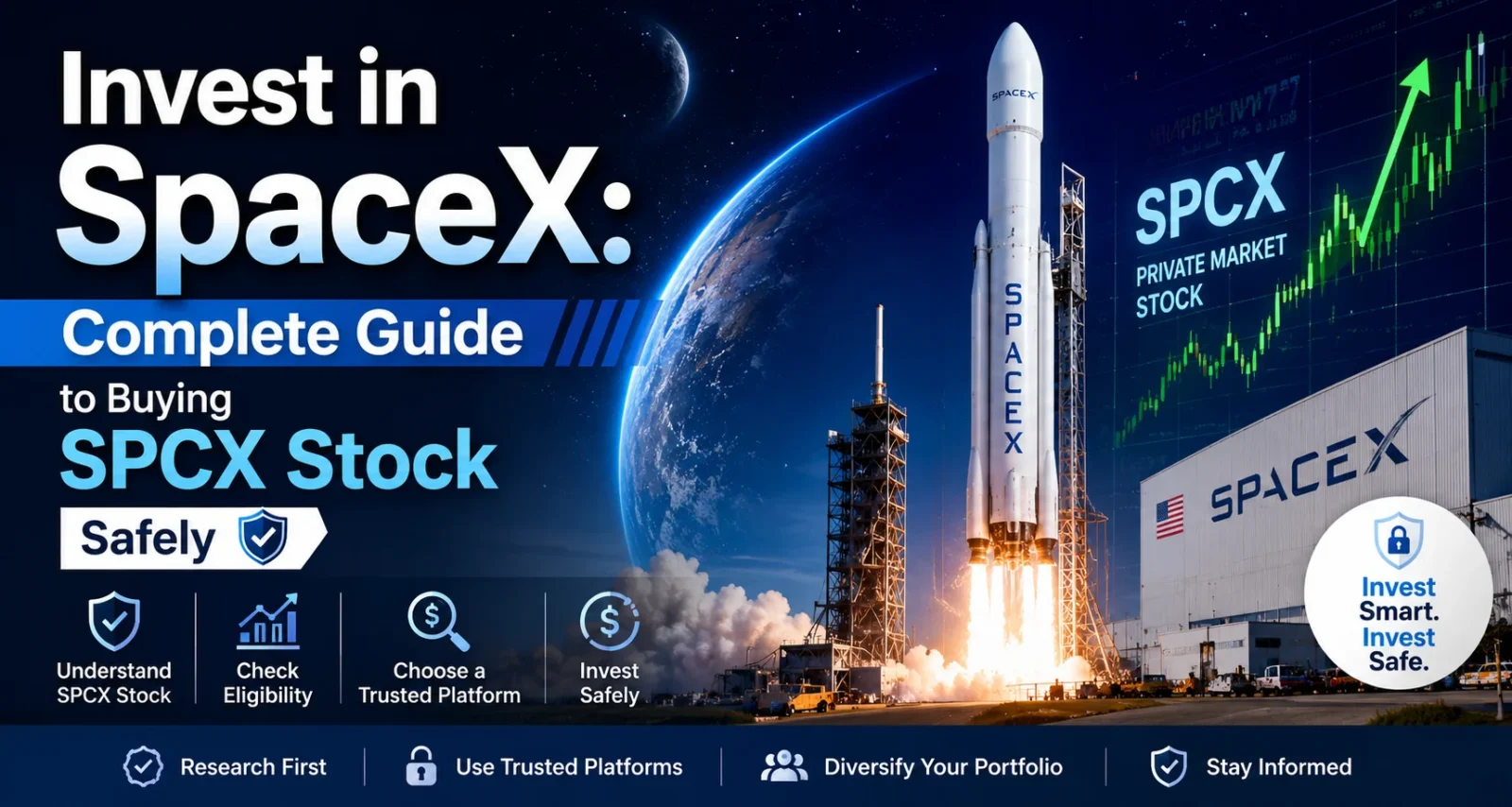
For over twenty years, the average person could only fantasize about invest in SpaceX. Regular investors watched from the sidelines as Elon Musk’s rocket company remained private, financed by employee stock, venture capital, and sovereign wealth funds. That all changed on June 12, 2026, when SpaceX successfully conducted the biggest IPO in history, making it possible for anyone with a brokerage account to purchase shares. You’ve come to the perfect place if you’ve been looking for a straightforward explanation of how this operates. The IPO, the current stock price, the risks, the options, and a practical, step-by-step plan are all covered in this guide.
This article is part of the Investing section on Wealth Start Today, where we break down complicated financial topics — from IPOs to retirement accounts — into guidance you can act on without a finance degree. You can explore more investing breakdowns in our Investing category.
What Does It Mean to Invest in SpaceX in 2026?
Investing in SpaceX now is very different from what it was even a year ago. Prior to 2026, the only ways to learn about the company were through venture funds, employee stock sales, or pre-IPO share purchases on specialist platforms, all of which were mostly off-limits to regular investors. Now that SpaceX is a publicly traded company, the purchase process is similar to that of other stocks.
SpaceX’s Journey From Private Company to Public Stock
Elon Musk founded SpaceX in 2002, and the company’s reusable rockets, Falcon 9 and Falcon Heavy launchers, and Starlink satellite internet network served as its foundation. In February 2026, the corporation also finished acquiring Musk’s artificial intelligence startup, xAI, making AI operations a third significant division of the organization. SpaceX had three main businesses by early 2026: AI, Starlink connectivity, and space launch. As a result, the company’s IPO was one of the most eagerly awaited market events of the decade.
Why Investors Want to Invest in SpaceX Now
The appeal is simple: SpaceX is situated at the nexus of three rapidly expanding industries: artificial intelligence computing, global satellite internet, and space infrastructure. AI, connectivity, and space solutions have a $28.5 trillion addressable market, according to the company’s IPO filing. Rather of waiting for the next IT behemoth to emerge, a lot of retail investors are lured to this stock because of its size.
Invest in SpaceX: IPO 2026 Key Facts to Know
It is helpful to know exactly how the company entered the public market and what has transpired since before investing in this stock.
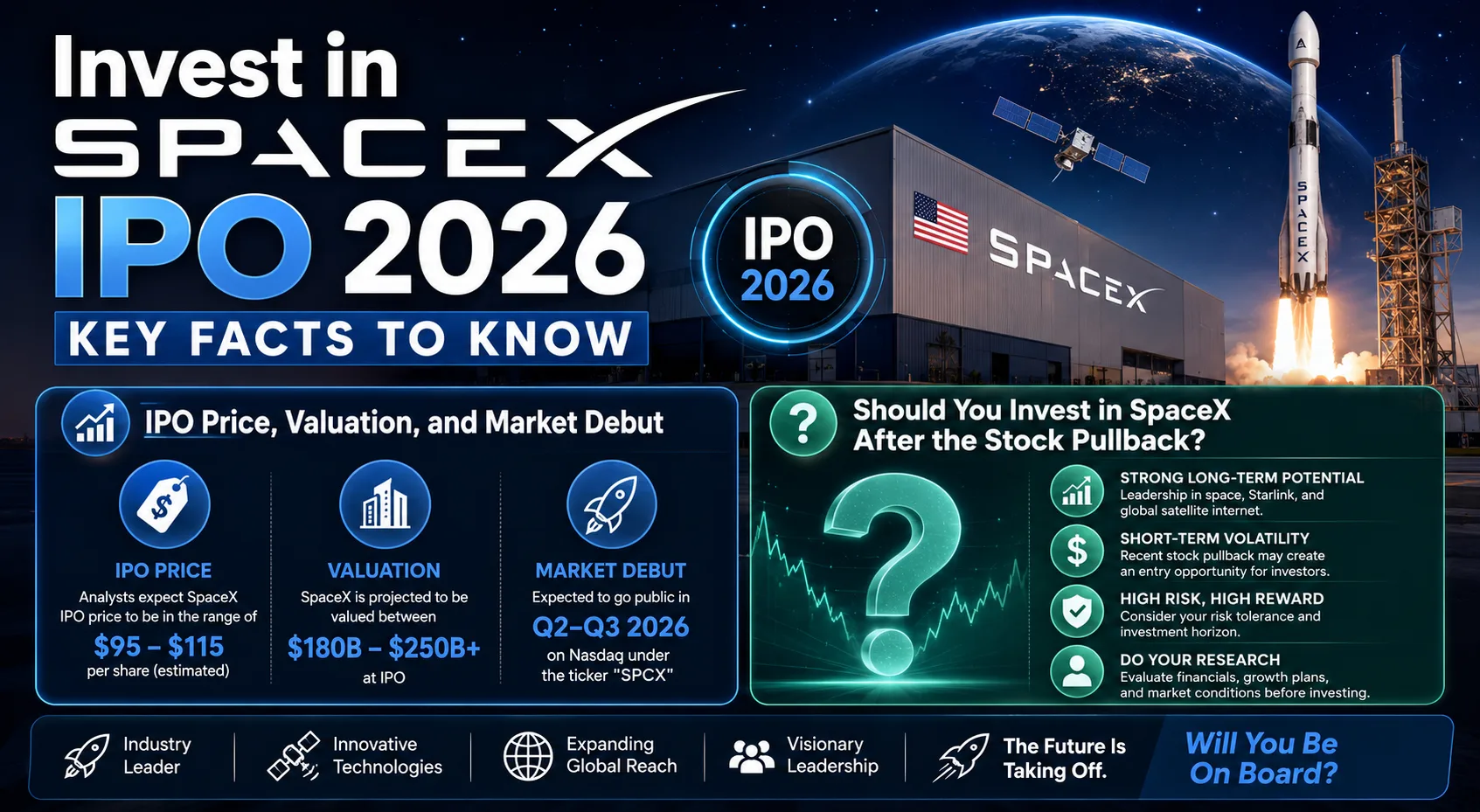
IPO Price, Valuation, and Market Debut
On June 12, 2026, SpaceX concluded its eagerly anticipated IPO, raising $75 billion—roughly three times the amount of the next-biggest offering—in the greatest IPO ever recorded. Before beginning at $150 and rising into the $160s during the first hour of trading, shares were valued at $135 apiece, valuing the firm at about $1.75 trillion, pushing the valuation above $2 trillion.
Later, on June 16, the stock reached an intraday high of $225.64 before significantly declining over the next few sessions.
Should You Invest in SpaceX After the Stock Pullback?
Anyone thinking about making a purchase today should be aware of how erratic the ride has been. By mid-July 2026, SpaceX’s market value had dropped by almost $1 trillion since its post-IPO peak and had dropped for six days in a row. Shares fell below the initial $135 IPO price as the momentum subsided sufficiently. The market value is currently between $1.6 trillion and $1.7 trillion, with recent trade placing shares between $120 and $130.
For those who wish to quickly review the numbers, here is a brief overview:
| Metric | Detail |
|---|---|
|
IPO Date |
June 12, 2026 |
|
IPO Price |
$135 per share |
|
IPO Valuation |
~$1.75–1.77 trillion |
|
Intraday All-Time High |
$225.64 |
| Ticker Symbol |
SPCX (Nasdaq) |
| Recent Trading Range |
~$120–$130 |
| Analyst Average Price Target |
~$164–$240 |
| Next Earnings Report |
August 6, 2026 |
This table makes it simpler to understand how much the stock has fluctuated since its launch; this is a trend typical of mega-cap initial public offerings (IPOs), but it’s something every investor should consider before making a serious investment.
How to Invest in SpaceX Stock (SPCX) Step by Step
If you’ve made the decision to proceed, the procedure is straightforward. Here’s how to do it exactly.
Step 1: Open a Brokerage Account to Invest in SpaceX
Investors can locate and trade SpaceX’s shares using any regular brokerage account. The company is openly traded on Nasdaq under the ticker code SPCX. SPCX is supported by well-known platforms like Fidelity, Charles Schwab, Robinhood, and E*TRADE. Opening a brokerage account, which involves basic banking information and identification, usually takes less than fifteen minutes if you don’t already have one.
Step 2: Research SpaceX Financials Before You Invest in SpaceX
Don’t omit this step. As of right now, SpaceX’s trailing twelve-month earnings per share are negative, indicating that the business is not yet profitable under GAAP. SpaceX’s 2026 revenue is predicted by analysts to be between $34.3 billion and $43.2 billion, with a base case of about $38.9 billion. This indicates that the stock continues to trade at a rich multiple in relation to sales even after its decline. Prior to purchasing shares, it is crucial to comprehend this valuation gap because high-multiple stocks are typically more volatile.
Step 3: Decide How Much to Invest in SpaceX
Financial advisors often advise keeping any one speculative stock position below 5% to 10% of your entire portfolio. Although SpaceX is an interesting company, it has just recently gone public, has no dividend, and has a beta that is significantly higher than the market average, which means that its price fluctuates more in both directions.
Step 4: Invest in SpaceX and Monitor Your Position
After your account has been paid, look for “SPCX” in your brokerage app, select a limit order (which only executes at the price you have selected) or a market order (which executes instantly at the current price), and then complete the deal. After the trade closes, pay attention to insider lock-up expiration dates, Starship launch updates, and quarterly earnings—all of which have historically caused price movements.
Is It a Good Idea to Invest in SpaceX Right Now?
The truth is that it depends on your time horizon and risk tolerance. This is the issue that most readers genuinely want answered.
Growth Drivers: Starlink, Starship, and AI
As of March 31, 2026, Starlink had more than 10.3 million active users in 160 countries, according to SpaceX. SpaceX has several options for long-term revenue growth thanks to this subscriber growth, the newly integrated AI section from the xAI acquisition, and its ongoing dominance in orbital launches. A recent note maintained a buy rating with a $300 price target, noting SpaceX’s “energy-to-intelligence edge.” Some analysts are still optimistic.
Risks to Consider Before You Invest in SpaceX
The opportunity is as real as the risks. As SpaceX’s stock faltered due to technical difficulties and lock-up-related selling pressure, short traders had already made large profits. Between late July and August 2026, a sizable portion of insider stock may be available for sale, which might put more downward pressure on the price. SpaceX’s aggressively high valuation suggests that investors could have to wait years for earnings to match the company’s current stock multiple, according to Morningstar analysts.
In summary, previous history indicates that you shouldn’t expect a smooth, consistent growth. This is not a cautious investment; it’s a high-volatility growth stock.
Alternative Ways to Invest in SpaceX Indirectly
Not everyone wishes to own individual shares outright. Thankfully, there are other ways to increase visibility without really owning SPCX.
ETFs: A Way to Invest in SpaceX Indirectly
Following the IPO, a few actively managed and thematic ETFs increased their holdings of SpaceX, providing investors with diverse exposure to trends in space, satellite, and AI infrastructure without concentrating risk in a single firm. The simplest method to verify SpaceX exposure is to look at a fund’s top ten holdings before making a purchase.
Invest in SpaceX Suppliers and Partners
Investing in businesses that supply, rival, or collaborate with SpaceX—such as producers of ground-station equipment, launch rivals, and satellite components—is an additional strategy. Instead of placing all of your bets on the performance of one enterprise, this distributes risk among the larger space economy.
| Approach | Pros | Cons |
|---|---|---|
|
Direct SPCX shares |
Full upside exposure, simple to buy | High volatility, no dividend, richly valued |
|
Space-themed ETFs |
Diversified, lower single-stock risk |
Diluted upside, management fees |
| Supplier/competitor stocks | Broader industry exposure |
Indirect SpaceX exposure only |
Invest in SpaceX: Valuation and Price Targets for 2026
With forecasts ranging from a low of $62 to a high of $800, the average 12-month analyst price objective for SpaceX is currently approximately $240. Most covering analysts have rated the company as a buy. That broad range shows real doubts about SpaceX’s ability to convert its enormous revenue base into steady profit. By the end of 2026, SpaceX shares are expected to reach about $220, according to a realistic base-case prediction, if the company’s sales multiple slightly decreases and revenue growth persists. Some are more cautious, believing that by year’s end, the stock will have settled closer to its IPO price. In the end, there is disagreement among analysts, which is precisely why anyone thinking about this stock should develop their own judgment instead of pursuing a single price target.
How Wealth Start Today Helps You Invest in SpaceX Wisely
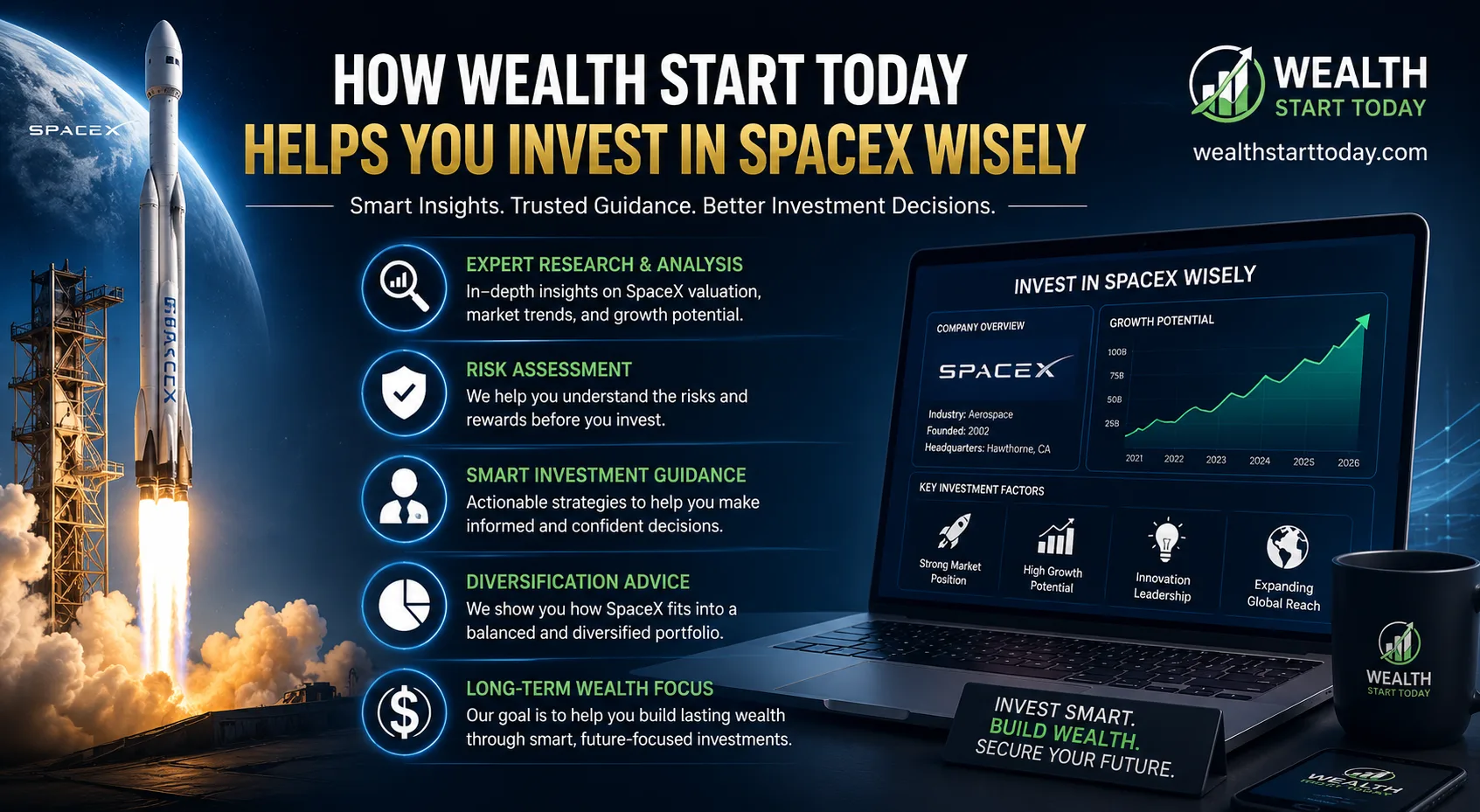
Our mission at Wealth Start Today is to assist novice and experienced investors in understanding important financial choices before they risk real money. Our Investing category is designed to provide you with jargon-free, research-backed explanations, whether this is your first time buying stocks, you’re creating an emergency fund, or you want to learn about index investing. We don’t pursue hype; instead, we provide you with the facts, risks, and practical results so you can make an informed decision. Before investing a sizable amount of your portfolio in SpaceX, we advise you to read a few more guides in our library if this is your first time buying individual stocks.
Related Reading: How to Invest in SpaceX
If you want a deeper walkthrough focused specifically on account setup, order types, and beginner mistakes to avoid, our earlier guide, How to Invest in SpaceX, covers the mechanics in more detail. That article was published closer to the IPO date and remains a useful companion piece to this 2026 update, especially for readers who are opening their first brokerage account.
For additional independent research on SpaceX’s valuation and business model, SmartAsset’s coverage of the company’s IPO, valuation, and risk factors is a solid, well-sourced starting point worth bookmarking alongside your own due diligence.
Frequently Asked Questions
Is it possible to invest in SpaceX right now?
Yes. Since the IPO on June 12, 2026, shares can be purchased by anyone using a regular brokerage account and the Nasdaq ticker code SPCX.
What is the minimum amount needed to invest in SpaceX?
Although a whole share now costs between $120 and $130, you may purchase fractional shares with as little as $1 to $5 at the majority of brokerages that support them.
Is SpaceX stock profitable yet?
Not according to GAAP. Investors are mostly placing bets on future growth rather than present profits because the company currently reports negative trailing earnings per share.
Why has SpaceX stock fallen since its IPO?
In the weeks after the debut, the price has been under pressure to decline due to a mix of profit-taking following the initial jump, significant short-selling activity, and impending insider lock-up expirations.
Should beginners invest in SpaceX?
Financial experts typically advise restricting any single speculative position to a tiny portion of a diversified portfolio, although novices can purchase shares.
Does SpaceX pay a dividend?
No. Instead of paying dividends to shareholders, SpaceX currently reinvests its capital on launches, Starlink development, and AI infrastructure, like the majority of high-growth businesses.
Conclusion
Deciding whether this stock belongs in your portfolio ultimately comes down to your personal risk tolerance, time horizon, and how much volatility you can comfortably handle. The company has real, industry-leading strengths — a dominant launch business, a fast-growing Starlink subscriber base, and a new AI division — but it also carries the classic risks of a newly public, richly valued stock: no profits yet, heavy short interest, and looming insider share sales. If you choose to invest in SpaceX, do it with money you can afford to see fluctuate significantly, keep the position sized appropriately within a diversified portfolio, and revisit your thesis after each earnings report.
For more research-driven guides like this one, keep exploring the Investing section on Wealth Start Today, and check out our companion piece, How to Invest in SpaceX, for a beginner-focused walkthrough. You can also follow us on Facebook, and x.com for daily updates on SpaceX stock movement and other investing news.
This article is for informational purposes only and does not constitute financial advice. Always do your own research or consult a licensed financial advisor before you invest in SpaceX or any other security.













Leave a comment