


A fixed annual return of up to 10.25% is often the goal of everyone looking at Yrefy Investment Reviews in 2026. The reason so many accredited investors keep entering “Yrefy Investment Reviews” into a search bar before signing anything is because that number looks impressive when compared to a savings account or a Treasury bond.
However, a headline rate is seldom a complete picture. Before any money is transferred, it is important to take a deeper look at the private placement, consumer debt, and regulatory background that lie behind that figure. Instead of depending on a radio commercial or a forum comment, this Yrefy Investment Reviews article compiles official rate structures, third-party ratings, verifiable investor comments, and recent regulatory measures to help you create your own informed conclusion.
We publish this piece under the Investing category on Wealth Start Today, our website dedicated to helping everyday investors and accredited investors alike understand alternative income opportunities before committing capital. You can browse more coverage like this in our Investing category, where we regularly break down private credit offers, fixed-income alternatives, and portfolio diversification strategies for 2026.
What Is Yrefy? Context Behind the Yrefy Investment Reviews
Since 2017, Yrefy, LLC, an Arizona-based specialty consumer finance firm, has concentrated on refinancing private student loans that are in crisis, past due, or defaulted. On paper, the company’s main business strategy is simple: it bargains with original lenders and collection agencies to obtain troubled private student loan debt at a discount, after which it offers the underlying borrowers new loans with lower fixed rates and repayment terms based on what they can actually afford. The investor is on the opposite end of that transaction. When individuals seek for Yrefy Investment Reviews, the most common question they have is about promissory notes that Yrefy sells to authorized investors to fund this lending activity.
It’s critical to realize that Yrefy is neither an FDIC-insured product, a bank, or a publicly traded firm. According to U.S. Regulation D Rule 506(c), it functions as a private placement, which allows it to openly publicize its offering but restricts participation to verified accredited investors. Nearly everything else discussed in these Yrefy Investment Reviews is shaped by that one structural truth.
How the Note Structure Actually Works
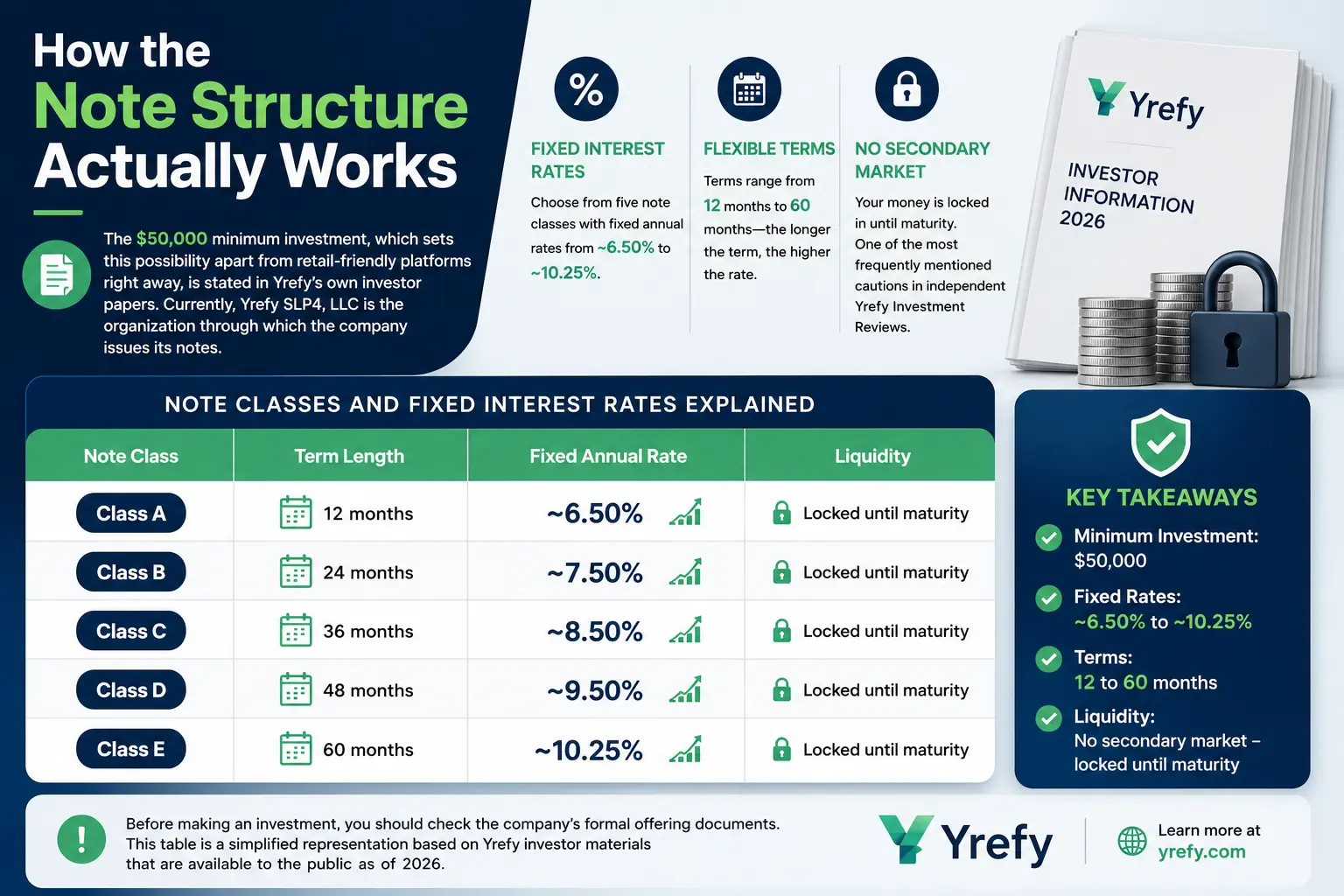
The $50,000 minimum investment, which sets this possibility apart from retail-friendly platforms right away, is stated in Yrefy’s own investor papers. Currently, Yrefy SLP4, LLC is the organization through which the company issues its notes. It offers five distinct note classes, each with a different fixed interest rate and maturity period.
Note Classes and Fixed Interest Rates Explained
When looking through Yrefy Investment Reviews, investors will usually find durations that range from 12 months to 60 months, with fixed annual rates that go from about 6.50% on the shortest note to 10.25% on the longest five-year commitment. The reasoning is straightforward: the claimed yield increases with the amount of time you lock up your capital. Your money is usually committed till maturity because there is no secondary market for these notes. One of the most frequently mentioned cautions in the independent Yrefy Investment Reviews released this year is that illiquidity.
| Note Class | Term Length | Fixed Annual Rate | Liquidity |
|---|---|---|---|
|
Class A |
12 months | ~6.50% | Locked until maturity |
|
Class B |
24 months | ~7.50% | Locked until maturity |
|
Class C |
36 months | ~8.50% |
Locked until maturity |
| Class D | 48 months | ~9.50% |
Locked until maturity |
| Class E | 60 months | ~10.25% |
Locked until maturity |
Before making an investment, you should check the company’s formal offering documents. This table is a simplified representation based on Yrefy investor materials that are available to the public as of 2026.
What Real Investors Are Saying
The majority of Yrefy Investment Reviews that are accessible to the public can be divided into two categories. Investors in the first group reported obtaining their promised fixed return without any problems after investing the minimum amount and treating it as a test. This year, a number of Trustpilot reviewers reported they received their promised 10.25% return on longer-term notes and characterized the paperwork procedure as straightforward. The second group is more cautious, and their Yrefy Investment Reviews typically concentrate more on whether the underlying risk was appropriately communicated beforehand than on whether payments were received.
Trustpilot and Third-Party Ratings
Depending on the review date, Yrefy’s rating on Trustpilot ranges from 3.2 to 4 stars, with the majority of positive reviews emphasizing the underwriting team’s communication and customer support above the investment product itself. Depending on the aspect of the company they assessed, independent review sites have given Yrefy varying scores.
Based on a panel review of Yrefy’s application process and support quality, one industry publication gave the company an Expert Score of 4.6 out of 5.0; however, a reputable student loan data outlet only gave the company’s refinance product a C+ rating, citing inconsistent information on the website and higher-than-average fees for borrowers. When reading a single Yrefy Investment Reviews summary in isolation, it’s important to keep in mind the distinction between borrower-side and investor-side scoring. Always make sure the review is assessing the loan product, the investment product, or both.
Yrefy has been recognized by the Better Business Bureau since April 2017, and its Pacific Southwest office now lists the company with an A+ rating. Although a BBB rating does not directly address investment risk, it does give a layer of operational credibility.
Regulatory History You Should Know
No sincere set of Yrefy Investment Reviews can overlook the regulatory history of the business. The Massachusetts Securities Division issued a consent order in February 2025 against organizations involved in the Yrefy offering, which led to an administrative punishment of $750,000. This type of state-level securities action is precisely the kind of information that generic marketing pages typically leave out, which is why independent Yrefy Investment Reviews were created in the first place: to highlight the aspects of the narrative that an advertisement would never address.
Any serious investor should study the consent order in its entirety before determining whether the risk-reward tradeoff still makes sense for their portfolio. A consent order does not necessarily indicate that an offering is fraudulent, but it does indicate that regulators found something worth formally addressing.
The U.S. Securities and Exchange Commission’s EDGAR database and state securities regulator websites are the most trustworthy resources for readers who wish to confirm this type of regulatory information directly from a primary source rather than depending on secondhand summaries. These resources can verify filing history, enforcement actions, and Regulation D exemption notices related to any private placement, including Yrefy’s offerings.
Is Yrefy a Legit Investment? Weighing the Yrefy Investment Reviews Evidence
Is Yrefy a viable investment opportunity, then? Based on the information that is currently available, Yrefy seems to be a legitimate company that operates and has a true niche in the refinancing of distressed private student loans. It also has actual borrowers, real underwriting employees, and investors who have reported getting their promised fixed payments. However, after reading a few favorable Yrefy Investment Reviews without delving deeper, consumers most frequently confuse the terms “legitimate” and “low-risk,” which are two completely distinct concepts. The facts from Yrefy Investment Reviews below should assist define the precise boundary between risk and opportunity.
Pros Highlighted in Yrefy Investment Reviews
- Fixed annual returns advertised between roughly 6.50% and 10.25%, well above typical fixed-income products in 2026
- A clearly defined niche business model focused on distressed private student loan debt
- BBB accreditation since 2017 with an A+ rating
- Multiple investor reports of receiving promised payments on schedule
- Straightforward paperwork and a responsive underwriting and support team, according to several reviewers
Cons and Red Flags to Consider
- $50,000 minimum investment restricts access to accredited investors only
- Notes are completely illiquid, with no secondary market and no early exit option
- Non-collateralized promissory notes mean investors carry direct credit and business risk
- February 2025 Massachusetts Securities Division consent order and $750,000 fine
- Limited public transparency around portfolio performance data and default rates
- Not FDIC-insured, not publicly traded, and not registered like a conventional bond fund
How Yrefy Compares to Other Private Credit Opportunities in 2026
Yrefy is just one choice among many, and private credit has become one of the more well-liked alternative asset classes for qualified investors this year. Based on average 2026 market data, the table below provides a broad comparison to help clarify Yrefy’s position in relation to other popular fixed-income options.
| Investment Type | Typical Fixed Return (2026) | Liquidity | Investor Access |
|---|---|---|---|
|
High-Yield Savings Account |
3.5% – 4.5% | Fully liquid | Anyone |
|
Investment-Grade Corporate Bonds |
4.5% – 5.5% | Liquid (secondary market) | Anyone |
|
Yrefy Promissory Notes |
6.50% – 10.25% | Illiquid until maturity |
Accredited investors only |
| General Private Credit Funds | 8% – 12% | Semi-liquid (quarterly windows common) |
Accredited investors only |
| Publicly Traded REITs | 4% – 7% | Fully liquid |
Anyone |
The comparison reveals that Yrefy’s claimed rate is comparable to more general private credit funds, but it lacks the diversification advantage of a pooled fund distributed among numerous borrowers or businesses. Every reader of Yrefy Investment Reviews should carefully consider this concentration on a single niche: defaulted private student loan debt. This is another reason why comprehensive Yrefy Investment Reviews advise diversifying beyond a single note class.
Who Should Consider This and Who Shouldn’t
Investors who are already accredited, have a diverse portfolio elsewhere, and feel comfortable locking up a five-figure amount for one to five years without access to it might find Yrefy’s promissory notes appealing. A number of independent Yrefy Investment Reviews this year have expressed discomfort with the idea of a non-collateralized note linked to a single company’s underwriting performance, and it is not a good fit for anyone who needs liquidity or who is not legally an authorized investor. The most appropriate method to approach a decision this large is to read several Yrefy Investment Reviews from several sources instead of just one positive one.
How to Evaluate Yrefy Investment Reviews Before You Invest
Knowing what distinguishes a helpful review from a superficial one is helpful because not every Yrefy Investment Reviews article you come across online was created with equal care. A good Yrefy Investment Reviews post should distinguish borrower-side opinion from investor-side discussion, mention the minimum investment level, identify any regulatory action on file, and immediately cite the current note rates from investor materials.
A bad review typically omits the accredited investor requirement, repeats the headline 10.25% rate without any context, and makes no mention of liquidity. Look for consistency in the figures when comparing many Yrefy Investment Reviews side by side. Since private placement terms might change between offering cycles, it is advisable to check the current terms directly on Yrefy’s investor portal if one source shows a different minimum investment or a different rate range than another.
Separating data-driven research from sentimental testimonies is also beneficial. You may learn virtually little about long-term default rates or portfolio performance from a single five-star review that praises quick customer service. As we have attempted to do throughout our Yrefy Investment Reviews guide, the most reliable Yrefy Investment Reviews integrate actual investor voices with hard data taken from official rate sheets and regulatory filings.
Yrefy Investment Reviews: Tax and Reporting Considerations
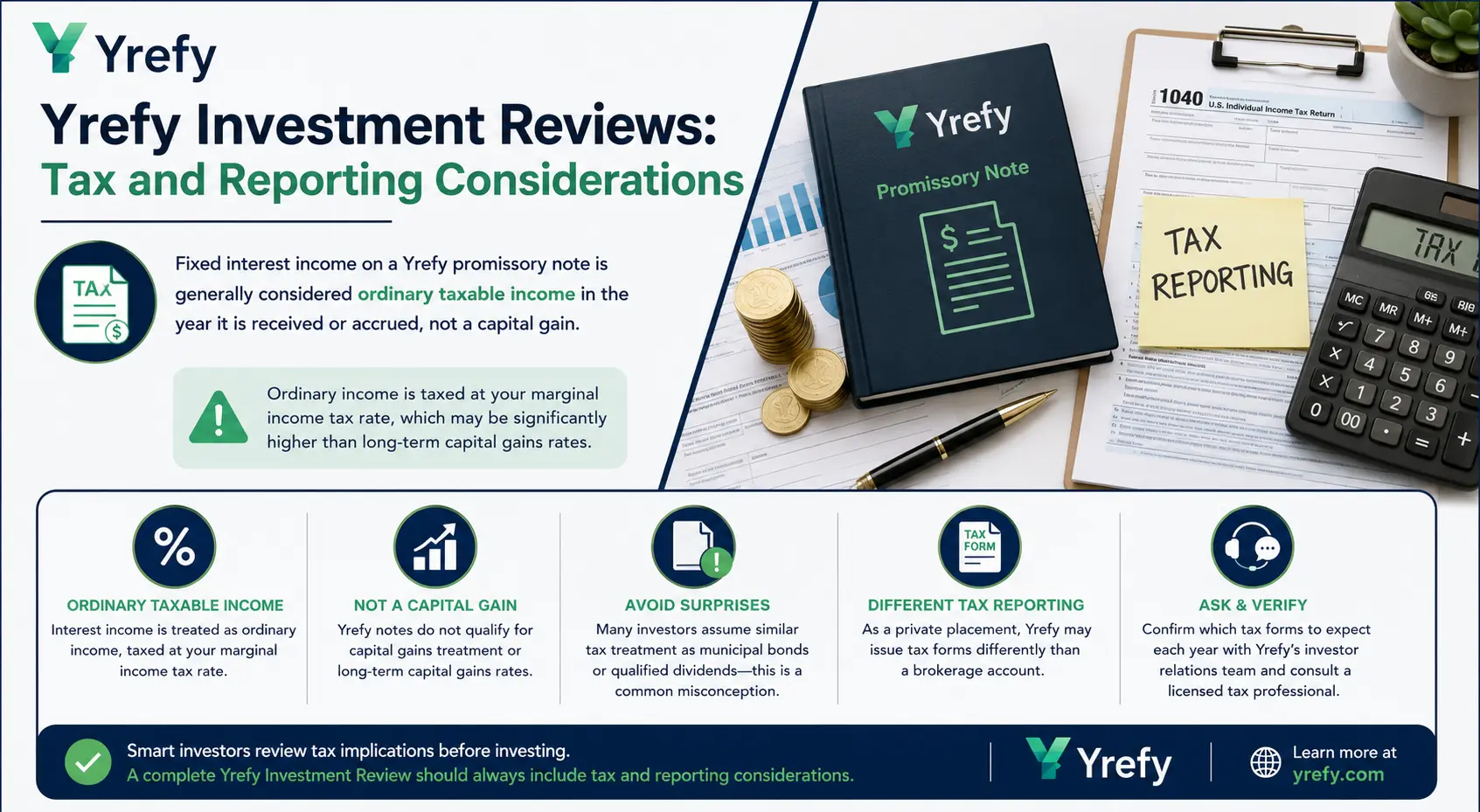
In the year that it is received or accrued, fixed interest income on a Yrefy promissory note is often regarded as ordinary taxable income rather than as a capital gain. This distinction is important because ordinary income is taxed at your marginal income tax rate, which, depending on your bracket, may be significantly higher than long-term capital gains rates. When reading Yrefy Investment Reviews for the first time, investors may assume that a fixed-rate note functions like a municipal bond or a qualified dividend for tax purposes.
This misconception may cause an unpleasant surprise when it comes time to file. Tax reporting paperwork may also arrive differently from a brokerage account because Yrefy functions as a private placement rather than a publicly listed securities. Therefore, it is worthwhile to inquire directly with Yrefy’s investor relations team about the precise tax forms you should anticipate each year and to double-check the information with a licensed tax expert prior to making an investment. Comprehensive Yrefy Investment Reviews should always include this useful information.
Our Take at Wealth Start Today on Yrefy Investment Reviews
Wealth Start Today, Instead of giving you an alarmist takedown or a biased sales pitch, our objective with our Yrefy Investment Reviews assessment is to provide you with the whole picture. Although we think Yrefy’s advertised fixed return is genuinely competitive with many private credit options available in 2026, we also think the non-collateralized structure, the illiquidity, and the recent Massachusetts consent order are facts that should be taken into consideration when making your decision.
We always advise reading a company’s complete offering circular, verifying your accredited investor status through the appropriate channels, and speaking with a licensed financial advisor before committing capital to any private placement like this one because our website is designed to assist investors in making educated decisions.
Wealth Start Today covers stories like this regularly under our Investing category, where we break down alternative assets, private placements, and fixed-income strategies for readers who want more than a marketing headline before they invest their money.
If this is your first time reading about this company on our site, we previously published a dedicated Yrefy Investing Review that walks through the company’s business model, its founding history, and how the refinancing side of the business operates for borrowers with defaulted private student loans. That piece is a useful companion to this one if you want more background on how Yrefy generates the capital it uses to fund investor payouts.
We also published a separate deep dive titled Yrefy Investment Risk, which focuses specifically on the risk side of the equation — the non-collateralized note structure, the lack of a secondary market, concentration risk in a single debt niche, and what a default scenario could realistically look like for investors. Reading that article alongside this Yrefy Investment Reviews roundup should give you a much more complete risk-reward picture than either piece alone.
Frequently Asked Questions
Is Yrefy a good investment in 2026?
Your risk tolerance and liquidity requirements will determine the outcome. Although the fixed rates are competitive, conservative or short-term investors should not consider it due to the illiquid, non-collateralized structure and the 2025 regulatory action.
What is the minimum investment for Yrefy?
According to current investor literature, only accredited investors are permitted to participate, and the minimum investment is $50,000. .
What returns does Yrefy advertise?
Depending on the note period chosen, which spans from 12 to 60 months, Yrefy’s promissory note classes offer set annual rates that vary from about 6.50% to 10.25%.
Is Yrefy FDIC-insured?
No. Yrefy’s promissory notes have no FDIC or other type of government-backed insurance and are private securities rather than bank deposits.
What happened with the Massachusetts Securities Division consent order?
In connection with the Yrefy offering, Massachusetts authorities issued a settlement order in February 2025 that included an administrative punishment of $750,000. Before making an investment, investors should directly check that file.
Can I sell my Yrefy note before it matures?
No. Your capital is often frozen until the note’s maturity date because Yrefy’s promissory notes do not presently have a secondary market.
Where can I read more Yrefy Investment Reviews?
In addition to this Yrefy Investment Reviews article, we recommend reading our companion pieces, the Yrefy Investing Review and Yrefy Investment Risk, for a fuller picture before making a decision.
Do Yrefy Investment Reviews mention how long the company has been operating?
Indeed, the majority of Yrefy Investment Reviews point out that since 2017, the company has concentrated on refinancing problematic private student loans, providing investors with a number of years of operational experience to assess.
Are Yrefy Investment Reviews consistent across different websites?
Not all the time. Before making a decision, it is essential to read a few different Yrefy Investment Reviews because some simply discuss the borrower refinancing experience, while others concentrate on the investor promissory note side.
A Quick Recap of This Yrefy Investment Reviews Guide
It is helpful to compile the main ideas discussed in this Yrefy Investment Reviews guide in one location before making any decisions. Accredited investors can purchase fixed-rate promissory notes from Yrefy; rates range from about 6.50% to 10.25% depending on the note period. The notes are not collateralized, there is no secondary market for early withdrawal, and the minimum investment is $50,000.
While independent Yrefy Investment Reviews from financial publications highlight illiquidity, concentration risk, and the February 2025 Massachusetts consent order as the most crucial considerations, public Yrefy Investment Reviews on Trustpilot and other platforms are generally positive regarding customer service. Taken together, these Yrefy Investment Reviews offer a picture of a legitimate but legitimately high-risk, high-reward investment best suited to experienced accredited investors who have already diversified elsewhere.
Conclusion
These Yrefy Investment Reviews honestly conclude that this is a real opportunity with real tradeoffs after reviewing investor testimonies, official rate structures, third-party ratings, and regulatory filings. In comparison to the majority of fixed-income products on the market in 2026, the fixed yields are actually appealing, and the underlying business model of refinancing distressed private student loans fills a gap that few other lenders can match.
However, the non-collateralized note structure, the $50,000 requirement, the total absence of liquidity, and the 2025 Massachusetts consent order are not minor features; rather, they are essential components of the risk profile that every accredited investor must accept before signing on. The main topic that each set of Yrefy Investment Reviews aims to address is whether or not Yrefy should be in your portfolio. This depends on how much weight you place on yield vs how much you value liquidity and collateral protection.
We hope that this guide to Yrefy Investment Reviews helped you see things more clearly and fairly than a standard marketing page could. Visit Wealth Start Today’s Investing section for more content like this. Don’t forget to follow us on Facebook and X.com for frequent updates on fixed-income options, private placements, and investing news throughout 2026.
Disclaimer: This article is for informational purposes only and does not constitute financial, legal, or investment advice. Always consult a licensed financial advisor and review a company’s official offering documents before making any investment decision.














Leave a comment