


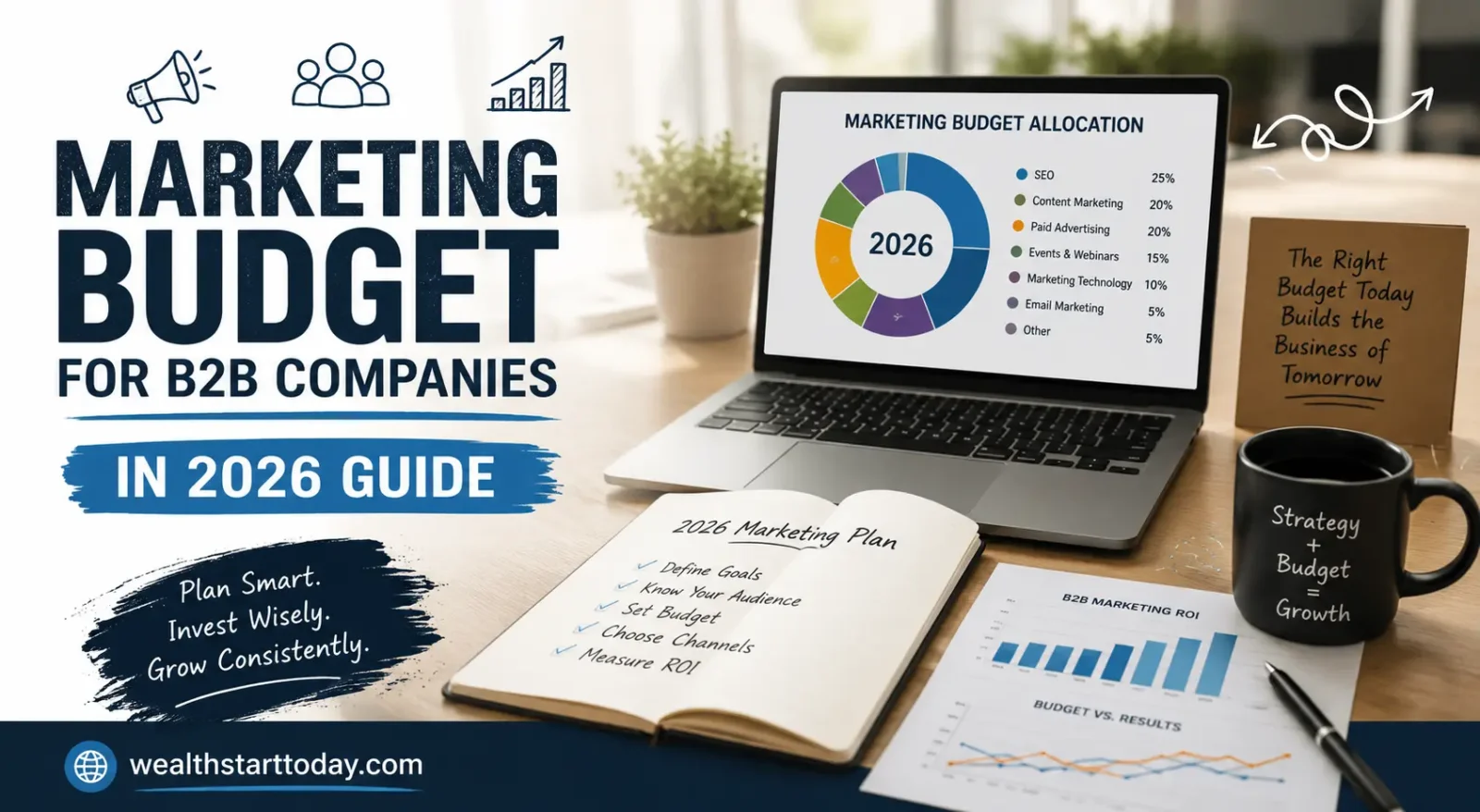
In today’s hyper-competitive business landscape, having a well-defined marketing budget for B2B companies is not just a financial formality — it is the strategic backbone of sustainable growth. B2B marketing necessitates a lengthier sales cycle, accurate targeting, relationship-building, and data-driven decision-making, in contrast to B2C marketing, which focuses on emotional impulse buying. Even the most skilled B2B marketing teams will find themselves spinning their wheels, squandering resources, and failing to produce qualified leads in the absence of a clear budget.
Whether you are an established business honing your go-to-market strategy or a startup attempting to gain market share, knowing how to organize, allocate, and optimize your marketing budget for B2B companies is critical. B2B businesses normally devote between 6% and 12% of their entire income on marketing, with digital channels taking up a bigger portion every year, according to Gartner data.
This comprehensive guide — published on Wealth Start Today, your go-to source for budgeting and financial planning, it guides you through every crucial step of creating a successful B2B marketing budget plan. This tutorial covers everything from figuring out the ideal budget % to choosing the best channels and calculating ROI.
What Is a Marketing Budget for B2B Companies?
A marketing budget for B2B companies is a detailed financial plan that outlines how much a business intends to spend on marketing activities over a defined period — typically quarterly or annually. Spending on content marketing, SEO, paid advertising, trade exhibitions, email campaigns, sales enablement, and marketing technology solutions are all mapped out.
This budget has two functions for B2B businesses: it provides leadership with insight into anticipated returns and directs the marketing staff in carrying out campaigns effectively. Three fundamental questions are addressed by a well-designed B2B marketing budget:
- How much should we spend on marketing?
- Where should we allocate that spend?
- How do we measure the return on each dollar invested?
Your industry, business size, growth objectives, and competitive environment all influence the responses to these questions. But the basic fundamentals of budgeting never change, and this article will help you grasp them.
How to Determine the Right Marketing Budget for B2B Companies
Percentage of Revenue: The Industry Standard for B2B Marketing Budget
The most widely used method for setting a marketing budget for B2B companies is basing it on a percentage of annual revenue. Industry benchmarks suggest:
- Early-stage B2B startups: 15–25% of revenue (aggressive growth phase)
- Growing mid-market B2B companies: 10–15% of revenue
- Established B2B enterprises: 6–10% of revenue
B2B goods firms typically spend about 8.6% of revenue on marketing, whereas B2B services companies spend closer to 8.9%, according to Duke University’s annual CMO Survey. These figures provide a reliable baseline for planning your own marketing budget for B2B companies.
Goal-Based Budgeting for B2B Marketing
Goal-based budgeting links marketing expenditures directly to corporate goals rather than depending only on revenue percentages. Your marketing budget should be reverse-engineered from your company’s 30% revenue growth target for the upcoming year. To begin, determine:
- How many new customers are needed to hit that revenue goal?
- What is the average customer lifetime value (CLV)?
- What is the current cost per lead (CPL) and conversion rate?
By working backward from these metrics, you can calculate an exact budget figure that aligns marketing investment with business outcomes — making your marketing budget for B2B companies truly strategic rather than arbitrary.
Key Channels to Include in Your Marketing Budget for B2B Companies
Content Marketing and SEO Budget Allocation
Content marketing is the cornerstone of any modern marketing budget for B2B companies. B2B businesses can develop authority, increase organic traffic, and nurture leads through extended buying cycles with the aid of excellent blog articles, whitepapers, case studies, webinars, and video content. Compared to outbound marketing, B2B organizations that prioritize content marketing get three times as many leads per dollar invested, according to industry data.
Your B2B content marketing budget should include a specific line item for SEO. Your business will rank highly on search engines for buyer-intent queries if you invest in technical SEO, link development, content optimization, and keyword research. Your company must be on the first page when prospective customers look for solutions, which calls for constant SEO investment.
Paid Advertising: LinkedIn, Google, and Programmatic
Paid advertising is a critical component of a balanced marketing budget for B2B companies. Because they provide unparalleled targeting by job title, industry, firm size, and seniority level, LinkedIn Ads are especially effective for B2B advertising. Google Ads are perfect for increasing bottom-of-funnel conversions since they attract high-intent customers looking for certain solutions.
With precise targeting and real-time bidding, programmatic advertising enables B2B advertisers to connect with decision-makers throughout premium publisher networks. Although this fluctuates depending on growth stage and level of competition, a typical B2B company devotes 20–30% of its marketing spend to paid digital platforms.
Email Marketing and Marketing Automation
With an average return of $42 for every $1 spent, email marketing routinely yields one of the greatest ROIs in B2B marketing. B2B organizations can effectively guide prospects down the funnel by developing a strong email nurture sequence that is supported by marketing automation solutions such as HubSpot, Marketo, or Pardot.
Your marketing budget for B2B companies should include investment in email marketing tools, list management, content creation, and A/B testing to continuously improve open rates, click-through rates, and conversion rates.
Events, Trade Shows, and Webinars
Face-to-face encounters at conferences and trade exhibits continue to be a major source of qualified leads for many B2B sectors. Because they are more affordable than in-person events, virtual and hybrid events have also become more popular. To optimize the return on investment of event marketing, set aside money for booth fees, swag, travel, and post-event follow-up initiatives.
Webinars are a great low-cost, high-impact way to showcase thought leadership and generate leads. Including a webinar line item in your marketing budget for B2B companies can deliver significant returns at a fraction of the cost of physical events.
Marketing Budget for B2B Companies: Allocation Framework
B2B marketing executives may allocate their budget across channels with clarity and purpose by using a useful allocation approach. Leading B2B companies employ the following tried-and-true framework:
- Content Marketing & SEO: 25–30%
- Paid Digital Advertising (LinkedIn, Google): 20–25%
- Marketing Technology (CRM, automation tools): 15–20%
- Events & Trade Shows: 10–15%
- Email Marketing & Nurturing: 10%
- Social Media Marketing: 5–10%
- Brand Awareness & PR: 5%
This allocation ensures a healthy mix of inbound and outbound tactics, short-term lead generation, and long-term brand building — all essential elements of a successful marketing budget for B2B companies.
Wealth Start Today: Your Partner in Smart B2B Budgeting
At Wealth Start Today, we are committed to helping entrepreneurs, business leaders, and financial professionals make smarter money decisions. Wealth start Today’s Budgeting category is packed with actionable guides, frameworks, and real-world strategies designed to help you take control of both personal and business finances.
Whether you are trying to understand how to build a marketing budget for B2B companies, manage cash flow, or plan for sustainable growth, Wealth Start Today provides the insights you need to build wealth with confidence. Smart budgeting, in our opinion, is about intelligently investing every dollar to maximize profits rather than merely decreasing expenses. Explore our whole library of budgeting resources to remain informed, stay ahead of the curve, and begin creating your financial future right now.
Understanding Business Budget and What Is Budgeting in Business?
A foundational concept that every B2B marketer must understand is the broader context of a business budget and what budgeting in business truly means. A business budget is a systematic financial plan that forecasts income, costs, and cash flows for a given time frame, usually a fiscal year. In business, budgeting is the act of developing, overseeing, and modifying this plan to guarantee the effective and efficient use of corporate resources.
Budgeting is more complicated for B2B businesses in particular since they have to take into consideration longer sales cycles, bigger deal sizes, numerous stakeholder decisions, and a substantial investment in relationship management. Your marketing budget for B2B companies does not exist in isolation — it is one component of a broader business budget that also covers operational costs, HR, technology, and R&D.
Marketing executives can make more intelligent spending decisions, defend budget requests to the CFO, and show how marketing contributes to overall business growth by having a clear understanding of the big-picture budget context. You can explore this topic in depth in the Business Budget and What Is Budgeting in Business guide on Wealth Start Today.
Portfolio Budget Statement and Your B2B Marketing Financials
A portfolio budget statement is a consolidated financial document that provides a high-level overview of all budget lines across an organization’s portfolio of projects, departments, or initiatives. For B2B companies managing multiple product lines, market segments, or regional operations, maintaining a clear portfolio budget statement is essential for governance, accountability, and strategic alignment.
At the topic of marketing budget for B2B companies, when it comes to your marketing budget for B2B companies, a portfolio budget statement helps you track spending across campaigns, channels, and business units in a single view. It helps CFOs and CMOs to promptly see misaligned priorities, overspending, and underspending before they become expensive issues. B2B executives obtain a comprehensive understanding of how marketing expenditure affects entire business performance by incorporating marketing spend data into the portfolio budget statement.
Wealth Start Today covers this topic in its Portfolio Budget Statement resource, providing templates and frameworks that B2B finance and marketing teams can use immediately.
Budgeting Guide for Beginners: A Foundation for B2B Marketing Budget Success
If you are new to building a marketing budget for B2B companies, starting with the fundamentals of budgeting is essential. A comprehensive budgeting guide for beginners lays the groundwork for understanding how money flows through a business, how to prioritize spending, and how to track results against financial goals. Understanding the distinction between fixed and variable costs, creating a precise revenue baseline, and establishing reasonable financial goals are the initial steps for novices. Beginner budgeters frequently make the error of viewing marketing as a cost center rather than a revenue engine in the context of B2B marketing; this mentality shift significantly alters how budgets are created and justified. A beginner’s guide to budgeting also introduces concepts like break-even analysis, ROI calculation, and variance reporting — all of which are critical skills for managing a marketing budget for B2B companies responsibly. Wealth Start Today’s Budgeting Guide for Beginners provides a structured, easy-to-follow framework that takes the guesswork out of financial planning for business professionals at every level.
Applying the 50/30/20 Rule in Budgeting to B2B Marketing
At the marketing budget for B2B companies, the 50/30/20 rule in budgeting is a well-known personal finance framework that divides income into three categories: 50% for needs, 30% for wants, and 20% for savings. While originally designed for personal budgeting, this principle can be creatively adapted to guide how B2B companies structure their marketing budget for B2B companies.
This framework can be viewed as follows in the context of B2B marketing: 20% of your marketing budget should be set aside for brand building, thought leadership, and long-term relationship marketing (savings for future growth); 30% should be invested in growth experiments and emerging platforms like AI-driven marketing tools or new social channels (wants); and 50% should be allocated to core, proven channels that consistently generate leads (needs).
This structured approach prevents budget bloat in any single channel while ensuring a balanced investment portfolio across short-term and long-term marketing strategies. Applying the 50/30/20 philosophy also creates a natural discipline that forces marketing leaders to regularly review channel performance and reallocate resources based on data. For a deeper dive into this rule, visit Wealth Start Today’s guide on the 50/30/20 Rule in Budgeting and explore how it can be adapted to your business.
How to Save Money on a Tight B2B Marketing Budget
Not every B2B company has a generous marketing budget to work with — and that is perfectly fine. Understanding how to save money on a tight budget while still executing an effective B2B marketing strategy is a skill that separates great marketers from great ones.
Ruthless prioritizing is the first stage. Determine which two or three channels provide the best return on investment for your particular firm, then focus more on those while stopping or discontinuing underperforming operations. For example, SEO and content marketing are high-return expenditures that compound over time; a well-written blog article can produce leads for years after it is published without requiring more investment.
Leveraging free and low-cost marketing tools, repurposing existing content across multiple channels, partnering with complementary businesses for co-marketing campaigns, and investing in organic social media rather than paid ads are all proven ways to stretch a tight marketing budget for B2B companies. Building a referral program is another highly cost-effective B2B growth tactic — satisfied clients referring new business costs far less than acquiring cold leads through paid channels. Wealth Start Today’s How to Save Money on a Tight Budget guide provides additional practical strategies that B2B marketers and entrepreneurs can implement immediately to do more with less.
Measuring the ROI of Your Marketing Budget for B2B Companies
Key Metrics Every B2B Marketing Budget Must Track
Investing in a marketing budget for B2B companies without robust measurement is like driving without a GPS — you might eventually reach your destination, but you will waste enormous time and resources along the way.Investments in analytics tools and procedures that provide precise performance evaluation must be part of any B2B marketing budget.
The most important KPIs to monitor are as follows:
- Cost per Lead (CPL): Total marketing spend divided by the number of leads generated.
- Customer Acquisition Cost (CAC): Total marketing and sales spend divided by new customers acquired.
- Marketing Qualified Leads (MQL) to Sales Qualified Leads (SQL) conversion rate.
- Pipeline contribution: The percentage of the sales pipeline sourced or influenced by marketing.
- Return on Marketing Investment (ROMI): Revenue generated from marketing activities minus marketing costs, divided by marketing costs.
B2B marketing executives can show the commercial value of their budget and make data-driven changes in real time by regularly monitoring these indicators.
Quarterly Budget Reviews for B2B Marketing
The most effective marketing budgets for B2B companies are not static documents — they are living plans that evolve with market conditions, campaign performance, and business priorities. Quarterly budget reviews guarantee that expenditures are always in line with outcomes. Analyze performance indicators by channel, compare actual and budgeted spending, and reallocate resources to the areas that are performing the best during these evaluations. Your B2B marketing budget becomes a dynamic growth engine rather than a strict constraint thanks to this iterative process.
Common Mistakes in Managing a Marketing Budget for B2B Companies
Even seasoned B2B marketing executives make budgetary errors that cost their businesses important chances for expansion. The most typical pitfalls consist of:
Underinvesting in SEO and content: Because paid channels yield fast victories, many B2B businesses place an excessive amount of emphasis on them while ignoring the cumulative long-term benefits of SEO and content marketing.
Failing to account for sales enablement: A strong marketing budget for B2B companies must include investment in sales collateral, CRM tools, and training materials that enable the sales team to close deals faster.
Ignoring marketing technology: Although they are often underfunded, martech technologies like CRM platforms, marketing automation software, and analytics dashboards are force multipliers that make every marketing dollar work harder.
Not involving sales in budget planning: Sales and B2B marketing are closely related. Missed revenue objectives and misplaced priorities result from excluding sales leaders from the budget planning process.
Discipline, cross-functional cooperation, and a dedication to data-driven decision-making—all characteristics of top-tier B2B marketing firms—are necessary to avoid these errors.
Frequently Asked Questions (FAQs) of Marketing Budget for B2B Companies
Q1: What percentage of revenue should a B2B company spend on marketing?
Most B2B companies allocate between 6% and 12% of their annual revenue to marketing. Startups in aggressive growth phases may invest up to 25%, while mature enterprises typically stay closer to 6–8%. The right percentage depends on your growth goals, competitive landscape, and industry norms.
Q2: What is the most effective channel for B2B marketing budgets?
Content marketing combined with SEO consistently ranks as one of the highest-ROI channels for B2B companies because it drives organic traffic, builds authority, and generates leads over the long term. LinkedIn Ads and email marketing also deliver strong returns for B2B-specific targeting.
Q3: How do I justify a larger marketing budget for my B2B company?
To justify a larger budget, present clear ROI data from existing campaigns: cost per lead, pipeline contribution, customer acquisition cost, and revenue influenced by marketing. Connecting marketing spend directly to revenue outcomes is the most persuasive argument for increased investment.
Q4: Can small B2B companies compete with a limited marketing budget?
Absolutely. Small B2B companies can compete effectively by focusing on high-ROI, low-cost channels such as SEO, content marketing, email nurturing, and referral programs. Prioritization and consistency matter more than budget size when resources are limited.
Q5: How often should a B2B company review and adjust its marketing budget?
Quarterly reviews are the industry best practice. This cadence allows marketing leaders to respond to market changes, reallocate spend based on campaign performance, and ensure the budget stays aligned with evolving business priorities throughout the year.
Q6: What tools help manage a marketing budget for B2B companies?
Popular tools include HubSpot (CRM and marketing automation), Google Analytics (performance tracking), Salesforce (pipeline reporting), SEMrush (SEO and competitor analysis), and Allocadia or Plannuh (dedicated marketing budget management platforms).
Conclusion
A strategically crafted marketing budget for B2B companies is the difference between marketing that drives measurable business growth and marketing that burns cash without results. B2B organizations can turn their marketing function from a cost center into a true revenue engine by setting up a revenue-based budget baseline, distributing spend over a balanced mix of channels, closely monitoring performance, and continuously adjusting based on data.
The concepts presented in this article will assist you in making more informed and self-assured budgeting decisions, regardless of whether you are an experienced CMO or a novice business owner creating your first marketing strategy. Recall that effective B2B marketing involves prudent investment, constant measurement, and rapid adaptation rather than excessive spending.
Explore more budgeting resources, templates, and expert insights at Wealth Start Today and visit the Budgeting category for the full library of guides. Follow us on Facebook and X.com for the latest updates and financial tips to help you grow your business and your wealth.














Leave a comment