



Buying a home is one of the biggest financial decisions most people make. For many buyers, paying the full property price upfront is simply not realistic. This is where a mortgage loan becomes useful. It allows individuals to purchase a home by borrowing money from a lender and repaying it over an agreed period, usually through monthly payments.
However, getting a mortgage is not just about finding a lender and signing a loan agreement. Borrowers need to understand interest rates, down payments, credit scores, repayment terms, closing costs, and the risks associated with borrowing against a property.
For example, a home that appears affordable based on its monthly mortgage payment may become expensive once property taxes, homeowners insurance, maintenance, and other expenses are included.
Understanding these details before applying can help you make a more informed decision and avoid financial pressure later.
In this guide, we will explain what a mortgage loan is, how it works, the different mortgage options available in the United States, and what borrowers should consider before choosing one.
What Is a Mortgage Loan?
A mortgage loan is a type of secured loan that allows someone to purchase or refinance real estate. The borrower receives money from a bank, credit union, or mortgage lender and agrees to repay it over a specified period.
The property serves as collateral for the loan. This means the lender has a legal claim against the property if the borrower fails to meet the repayment obligations. If the borrower defaults and the lender follows the required legal process, the property may eventually be sold through foreclosure to recover the outstanding debt.
Unlike an unsecured personal loan, a mortgage is directly connected to the property being financed.
Most residential mortgages in the United States have repayment terms of 15 or 30 years, although other terms are available.
Simple example:
Imagine someone wants to purchase a house worth $300,000 but has only $60,000 available for the down payment.
They may borrow the remaining $240,000 through a mortgage loan. The lender provides the financing, and the borrower repays the amount with interest through scheduled monthly payments.
The exact payment depends on the interest rate, repayment term, and other loan expenses.
How Does a Mortgage Loan Work?
A mortgage loan works through an agreement between the borrower and the lender. The lender provides financing for the property, while the borrower promises to make regular payments according to the loan agreement.
Here is how the process generally works in the United States.
1. Choose a Property and Estimate Your Budget
Before applying, buyers should understand how much they can realistically afford.
A lender may approve a particular loan amount, but that does not automatically mean the borrower should spend the entire amount.
Consider your monthly income, existing debts, household expenses, savings, and future financial responsibilities.
2. Make a Down Payment
A down payment is the amount you pay toward the property’s purchase price using your own funds.
For example, if a property costs $300,000 and you make a 20% down payment, you contribute $60,000.
The remaining $240,000 may be financed through a mortgage.
Some mortgage programs allow smaller down payments, depending on eligibility and lender requirements.
3. Apply for the Mortgage
After choosing a property or preparing to purchase one, you can apply with a mortgage lender.
The lender generally reviews:
- Credit history and credit score
- Employment and income
- Existing debts
- Available savings and assets
- Down payment funds
- Property information
The lender uses this information to evaluate whether you can reasonably repay the loan.
4. Complete the Underwriting Process
Underwriting is the lender’s detailed assessment of your financial situation and the property.
The lender may verify your income, employment, bank statements, credit report, and other financial documents.
A property appraisal may also be required to estimate its market value.
5. Close the Mortgage
If the lender approves the application and all necessary conditions are satisfied, the loan moves toward closing.
During closing, you review and sign the required documents, pay applicable closing costs, and complete the purchase.
Once the transaction is finalized, you become responsible for making mortgage payments according to the agreement.
Types of Mortgage Loans in the United States
Not every mortgage loan works the same way. Different programs are designed for different financial situations, property types, and borrower needs.

Understanding these options can help you compare financing choices before applying.
1. Conventional Mortgage Loan
A conventional mortgage is a home loan that is not insured or guaranteed by the federal government.
These mortgages are commonly offered by banks, credit unions, and private mortgage lenders.
Some conventional loans follow the requirements established by Fannie Mae and Freddie Mac, while others do not.
Key features:
- Available with different repayment terms.
- May offer fixed or adjustable interest rates.
- Down payment requirements vary.
- Private mortgage insurance (PMI) may apply when the down payment is below 20%.
Conventional mortgages can be suitable for buyers with stable income, acceptable credit, and sufficient savings.
2. FHA Mortgage Loan
An FHA loan is a mortgage insured by the Federal Housing Administration.
It is designed to make homeownership more accessible to borrowers who may not meet the requirements of some conventional mortgage products.
Eligible borrowers may qualify for a down payment as low as 3.5%, depending on their credit score and other requirements.
FHA loans also involve mortgage insurance costs, which borrowers should include when comparing the total expense.
Best for: Buyers who have limited savings for a down payment or need more flexible qualification options.
3. VA Mortgage Loan
A VA loan is a mortgage program backed by the U.S. Department of Veterans Affairs.
It is available to eligible veterans, active-duty service members, and certain surviving spouses who meet the program’s requirements.
One major advantage is that eligible borrowers may purchase a home without a down payment, subject to lender approval and other conditions.
VA loans generally do not require monthly mortgage insurance, although a VA funding fee may apply unless the borrower qualifies for an exemption.
Best for: Eligible military service members, veterans, and qualifying surviving spouses.
4. USDA Mortgage Loan
USDA loans are backed by the United States Department of Agriculture.
These loans are designed to support eligible buyers purchasing homes in qualifying rural and certain suburban areas.
Qualified borrowers may be able to purchase an eligible property without a down payment.
However, income limits, property location requirements, household eligibility, and other conditions apply.
Best for: Eligible buyers who want to purchase a home in an approved area and meet the program’s income requirements.
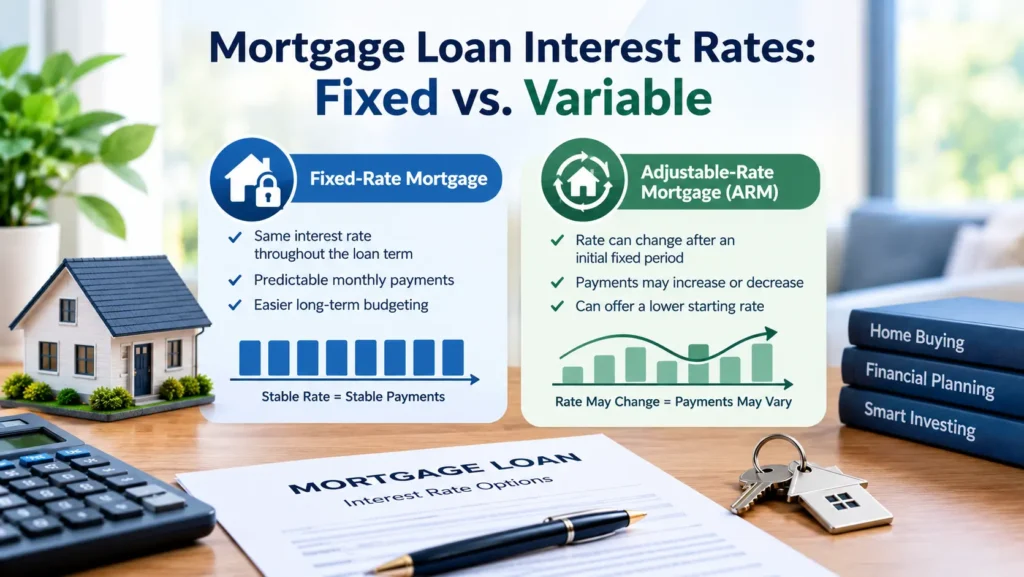
5. Fixed-Rate Mortgage
A fixed-rate mortgage has an interest rate that remains unchanged throughout the agreed loan term.
For example, if you receive a 30-year fixed-rate mortgage at a 6% interest rate, your scheduled principal and interest payment generally remains the same throughout the repayment period.
This makes budgeting easier because borrowers do not have to worry about changes in the interest rate on their existing loan.
Best for: Buyers who prefer predictable monthly principal and interest payments.
6. Adjustable-Rate Mortgage (ARM)
An adjustable-rate mortgage has an interest rate that can change after an initial fixed-rate period.
For example, a 5/1 ARM generally has an initial fixed interest rate for five years, followed by adjustments that typically occur annually.
The rate may increase or decrease depending on the loan’s index, margin, and adjustment limits.
Although an ARM may offer an attractive starting rate, borrowers should understand how much their payments could increase later.
Best for: Buyers who understand interest-rate risk and have a realistic plan for managing future payment changes.
Mortgage Loan Interest Rates: Fixed vs. Variable
Interest is one of the most important factors when choosing a mortgage. Even a small difference in the interest rate can affect the total amount you pay over several years.
Mortgage interest rates are influenced by several factors, including:
- Your credit score and credit history.
- The loan amount and repayment period.
- The size of your down payment.
- The type of mortgage you select.
- Broader economic and financial market conditions.
According to the Consumer Financial Protection Bureau (CFPB), a borrower’s credit score can affect both mortgage approval and the interest rate offered by lenders.
You can read the CFPB’s explanation here: Does my credit score affect my ability to get a mortgage?.
Why Does the Interest Rate Matter?
Consider two borrowers who each take out a $240,000 mortgage with a 30-year repayment term.
Illustrative principal and interest calculations; excludes taxes, insurance and other fees.
|
Interest rate |
Monthly payment |
|
5.5% |
$1,362 |
| 6.0% |
$1,439 |
| 6.5% |
$1,517 |
| 7.0% |
$1,597 |
Estimated monthly principal and interest payments on a $240,000, 30-year mortgage.
04509001.4K$1.8K5.5%6.0%6.5%7.0%
As the table shows, a higher interest rate increases the monthly payment. Over a long repayment period, the additional interest can become a substantial expense.
This is why borrowers should compare mortgage offers rather than accepting the first rate they receive.
What Are the Costs of Getting a Mortgage Loan?
The purchase price is not the only expense involved in buying a home. Borrowers should prepare for several upfront and ongoing costs.
1. Down Payment
This is the amount you contribute toward the purchase price. A larger down payment generally reduces the amount you need to borrow.
However, using all your savings for a down payment can leave you without enough money for emergencies or unexpected home repairs.
2. Closing Costs
Closing costs are expenses associated with finalizing the mortgage and transferring property ownership.
They may include:
- Loan origination fees.
- Property appraisal charges.
- Credit report fees.
- Title services.
- Recording fees.
- Prepaid property taxes.
- Homeowners insurance expenses.
The exact amount depends on the lender, property, location, and loan program.
The CFPB explains these expenses in its Loan Estimate guide.
3. Property Taxes
Homeowners generally pay property taxes based on the rules and tax rates of their local jurisdiction.
These taxes can change over time, so buyers should not assume the current amount will remain the same.
4. Homeowners Insurance
Most mortgage lenders require borrowers to maintain homeowners insurance to protect the property against covered losses.
Insurance premiums depend on factors such as location, property characteristics, coverage, and insurer.
5. Private Mortgage Insurance (PMI)
Some conventional mortgage borrowers must pay private mortgage insurance when their down payment is below 20%.
PMI protects the lender rather than the homeowner.
It increases the monthly housing expense, so borrowers should include it when calculating affordability.
How to Qualify for a Mortgage Loan
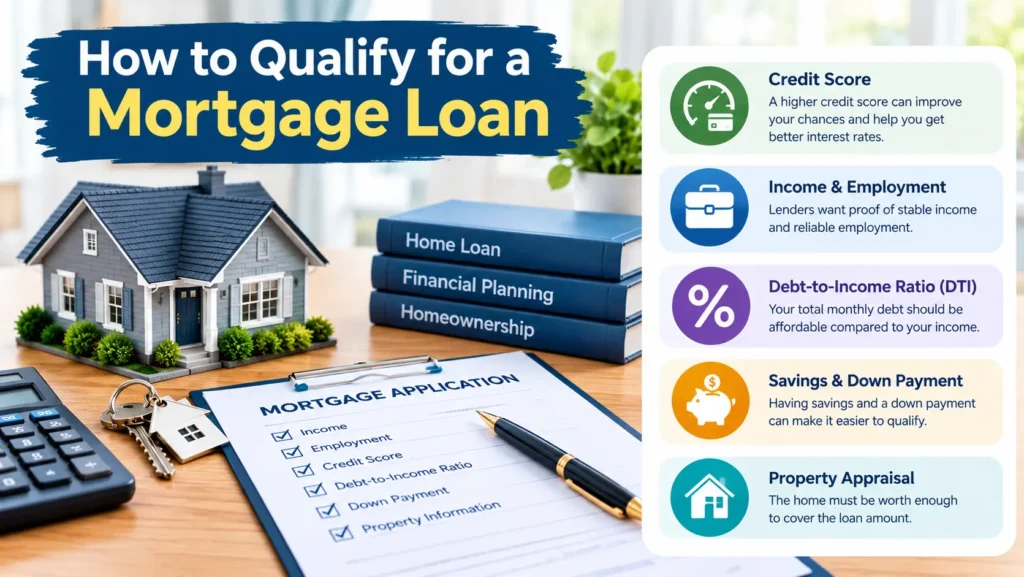
Mortgage approval depends on your financial position, the property, and the lender’s requirements. There is no single credit score or income level that guarantees approval for every borrower.
Here are some important factors lenders commonly consider.
Credit Score
Your credit history helps lenders understand how you have managed borrowed money in the past.
A stronger credit profile may improve your chances of approval and help you qualify for more competitive interest rates.
Before applying, review your credit reports for inaccurate information and address outstanding issues where possible.
Income and Employment
Lenders generally want evidence that you have reliable income to support the proposed mortgage payments.
Depending on your circumstances, they may request:
- Recent pay stubs.
- W-2 forms.
- Federal tax returns.
- Bank statements.
- Employment verification.
- Business income records for self-employed applicants.
Debt-to-Income Ratio (DTI)
Your debt-to-income ratio compares your monthly debt obligations with your gross monthly income.
For example, imagine your gross monthly income is $7,000 and your monthly debt payments total $2,100.
Your DTI ratio would be:
\[ DTI = \frac{2,100}{7,000}\times100 = 30\% \]
This means 30% of your gross monthly income goes toward the debts included in the calculation.
Lenders consider DTI alongside other financial information. Different mortgage programs have different underwriting standards.
Savings and Down Payment
Lenders may review your savings, available assets, and the source of your down payment.
Having additional reserves can also help you manage unexpected expenses after purchasing a home.
Property Appraisal
A lender may require an appraisal to determine whether the property provides sufficient collateral for the proposed loan.
If the appraised value is lower than the agreed purchase price, you may need to renegotiate the price, contribute additional funds, or explore another option.
Real Example: How Umar Could Plan a Mortgage Loan
Let’s consider a hypothetical situation to understand how mortgage financing works in practice.
Umar wants to purchase a house in the United States for $300,000. He has saved $60,000 and is considering applying for a conventional mortgage.

His estimated financing arrangement looks like this:
|
Description |
Amount |
|
Property price |
$300,000 |
|
Down payment (20%) |
$60,000 |
| Mortgage loan |
$240,000 |
| Interest rate |
6% |
| Loan term |
30 years |
| Monthly principal and interest |
Approximately $1,439 |
In this example, Umar contributes 20% of the property price and finances the remaining amount.
His estimated monthly principal and interest payment is approximately $1,439.
However, this is not his complete housing expense. He must also account for property taxes, homeowners insurance, maintenance, utilities, and any applicable homeowners association fees.
Umar should also keep enough savings available for emergencies rather than spending every dollar on the property purchase.
Key lesson: A mortgage should fit comfortably within your financial situation. Getting approved for a particular amount does not mean borrowing the maximum available amount is the right decision.
Editorial note: Umar’s scenario is an illustrative financial example, not a verified personal home purchase or an actual mortgage transaction.
Advantages and Disadvantages of a Mortgage Loan
Before choosing a mortgage, borrowers should understand both its benefits and potential drawbacks.
Advantages
- Makes Homeownership More Accessible
A mortgage allows buyers to purchase property without paying the entire purchase price upfront.
- Builds Home Equity
As you repay the loan and the property value changes, you may build equity in your home. Equity is the difference between the property’s value and the outstanding mortgage balance.
- Predictable Payments With Fixed Rates
A fixed-rate mortgage offers predictable principal and interest payments, making long-term budgeting easier.
- Different Financing Options
Borrowers may choose from conventional, FHA, VA, USDA, fixed-rate, and adjustable-rate mortgage options, depending on their eligibility.
Disadvantages
- Long-Term Financial Commitment
A mortgage can remain a financial responsibility for 15, 20, or 30 years.
- Interest Increases the Total Cost
Borrowers repay more than the original amount borrowed because interest accumulates over the repayment period.
- Additional Homeownership Expenses
Property taxes, insurance, maintenance, and repairs can make owning a home more expensive than expected.
- Foreclosure Risk
If borrowers repeatedly fail to make their mortgage payments, they may face foreclosure and could lose their property.
Common Mistakes to Avoid When Applying for a Mortgage
Many homebuyers focus only on getting approved. However, making the right financial decision requires more than receiving a loan offer.
Avoid these common mistakes:
- Ignoring the total monthly payment: Consider principal, interest, taxes, insurance, and applicable mortgage insurance.
- Choosing a lender without comparing offers: Different lenders may offer different interest rates and fees.
- Using all your savings: Keep an emergency fund for unexpected expenses.
- Ignoring adjustable-rate risks: Understand when and how your interest rate can change.
- Taking on new debt before closing: New credit accounts or large purchases can affect your financial profile and loan approval.
- Skipping the loan documents: Review the repayment terms, fees, rate adjustments, and other conditions before signing.
The CFPB recommends comparing Loan Estimates from different lenders. Its mortgage comparison guide explains what to review when evaluating offers.
How to Choose the Right Mortgage Loan
Choosing a mortgage should involve more than comparing interest rates. The right option depends on your financial goals, savings, credit profile, and how long you plan to stay in the property.
Here are some practical steps:
- Compare multiple lenders: Request mortgage quotes from banks, credit unions, and mortgage companies.
- Review the APR: The annual percentage rate (APR) helps you understand the broader cost of borrowing, including certain loan fees.
- Choose a suitable repayment term: A 15-year mortgage may reduce total interest but generally requires higher monthly payments than a 30-year mortgage.
- Understand mortgage insurance: Check whether your selected mortgage requires PMI, FHA mortgage insurance, or another program-related charge.
- Read the loan agreement: Make sure you understand payment terms, penalties, interest adjustments, and closing expenses.
You can also explore our Types of Loans Explained guide to understand how mortgage financing compares with other borrowing options.
Frequently Asked Questions About Mortgage Loans
- What is the main purpose of a mortgage loan?
The main purpose of a mortgage loan is to help individuals purchase real estate without paying the full property price upfront. The borrower receives financing from a lender and repays it over an agreed period, with interest.
- What credit score do I need for a mortgage loan?
There is no universal minimum credit score for every mortgage. Requirements depend on the loan program and lender. FHA loans, for example, may allow a 3.5% down payment for eligible borrowers with credit scores of 580 or higher, subject to applicable requirements.
- Can I get a mortgage loan without a down payment?
Yes, certain eligible borrowers may qualify for mortgages without a down payment. VA and USDA programs offer options that can provide 100% financing, subject to their respective eligibility and property requirements.
- What is the difference between a fixed-rate and adjustable-rate mortgage?
A fixed-rate mortgage maintains the same interest rate throughout the loan term. An adjustable-rate mortgage (ARM) can change after an initial fixed-rate period. The choice depends on your financial circumstances and tolerance for payment changes.
- How long does it take to repay a mortgage loan?
Common repayment periods include 15 and 30 years. However, some lenders offer other terms. A shorter repayment period generally means higher monthly payments but less total interest over the life of the loan, assuming other terms are comparable.
- What happens if I cannot make my mortgage payments?
Missing mortgage payments can lead to late fees, credit damage, and eventually foreclosure if the situation is not resolved. Contact your mortgage servicer as soon as possible if you are struggling financially. You may have options such as repayment plans, loan modifications, or other loss-mitigation assistance.
- Is a mortgage loan considered a secured loan?
Yes. A mortgage is a secured loan because the property serves as collateral. If the borrower defaults, the lender may pursue foreclosure under applicable laws and contractual requirements.
Conclusion
A mortgage loan can make homeownership possible for people who cannot afford to purchase a property with cash. However, it is also a significant long-term financial commitment that requires careful planning.
Before applying, compare lenders, review interest rates, understand down payment requirements, and calculate the complete cost of owning a home. Consider your income, existing debts, savings, and future financial responsibilities before deciding how much to borrow.
There is no single mortgage option that works for everyone. A conventional mortgage may suit one buyer, while an FHA, VA, or USDA loan may be more appropriate for another.
At Wealth Start Today, our goal is to help readers understand financial products and make informed borrowing decisions. Explore our Loans Category for more guides on loans, borrowing costs, and responsible financial planning.









1 Comment