

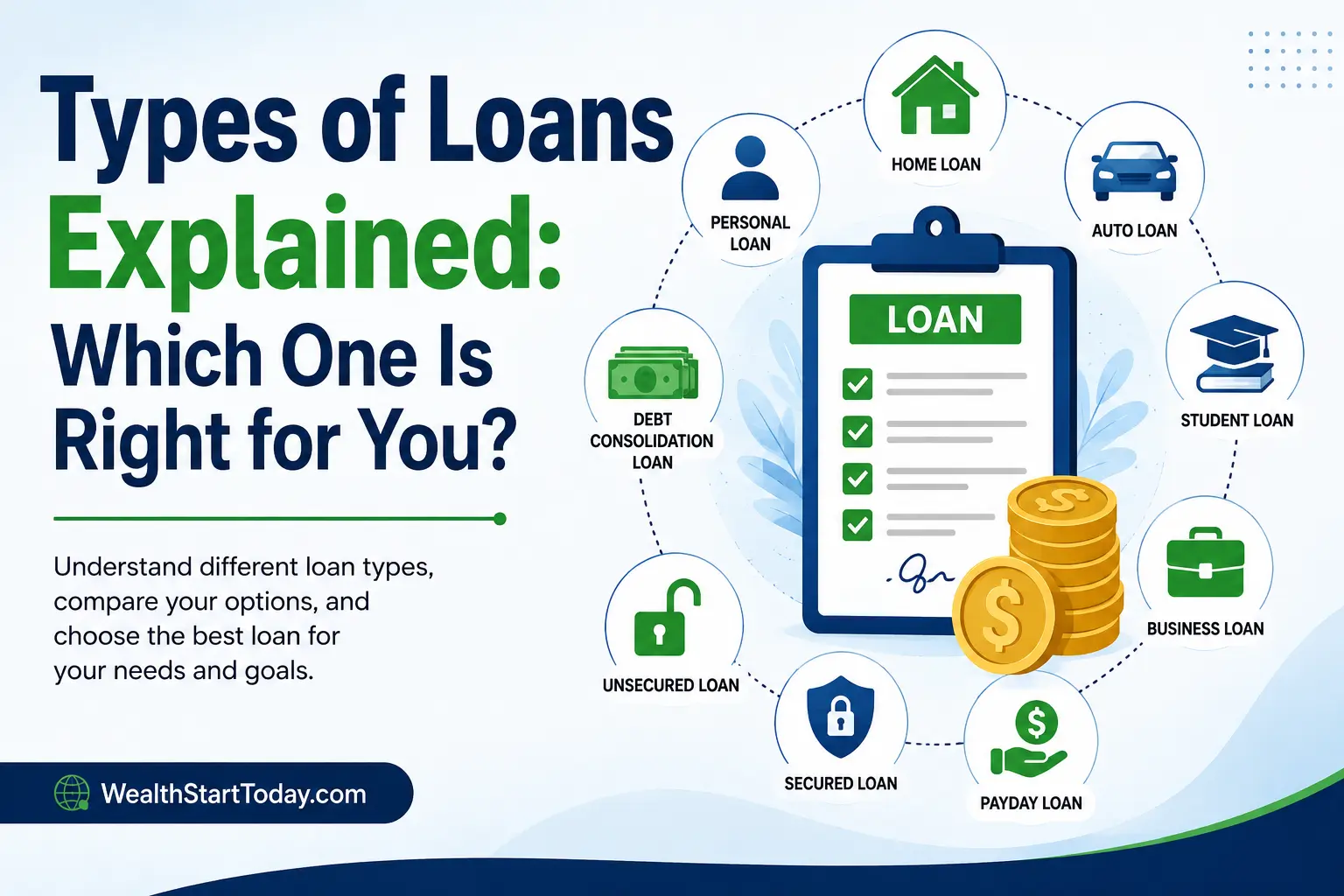
Borrowing money can help you achieve important financial goals, whether you want to buy a home, start a business, pay for college, or cover an unexpected emergency. However, not every loan is designed for the same purpose. Understanding the types of loans available can help you choose the right borrowing option while avoiding unnecessary debt and high interest costs.
Imagine Sarah wants to buy her first car. She quickly accepts the first loan offer she receives because the monthly payment seems affordable. A few months later, she discovers another lender was offering a much lower interest rate, which could have saved her thousands of dollars over the life of the loan. This is why understanding the different types of loans before borrowing is so important—it helps you choose the right financing option and avoid costly mistakes.
Today, banks, credit unions, and online lenders offer many different loan products. Some loans are secured by collateral, while others are unsecured and based mainly on your creditworthiness. Each loan comes with its own eligibility requirements, repayment period, interest rate, and financial risks.
Choosing the wrong loan can lead to higher monthly payments, additional fees, or borrowing more money than you actually need. On the other hand, selecting the right loan can make financing more affordable and help you achieve your financial goals with confidence.
In this guide, you’ll learn what loans are, how they work, and the most common types of loans available today. By the end of this article, you’ll understand which loan may be the best fit for your financial situation and what factors you should consider before applying.
What Are Loans?
A loan is an amount of money that a lender gives to a borrower with the agreement that it will be repaid over time. In most cases, the borrower must repay not only the original amount borrowed, known as the principal, but also an additional cost called interest.
Loans are one of the most common financial tools used by individuals, families, and businesses. Instead of paying a large amount of money upfront, borrowers can spread the cost over months or years through manageable payments.
For example:
- A family may take out a home loan to purchase a house.
- A student may use a student loan to pay tuition fees.
- A small business owner may apply for a business loan to expand operations.
- Someone facing an unexpected medical emergency may use a personal loan to cover expenses.
Loans make it possible to finance large purchases or handle urgent financial needs without waiting years to save enough money.
If you’re new to borrowing, the Consumer Financial Protection Bureau provides additional information about how loans work, common loan terms, and what borrowers should know before applying.
Why Do People Take Loans?
People borrow money for many different reasons. Some of the most common include:
- Buying a home
- Purchasing a vehicle
- Paying college or university expenses
- Starting or growing a business
- Consolidating high-interest debt
- Covering emergency medical bills
- Renovating a home
- Managing temporary cash flow problems
The right loan depends on your purpose, financial situation, and ability to repay.
Main Parties in a Loan
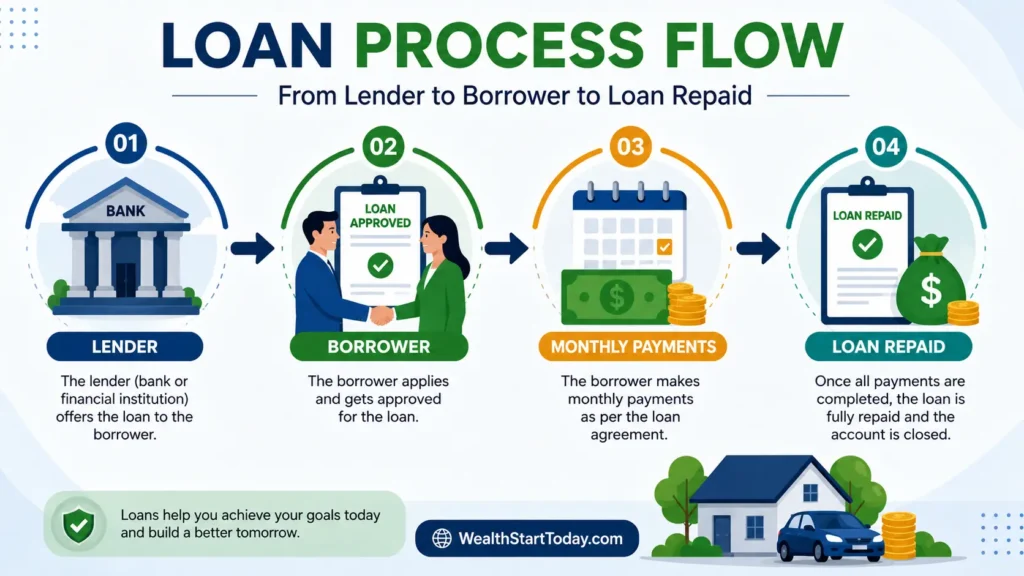
Every loan involves two parties:
Lender:
The bank, credit union, online lender, or financial institution that provides the money.
Borrower:
The individual or business that receives the money and agrees to repay it according to the loan agreement.
The agreement between the lender and borrower explains the interest rate, repayment schedule, loan amount, fees, and other important terms.
How Do Loans Work?
Before comparing the different types of loans, it’s important to understand how loans actually work. Knowing the basic components of a loan will help you compare offers from different lenders and make better financial decisions.
1. Loan Amount (Principal)
The principal is the amount of money you borrow.
For example, if you borrow $15,000, your principal is $15,000.
Interest is calculated based on this amount, although the exact calculation depends on the loan type and repayment method.
2. Interest Rate
The interest rate is the cost of borrowing money.
Lenders charge interest because they are providing funds and taking the risk that the borrower may not repay the loan.
Interest rates can be:
- Fixed
- Variable (Adjustable)
A fixed interest rate stays the same throughout the loan term, making monthly payments predictable.
A variable interest rate can increase or decrease over time based on market conditions, which means monthly payments may change.
3. Loan Term
The loan term is the amount of time you have to repay the loan.
Common loan terms include:
- 12 months
- 24 months
- 36 months
- 60 months
- 15 years
- 30 years
Shorter loan terms usually mean higher monthly payments but lower total interest costs.
Longer loan terms generally reduce monthly payments but increase the total amount of interest paid over the life of the loan.
4. Monthly Payments
Most loans require monthly repayments.
Each payment usually includes:
- Part of the principal
- Interest charges
- Any applicable fees (if included in the agreement)
Missing payments may result in late fees, damage to your credit score, and, in serious cases, legal action or repossession of collateral.
5. Collateral
Some loans require collateral.
Collateral is an asset that secures the loan, such as:
- A house
- A car
- Savings or investments
If the borrower fails to repay the loan, the lender may take ownership of the collateral to recover the outstanding balance.
Loans backed by collateral are called secured loans.
Loans that do not require collateral are known as unsecured loans.
Example: How a Loan Works
Imagine you borrow $20,000 from a bank to buy a car.
- Loan Amount: $20,000
- Interest Rate: 6% per year
- Loan Term: 5 years
- Monthly Payment: Fixed according to the repayment schedule
Each monthly payment reduces a portion of the principal while also covering the interest charged by the lender. Once all scheduled payments are made, the loan is considered fully repaid.
Practical Tip: Before accepting any loan offer, use the lender’s loan calculator to estimate your monthly payment and the total amount you’ll repay. Comparing these figures from multiple lenders can help you choose a loan that fits your budget and reduces overall borrowing costs.
Things to Consider Before Taking a Loan
Before applying for any loan, ask yourself the following questions:
- Do I really need to borrow this money?
- Can I comfortably afford the monthly payments?
- What is the total cost of the loan, including interest and fees?
- Is there a loan with a lower interest rate available?
- Have I compared offers from multiple lenders?
- Is the repayment period suitable for my budget?
Taking time to answer these questions can help you avoid unnecessary debt and choose a loan that supports your long-term financial goals instead of creating financial stress.
Before signing any loan agreement, it’s also a good idea to review the Federal Trade Commission’s guidance on borrowing money safely and recognizing common lending scams.
Types of Loans
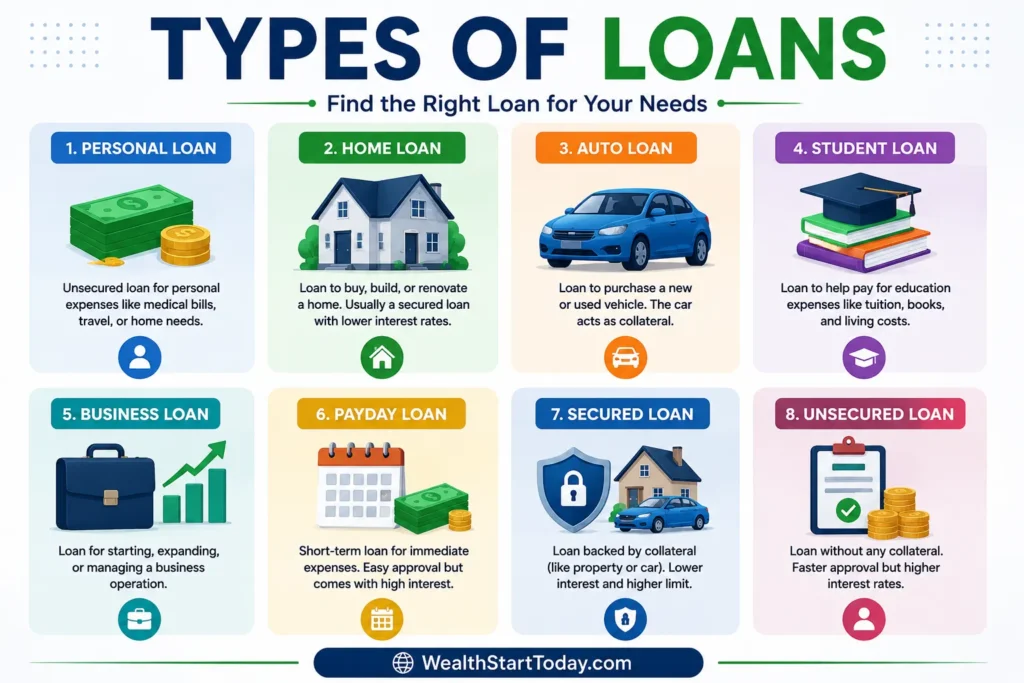
There are many different types of loans, and each is designed for a specific financial purpose. Choosing the right loan depends on your needs, income, credit history, and repayment ability. Below are the most common loan types you should know before borrowing money.
Personal Loan
A personal loan is one of the most flexible borrowing options available. It allows you to borrow a fixed amount of money and use it for almost any personal expense, such as medical bills, home improvements, weddings, vacations, or debt consolidation.
Most personal loans are unsecured, meaning you don’t need to provide collateral. However, lenders usually evaluate your credit score, income, and debt-to-income ratio before approving your application.
Best for:
- Emergency expenses
- Medical bills
- Home renovations
- Wedding costs
- Debt consolidation
Pros
- No restrictions on how the money is used
- Fixed monthly payments
- Fast approval from many lenders
Cons
- Higher interest rates than secured loans
- Good credit often required for the best rates
Home Loan (Mortgage Loan)
A home loan, also known as a mortgage loan, helps people purchase a house or other residential property. Because the property itself serves as collateral, mortgage loans generally offer lower interest rates than unsecured loans.
Repayment periods are often 15 to 30 years, making monthly payments more affordable.
Best for:
- Buying a home
- Purchasing investment property
- Refinancing an existing mortgage
Pros
- Lower interest rates
- Long repayment terms
- Opportunity to build home equity
Cons
- Long approval process
- Risk of foreclosure if payments are missed
- Closing costs and additional fees
Auto Loan
An auto loan is specifically designed to finance the purchase of a new or used vehicle. The vehicle acts as collateral until the loan is fully repaid.
Loan terms typically range from 36 to 84 months, depending on the lender and vehicle.
Best for:
- Buying a new car
- Purchasing a used vehicle
- Refinancing an existing auto loan
Pros
- Competitive interest rates
- Fixed monthly payments
- Allows immediate vehicle ownership
Cons
- Vehicle depreciation
- Repossession risk if payments are missed
Student Loan
A student loan helps cover education-related expenses such as tuition, books, housing, and other academic costs.
Student loans may come from government programs or private lenders. Many offer flexible repayment options after graduation.
Best for:
- College tuition
- University fees
- Educational expenses
- Professional certifications
Pros
- Makes higher education more affordable
- Flexible repayment options
- Lower interest rates in many government programs
Cons
- Debt may take years to repay
- Interest continues to accumulate on some loans
Business Loan
A business loan provides financing for entrepreneurs and companies to start, operate, or expand their businesses.
Business loans can be used for purchasing equipment, hiring employees, increasing inventory, marketing campaigns, or improving cash flow.
Best for:
- Starting a business
- Business expansion
- Purchasing equipment
- Working capital
Pros
- Supports business growth
- Various loan options available
- May improve business cash flow
Cons
- Extensive documentation required
- Approval may take longer
- Some loans require collateral
Payday Loan
A payday loan is a short-term loan intended to cover urgent expenses until your next paycheck. Although these loans are easy to obtain, they usually carry extremely high interest rates and fees.
Financial experts generally recommend exploring other borrowing options before considering a payday loan.
Best for:
- Short-term emergencies only
Pros
- Fast approval
- Minimal documentation
Cons
- Very high interest rates
- Short repayment period
- Can lead to a cycle of debt
Debt Consolidation Loan
A debt consolidation loan combines multiple debts into a single loan with one monthly payment. This can simplify repayment and, in some cases, reduce the overall interest rate.
Many people use these loans to pay off credit cards or other high-interest debts.
Best for:
- Combining multiple debts
- Simplifying monthly payments
- Lowering interest costs
Pros
- One monthly payment
- Easier financial management
- Potentially lower interest rate
Cons
- Doesn’t eliminate debt
- May require good credit for favorable terms
Secured Loan
A secured loan requires collateral such as a home, vehicle, savings account, or other valuable asset. Because the lender has security, these loans often come with lower interest rates and higher borrowing limits.
If repayments are not made, the lender can seize the collateral.
Best for:
- Large loan amounts
- Borrowers seeking lower interest rates
Pros
- Lower interest rates
- Higher approval chances
- Larger loan limits
Cons
- Risk of losing collateral
- Longer approval process
Unsecured Loan
An unsecured loan does not require collateral. Instead, lenders rely on your credit score, income, and financial history to determine eligibility.
Personal loans and many credit cards fall into this category.
Best for:
- Borrowers without assets to pledge
- Smaller financing needs
Pros
- No collateral required
- Faster approval
- Lower financial risk to personal assets
Cons
- Higher interest rates
- Lower borrowing limits
- Strong credit often required
Construction Loan
A construction loan provides short-term financing to build a new home or commercial property. Unlike traditional mortgages, funds are released in stages as construction progresses.
After construction is complete, borrowers often refinance into a standard mortgage.
Best for:
- Building a new home
- Commercial construction
- Major renovation projects
Pros
- Funds released as needed
- Designed specifically for construction projects
- Flexible financing during building
Cons
- Higher interest rates than traditional mortgages
- More paperwork and inspections
- Short repayment period before refinancing
Secured vs. Unsecured Loans: What’s the Difference?
Understanding the difference between secured and unsecured loans can help you choose the right financing option.
|
Feature |
Secured Loan |
Unsecured Loan |
|
Collateral Required |
Yes |
No |
|
Interest Rates |
Usually Lower |
Usually Higher |
|
Approval Process |
May Take Longer |
Often Faster |
|
Risk to Borrower |
Collateral Can Be Lost |
No Asset at Risk |
|
Loan Amount |
Usually Higher |
Usually Lower |
|
Best For |
Large Purchases |
Personal Expenses |
If you own valuable assets and want a lower interest rate, a secured loan may be a good choice. If you prefer not to risk your property and qualify based on your income and credit history, an unsecured loan may be more suitable.
By understanding these different types of loans, you can compare your options and select the one that best matches your financial goals and repayment ability.
Two people may borrow the same amount of money but end up paying very different total costs simply because they chose different loan types. Taking a few minutes to compare your options before applying can save you money and prevent unnecessary financial stress.
Expert Tip: Many borrowers focus only on the monthly payment, but the total repayment amount is just as important. A loan with a lower monthly payment may cost much more in interest if the repayment term is significantly longer.
How to Choose the Right Loan
With so many types of loans available, selecting the right one can feel overwhelming. The best loan for one person may not be the right choice for another. Before applying, take time to compare your options and evaluate your financial situation.
Here are some important factors to consider:
1. Identify Your Purpose
Start by determining why you need the loan. Different loans are designed for different purposes.
- Buying a home? Consider a home loan.
- Purchasing a vehicle? An auto loan may be the best option.
- Paying for college? A student loan is usually more suitable.
- Covering personal expenses? A personal loan could be the right choice.
Borrowing for the right purpose helps you avoid paying unnecessary interest or fees.
2. Compare Interest Rates
The interest rate has a significant impact on the total cost of borrowing. Even a small difference in rates can save—or cost—you thousands of dollars over the life of the loan.
Before choosing a lender, compare offers from several banks, credit unions, and reputable online lenders.
3. Review the Loan Term
A shorter loan term usually means:
- Higher monthly payments
- Lower total interest paid
A longer loan term generally means:
- Lower monthly payments
- Higher total interest costs
Choose a repayment period that fits comfortably within your monthly budget.
4. Check Your Credit Score
Many lenders use your credit score to determine:
- Whether you qualify
- Your interest rate
- Your borrowing limit
Improving your credit score before applying may help you secure better loan terms.
5. Understand All Fees
Don’t focus only on the interest rate. Some lenders also charge:
- Origination fees
- Late payment fees
- Prepayment penalties
- Processing charges
Always read the loan agreement carefully before signing.
6. How to Compare Loan Offers
Before choosing a loan, don’t focus only on the monthly payment. Comparing several loan offers can help you find the most affordable option and avoid unnecessary costs over time. Pay close attention to these key factors before making your decision:
APR (Annual Percentage Rate)
The APR gives you a clearer picture of the true cost of borrowing because it includes both the interest rate and certain lender fees. When comparing similar loans, the one with the lower APR is often the better value.
Interest Rate
The interest rate determines how much you’ll pay to borrow money. Even a small difference in interest rates can save you a significant amount over the life of the loan, so it’s worth shopping around.
Processing Fee
Some lenders charge an upfront processing or origination fee when your loan is approved. Always check whether this fee is included in the total borrowing cost before accepting an offer.
Loan Term
The loan term is the length of time you have to repay the loan. A shorter term usually means higher monthly payments but lower total interest, while a longer term reduces monthly payments but increases the overall cost.
Monthly Payment
Make sure the monthly payment fits comfortably within your budget. Borrowing more than you can realistically repay may lead to financial stress or missed payments.
Prepayment Penalty
Some lenders charge a fee if you repay your loan earlier than scheduled. If you plan to pay off your loan ahead of time, choose a lender that allows early repayment without penalties.
Quick Tip: Always compare at least three loan offers before making a final decision. Looking beyond the monthly payment and reviewing the APR, fees, and repayment terms can help you save money and choose the loan that best fits your financial goals.
7. Borrow Only What You Need
It can be tempting to borrow the maximum amount offered, but doing so increases your monthly payments and total interest costs.
Borrow only the amount you truly need and can comfortably repay.
Common Mistake to Avoid: Don’t apply for multiple loans on the same day unless you’re shopping within a recognized rate-shopping window. Multiple unnecessary applications can affect your credit profile and reduce your chances of getting the best loan terms.
Advantages and Disadvantages of Each Loan Type
The table below provides a quick comparison of the most common types of loans.
|
Loan Type |
Main Advantage |
Main Disadvantage |
|
Personal Loan |
Flexible use of funds |
Higher interest rates than secured loans |
|
Home Loan |
Lower interest rates |
Long repayment period |
|
Auto Loan |
Makes vehicle ownership easier |
Vehicle can be repossessed if payments are missed |
|
Student Loan |
Helps finance education |
Long-term repayment obligations |
|
Business Loan |
Supports business growth |
Strict eligibility requirements |
|
Payday Loan |
Fast access to cash |
Extremely high interest and fees |
|
Debt Consolidation Loan |
Combines multiple debts into one payment |
Doesn’t eliminate debt itself |
|
Secured Loan |
Lower interest rates |
Risk of losing collateral |
|
Unsecured Loan |
No collateral required |
Higher interest rates |
|
Construction Loan |
Designed for building projects |
Complex approval process |
Every borrower has different financial goals. Compare loan features carefully before making a decision.
Common Loan Mistakes to Avoid
Avoiding common borrowing mistakes can save you money and protect your financial future.
Borrowing More Than Necessary
Only borrow what you actually need. Larger loans increase both monthly payments and the total interest you’ll pay.
Ignoring the Total Loan Cost
A low monthly payment doesn’t always mean a loan is inexpensive. Consider the total repayment amount, including interest and fees.
Missing Monthly Payments
Late or missed payments can:
- Damage your credit score
- Result in late fees
- Make future borrowing more difficult
Setting up automatic payments can help you stay on track.
Not Comparing Lenders
Interest rates and fees vary between lenders. Comparing multiple loan offers may help you find better terms and save money over time.
Skipping the Fine Print
Always review the loan agreement carefully. Understand the repayment schedule, fees, and conditions before accepting the loan.
Frequently Asked Questions
What are the main types of loans?
The most common types of loans include personal loans, home loans, auto loans, student loans, business loans, payday loans, debt consolidation loans, secured loans, unsecured loans, and construction loans.
Which type of loan is best?
The best loan depends on your financial needs. For example, a home loan is suitable for buying property, while a personal loan may be ideal for general expenses or emergencies.
What is the difference between a secured and unsecured loan?
A secured loan requires collateral, such as a house or vehicle. An unsecured loan does not require collateral but often has higher interest rates.
Which loan usually has the lowest interest rate?
Home loans and other secured loans typically offer lower interest rates because they are backed by collateral.
Can I get a loan with bad credit?
Yes, some lenders offer loans to borrowers with lower credit scores. However, these loans often come with higher interest rates and stricter terms.
Is it possible to repay a loan early?
Many lenders allow early repayment, but some may charge a prepayment penalty. Always check the loan terms before signing the agreement.
How do I improve my chances of loan approval?
You can improve your approval chances by maintaining a good credit score, having a stable income, reducing existing debt, and providing accurate financial information.
Final Advice: A loan should help you achieve a financial goal—not create long-term financial stress. Compare lenders, understand every fee, borrow only what you need, and make sure the monthly payments comfortably fit your budget before signing any agreement.
Conclusion
Understanding the different types of loans is essential before borrowing money. Each loan serves a specific purpose and comes with its own benefits, risks, interest rates, and repayment terms. Whether you’re financing a home, buying a vehicle, paying for education, starting a business, or covering unexpected expenses, choosing the right loan can make a significant difference to your financial well-being.
Before applying, compare lenders, review interest rates and fees, and make sure the monthly payments fit comfortably within your budget. Borrow responsibly, read the loan agreement carefully, and avoid taking on more debt than necessary.
By learning how different types of loans work, you’ll be better prepared to make informed financial decisions and choose the borrowing option that best supports your long-term goals.
Choosing the right loan isn’t just about getting approved—it’s about finding an option that supports your financial goals without creating unnecessary debt. Before applying, compare multiple lenders, review interest rates, repayment terms, and fees, and borrow only what you truly need.
If you found this guide helpful, explore more practical personal finance resources on Wealth Start Today. You’ll find expert guides on budgeting, saving money, loans, and building long-term financial confidence to help you make smarter financial decisions every step of the way.










Leave a comment