



In 2026, if you have perused the news, you have most likely encountered the term “cryptocurrency.” Cryptocurrency has evolved from a specialized online experiment into a global financial discussion, whether it is through Bitcoin reaching new milestones, governments discussing regulation, or your neighbor bringing up their newest digital wallet. But what is cryptocurrency, really, and why does it matter to everyday people trying to build wealth?
In this guide, we break down what is cryptocurrency in plain English, the many forms of cryptocurrency that are currently available, the inner workings of cryptocurrencies, and the state of the cryptocurrency economy in 2026. By the conclusion, you will have enough knowledge about cryptocurrencies to choose whether or not they should be included in your financial strategy. This article is published in the Crypto category on Wealth Start Today.
What Is Cryptocurrency? A Simple Definition
So, what is cryptocurrency at its core? Cryptocurrency is a type of digital money that is only available electronically and is protected by encryption as opposed to a government or central bank. A cryptocurrency is neither printed or managed by a single entity, in contrast to the dollar or the euro. Rather, it operates on a dispersed network of computers that all concur on a common, unchangeable record known as a blockchain.
When people ask what is cryptocurrency, the simplest explanation is that, rather than a bank vault, it is internet-native money based on arithmetic, code, and a global network of people. Because every bitcoin unit is maintained on a public ledger, anyone can confirm that a transaction took place without having to rely on a middleman. This is the fundamental concept that distinguishes cryptocurrencies from the conventional financial system that the majority of us were raised with.
How Cryptocurrency Works Behind the Scenes
To really grasp what is cryptocurrency, it helps to peek behind the curtain. Every cryptocurrency transaction is broadcast to a network of computers, known as nodes. These nodes use a consensus mechanism, such as proof of work or proof of stake, to confirm the transaction is valid and has not already been spent elsewhere. Once confirmed, the transaction is bundled into a “block” and permanently added to the blockchain.
This process removes the need for a bank to sit in the middle of a transaction. Two people anywhere in the world can send cryptocurrency directly to each other in minutes, at any hour, without asking permission from a financial institution. That single feature is one of the biggest reasons cryptocurrency has attracted so much attention over the past decade.
The History of Cryptocurrency: From Bitcoin to 2026
Understanding what is cryptocurrency also means understanding where it came from. In 2009, an anonymous developer (or group) going by the name Satoshi Nakamoto introduced Bitcoin, marking the beginning of cryptocurrency as we know it today. In reaction to the 2008 financial crisis, Bitcoin was created as a substitute for a banking system that many believed had let regular savers down.
For many years, programmers and early adopters were the only ones interested in cryptocurrencies. This was altered in 2015 when Ethereum introduced programmable “smart contracts,” which made it possible for thousands of new cryptocurrency applications beyond just digital currency. Today, major financial data sources track cryptocurrencies, which have expanded into a multitrillion-dollar global asset class.
Key Milestones in Cryptocurrency Development
A few milestones explain how cryptocurrency reached where it is in 2026:
- 2009: Bitcoin launches as the first cryptocurrency, introducing blockchain to the world.
- 2015: Ethereum brings smart contracts, expanding what cryptocurrency can actually do.
- 2017–2021: Retail interest explodes, and thousands of new cryptocurrency tokens appear.
- 2024: Spot Bitcoin exchange-traded funds (ETFs) launch in the United States, giving traditional investors regulated access to cryptocurrency for the first time.
- 2025–2026: Stablecoin regulation matures, institutional adoption accelerates, and cryptocurrency ETFs collectively attract tens of billions of dollars in inflows, signaling that cryptocurrency is increasingly viewed as a mainstream asset class rather than a fringe experiment.
How Does Cryptocurrency Actually Work?
Now that we have covered what is cryptocurrency conceptually, let’s look at the mechanics that keep the system running smoothly day to day.

Blockchain Technology Explained
The technology that enables cryptocurrencies is called blockchain. Imagine a digital notebook that is replicated on thousands of computers around the globe. Each time a cryptocurrency transaction is made, a new line is added to that notebook. No one individual can covertly change historical records without the rest of the network seeing and rejecting the change since every machine has an identical copy.
Because of this shared, open structure, cryptocurrencies are frequently referred to as “trustless”—not because no one can be trusted, but rather because the system is set up so that you don’t need to trust any one person. The security assurance is provided by the network itself and the math.
Mining vs Staking in Cryptocurrency
Two main methods keep cryptocurrency networks secure and new coins flowing into circulation:
- Mining (Proof of Work): Mining, which is used by Bitcoin, entails strong computers resolving challenging riddles to verify transactions. In exchange for their labor and electricity expenses, miners receive newly produced bitcoin.
- Staking (Proof of Stake): Staking, which is used by Ethereum and many more recent networks, entails securing current bitcoin as collateral to aid with transaction validation. Validators use significantly less energy than miners and receive cryptocurrency rewards for their honest involvement.
The fundamental issue that both approaches address is how to maintain the integrity of a decentralized network in the absence of a central arbiter. For those who are new to cryptocurrencies, this is one of the most intriguing things to discover.
Types of Cryptocurrency You Should Know in 2026
Not every cryptocurrency has the same function. Only a small portion of the more than 17,000 individual cryptocurrency currencies and tokens that are tracked by data aggregators like CoinGecko across more than 1,400 exchanges globally have significant trading volume or practical applications as of 2026. Cryptocurrencies often fall into a few main categories.
Bitcoin and Altcoins
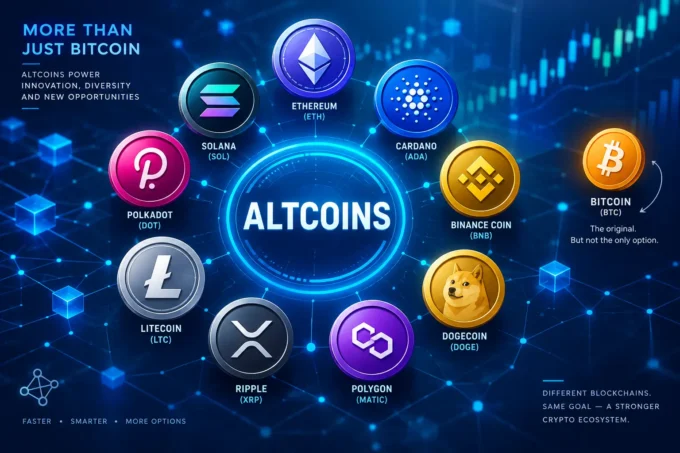
Often referred to as “digital gold” due to its fixed supply cap of 21 million coins, Bitcoin continues to be the first and biggest cryptocurrency. By valuation, Bitcoin still accounts for more than half of the whole cryptocurrency market in 2026; analysts refer to this as “Bitcoin dominance.”
The term altcoin, which stands for alternative coin, refers to all other cryptocurrencies. Among the biggest altcoins are Ethereum, Solana, XRP, and Binance Coin, each of which offers unique capabilities like smart contracts, quicker transaction times, or niche applications inside the larger cryptocurrency ecosystem.
Stablecoins and Their Role in the Cryptocurrency Market
In order to reduce the erratic price fluctuations associated with assets like Bitcoin, stablecoins are a special class of cryptocurrency that are tied to a stable asset, typically the US dollar. This market is dominated by Tether (USDT) and USD Coin (USDC), and industry trackers estimate that by late 2025, the total stablecoin market had reached over $310 billion. By serving as a link between conventional money and the rest of the cryptocurrency market, stablecoins enable traders and regular users to swiftly transfer value without being constantly exposed to volatility.
Why Is Cryptocurrency Important in 2026?
In 2026, cryptocurrency will be important for reasons that go far beyond conjecture. To safeguard their funds, a lot of people in nations with volatile currencies use cryptocurrencies. Compared to typical wire transfers, cryptocurrency allows businesses to settle cross-border payments more quickly and affordably. Along with equities, bonds, and real estate, investors are increasingly treating cryptocurrencies as a separate asset class.
Cryptocurrency Adoption Statistics 2026
The numbers behind cryptocurrency adoption in 2026 tell a compelling story:
- Global cryptocurrency holders surpassed roughly 560 million people by March 2026, up sharply from about 420 million in 2023, according to industry estimates.
- The combined global cryptocurrency market capitalization has fluctuated between roughly $2 trillion and nearly $4 trillion at various points in 2026, reflecting the asset class’s well-known volatility.
- Cumulative inflows into U.S. spot Bitcoin ETFs reached approximately $58.7 billion through May 2026, with these funds collectively holding more than 1.3 million Bitcoin.
- Bitcoin dominance has hovered between roughly 55% and 58% of the total cryptocurrency market throughout early 2026.
Because cryptocurrency markets move quickly, these numbers fluctuate regularly. Therefore, before making any judgments, always check a live data source like CoinGecko or CoinMarketCap, and consider any one snapshot to be a point in time rather than a permanent truth.
Benefits of Investing in Cryptocurrency
Cryptocurrency offers several advantages that explain its growing popularity:

- Accessibility: Anyone with an internet connection can buy, hold, or send cryptocurrency, without needing a traditional bank account.
- Speed: Cryptocurrency transactions, especially on faster networks, can settle in seconds to minutes, even across borders.
- Transparency: Every cryptocurrency transaction is recorded on a public blockchain, allowing independent verification.
- Potential Growth: Some cryptocurrency assets have delivered substantial long-term returns, though this comes with significant risk and is never guaranteed.
- Financial Independence: Cryptocurrency lets individuals hold and control their own assets without relying entirely on banks or brokers.
Risks and Challenges of Cryptocurrency
No honest discussion of what is cryptocurrency would be complete without addressing its downsides. Cryptocurrency is not a risk-free path to wealth, and treating it that way is one of the most common mistakes new investors make.
Cryptocurrency Volatility and Security Concerns
The price of cryptocurrencies can fluctuate significantly in a matter of hours. Several times, including in early 2026, the entire cryptocurrency market cap has dropped by 20% or more in a single quarter, demonstrating how quickly sentiment may change. In addition to price fluctuations, cryptocurrency investors face actual security threats. The sector has lost billions of dollars as a result of exchange hacks, phishing schemes, and misplaced private keys. According to reports, hackers stole more than $3 billion in bitcoin in 2025 alone—a significant rise from the previous year.
As a result, instead of keeping bitcoin on an exchange for an extended period of time, anyone storing cryptocurrency should use trustworthy exchanges, enable two-factor authentication, and think about safe hardware wallets for long-term storage.
How to Buy Cryptocurrency Safely
If you’ve determined that cryptocurrency is a good fit for your financial objectives, the actual purchasing process is quite simple if you know what to do.
- Choose a regulated exchange that operates legally in your country.
- Verify your identity through the exchange’s know-your-customer (KYC) process.
- Fund your account using a bank transfer, debit card, or other supported payment method.
- Select the cryptocurrency you want to purchase, such as Bitcoin or Ethereum.
- Secure your holdings by transferring larger amounts to a personal wallet rather than leaving everything on the exchange.
Choosing a Cryptocurrency Exchange
Not all cryptocurrency exchanges are made equally. Examine regulatory licenses, security history, fee schedule, available coins, and customer service quality while comparing platforms. Additionally, a reputable cryptocurrency exchange will provide transparent documentation regarding the security of client cash and cryptocurrency holdings, which becomes much more important as an account balance increases.
Cryptocurrency Regulations in 2026
In 2026, regulation emerged as a key concept in the cryptocurrency sector. After years of ambiguity, a number of significant economies have moved toward more precise regulations for stablecoins, cryptocurrency exchanges, and digital asset custody. While other regions continue to improve frameworks for taxes and consumer protection, regulators in the United States have been forced to clarify how these products are overseen due to the approval and proliferation of spot bitcoin ETFs.
This increasing regulatory clarity is generally encouraging for regular consumers. It implies that bitcoin is being viewed more as a genuine, if still developing, component of the global financial system than as an unregulated experiment. However, regulations still differ greatly between nations, so anyone who owns cryptocurrencies should be aware of their local tax and reporting requirements.
Is Cryptocurrency a Good Investment in 2026?
The truth is that it totally depends on your objectives, time horizon, and risk tolerance. This is the question that most people truly want answered when they search for “what is cryptocurrency.” Although cryptocurrency has the potential for long-term development and diversification, its volatility is significantly higher than that of most conventional asset classes.
Instead of considering cryptocurrencies as an all-in gamble, financial experts typically advise handling it as a tiny, purposeful part of a larger portfolio. Chasing short-term price spikes is typically not as beneficial for cryptocurrency investors as dollar-cost averaging, position sizing, and continuous education. As usual, before making significant decisions, think about consulting a skilled financial counselor and never invest more in cryptocurrencies than you are willing to lose.
Wealth Start Today: Your Trusted Guide to Cryptocurrency
At Wealth Start Today, our mission is to make personal finance and cryptocurrency easier to understand for everyday readers, not just industry insiders. This article lives in Wealth Start Today’s Crypto category, where we regularly publish beginner-friendly breakdowns of cryptocurrency news, market trends, and practical guides for 2026 and beyond. Whether you are completely new to cryptocurrency or refining an existing strategy, our goal is to give you accurate, well-researched, and trustworthy information so you can make confident decisions with your money. We do not provide personalized financial advice, but we do our best to explain complex cryptocurrency topics clearly, cite credible data, and update our content as the fast-moving cryptocurrency market evolves.
Frequently Asked Questions About Cryptocurrency
- What is cryptocurrency in the simplest terms?
Instead of being issued or managed by a central bank, cryptocurrency is digital money that is encrypted and stored on a decentralized blockchain.
- Is cryptocurrency legal in 2026?
Yes, in the majority of nations. Although laws pertaining to taxes, exchanges, and stablecoins differ greatly by country, it is legal to purchase, retain, and trade cryptocurrency.
- What is the difference between Bitcoin and other cryptocurrency?
Although thousands of cryptocurrencies provide various features like smart contracts, quicker speeds, or specialized applications, Bitcoin was the first cryptocurrency and is now the biggest by market value.
- How do I store cryptocurrency safely?
For increased security, most novices transfer bigger quantities of bitcoin to a personal hardware or software wallet after initially keeping them on a reliable exchange.
- Can cryptocurrency lose all its value?
Diversification, analysis, and only investing what you can afford to lose are crucial because individual bitcoin projects may fail or lose the majority of their value.
- Is cryptocurrency the same as blockchain?
No, cryptocurrency is just one application built on top of blockchain technology, which also serves other purposes like digital identity and supply chain tracking.
- How much should a beginner invest in cryptocurrency?
Many financial experts advise keeping cryptocurrency to a small portion of a total portfolio that you are comfortable with seeing vary considerably, while there is no set amount.
Conclusion
So, what is cryptocurrency, in the end? It is a quickly developing type of digital currency based on blockchain technology that frequently outperforms traditional finance in terms of speed, transparency, and worldwide accessibility. However, there are still significant risks associated with cryptocurrencies, such as price fluctuations, security issues, and changing regulations.
Your personal objectives, risk tolerance, and readiness to continue learning as the market develops will determine whether or not cryptocurrencies should be included in your financial plan.
We hope this guide gives you a clear, honest answer to what is cryptocurrency and how it actually works in 2026. For more in-depth guides like this one, explore the Crypto category, part of Wealth Start Today, and don’t forget to follow us on Facebook and X.com so you never miss an update on the ever-changing world of cryptocurrency.











1 Comment