



In the fast-paced world of today, handling several accounts, obligations, and spending may make managing finances daunting. Financial consolidation tools are useful in this situation. These solutions make it simpler for people and companies to track, manage, and make the best financial decisions by bringing all financial data into one location.
The purpose of financial consolidation tools is to make complicated financial arrangements easier to understand. These tools offer clarity, increase accuracy, and save time whether you are handling your personal finances or operating a business. We will cover all you need to know about financial consolidation tools in this article, including their types, features, advantages, and how to pick the best one.
What Are Financial Consolidation Tools and Why They Matter
Software programs called financial consolidation tools are made to compile financial information from several accounts and platforms into a single, unified system. These technologies enable users to examine all of their financial data on a single dashboard by connecting to bank accounts, credit cards, loans, investments, and other financial sources. Financial aggregation solutions give real-time data and streamline the process of tracking income, spending, and balances across many platforms. Businesses and individuals may more effectively monitor financial progress, recognize expenditure trends, and gain a better understanding of their financial situation thanks to this single picture.
These systems also frequently have capabilities that improve financial management, such forecasting, reporting, budgeting, and notifications. Users save time and lower the possibility of errors by doing away with the necessity for several spreadsheets and manual computations. By enabling teams to safely access common financial data, financial consolidation technologies can help firms collaborate more effectively. All things considered, these solutions streamline financial management by consolidating all pertinent data into a single, well-organized system, which makes it simpler to stay informed and keep financial control.
Financial consolidation tools are crucial since they make financial management simpler and more effective. It is challenging to monitor performance, spot patterns, and make wise decisions when financial data is dispersed over several accounts and systems. By providing a thorough picture of all financial activity in one location, financial consolidation solutions address this issue.
This centralized method reduces mistakes that frequently arise during manual data entry and increases accuracy. Users are able to make more informed financial decisions by rapidly analyzing their income, spending, debts, and investments.
By offering thorough reports and estimates, these tools also enhance financial planning by assisting users in setting reasonable objectives and monitoring advancement over time. Financial consolidation solutions are increasingly crucial for both people and enterprises in the fast-paced digital world of today. They enhance responsibility, provide users a comprehensive understanding of their financial situation, and guarantee that no crucial financial data is missed.
Benefits of Financial Consolidation Tools for Individuals and Businesses
By streamlining financial administration and increasing overall efficiency, financial consolidation tools provide substantial benefits to both people and enterprises. Increased financial visibility is one of the most significant advantages. With the use of these tools, customers may compile all of their financial data into a single platform, including income, spending, debts, and assets.
Users are better able to comprehend their financial situation and see trends in their spending and saving thanks to this consolidated picture. Businesses and individuals are better able to manage budgets, cut back on wasteful spending, and allocate resources when they can clearly see where their money is coming from and leaving.
Time savings is another significant advantage. Manually handling several accounts may be difficult and time-consuming, particularly for companies that deal with a lot of transactions. Financial consolidation solutions greatly save human labor by automating tasks like data input, transaction tracking, and report preparation. Another important benefit of automation is that it increases accuracy.
These technologies lower the possibility of mistakes and guarantee consistent financial records by reducing human participation in repetitive computations and data management. For companies that rely on trustworthy financial reporting for planning, compliance, and performance assessment, this degree of precision is crucial.
Additionally, by offering real-time insights and statistics, financial consolidation solutions improve decision-making. Users are able to swiftly analyze risks, examine financial trends, and make well-informed decisions that support their financial objectives. All things considered, these technologies increase output, lower stress levels, and facilitate more intelligent financial planning for both people and businesses.
Types of Financial Consolidation Tools You Should Know
There are many different kinds of financial consolidation solutions, each of which is intended to satisfy distinct financial management requirements for both people and companies. Among the most popular are personal finance consolidation solutions, particularly for people who wish to have more financial control. These applications enable users to manage their bills, savings, income, and spending all in one location. They frequently have functions like financial goal-setting, bill reminders, spending monitoring, and budgeting. People may use these tools to better analyze their spending patterns and create more effective saving plans.
Financial consolidation technologies are increasingly sophisticated and made to handle intricate financial processes on the company side. These technologies are essential for accurate financial reporting, forecasting, and compliance management in organizations with several divisions, subsidiaries, or accounts. Automation features, compatibility for many currencies, and real-time dashboards that give a thorough picture of financial performance are common components of business tools.
Cloud-based financial consolidation solutions are another significant category that has grown in popularity because of its accessibility and versatility. These technologies are perfect for remote teams and enterprises that operate across several locations since they enable users to view financial data from any location with an internet connection. Additionally, cloud-based systems are scalable, enabling customers to add more features as their requirements change.
Furthermore, there are specialist financial consolidation programs made for certain uses including tax preparation, debt consolidation, and investment management. These focused solutions provide more effective and strategic financial management by assisting users in concentrating on specific financial objectives and obstacles.
Key Features of Financial Consolidation Tools That Drive Efficiency
Tools for financial consolidation tools best when they include strong features intended to increase operational effectiveness and simplify financial administration. Data integration is one of the most important components. Multiple accounts, including bank accounts, credit cards, accounting software, and investment platforms, should be connected to a robust financial consolidation tool. This connection guarantees that all financial data is collected in a single, central location and does away with the necessity for manual data entry.
Real-time updates are another essential aspect. Access to current financial data enables people and organizations to keep an eye on transactions as they take place, enabling them to react swiftly to changes in the financial landscape. Businesses that depend on timely information to manage cash flow, make strategic choices, and steer clear of possible hazards may find this very helpful. Efficiency is also greatly enhanced by user-friendly interfaces.
Financial consolidation tools should be simple to use, with straightforward workflows and clear displays that enable people with little technical expertise to utilize them efficiently. Users are more likely to make the most of tools and keep regular financial supervision when they are easy to use. Given how sensitive financial data is, security is still another essential component.
To prevent unwanted access to user data, trustworthy financial consolidation solutions incorporate encryption, multi-factor authentication, and safe data storage. Furthermore, analytics and reporting tools offer insightful information on financial performance. These tools assist users find areas for improvement, save expenses, and make wise financial decisions that promote long-term success by producing comprehensive reports, visual dashboards, and trend analysis.
How Financial Consolidation Tools Improve Financial Planning
By giving customers a comprehensive and well-organized picture of their financial status, financial consolidation tools are crucial for enhancing financial planning. Businesses and individuals may better understand income, spending, savings, loans, and investments when they have access to all financial data in one location. Users may establish reasonable financial objectives and create organized plans to reach them thanks to this thorough visibility.
Improved budgeting is one of the most important ways these tools help financial planning. Users are able to examine expenditure trends, spot wasteful spending, and make budgets that support both their immediate and long-term goals. Over time, budgeting becomes more precise and manageable with automated tracking and classification. By combining all obligations into a single screen, financial consolidation technologies can facilitate efficient debt management.
Monitoring payment plans, interest rates, and outstanding debt is made simpler as a result. After that, users may prioritize high-interest loans, develop smart payback schedules, and more effectively lessen their total financial load. These technologies greatly enhance investment planning in addition to budgeting and debt management. Real-time portfolio diversification evaluation, market tracking, and investment performance monitoring are all available to users.
Users may make well-informed decisions and modify their investment plans according to their risk tolerance and financial objectives by having access to comprehensive data and insights. In general, financial consolidation tools assist people and organizations achieve financial stability and long-term success by strengthening financial planning through increased organization, increased visibility, and actionable insights.
Best Practices for Using Financial Consolidation Tools Effectively
Adopting best practices that guarantee accuracy, efficiency, and significant financial insights is necessary for the proper use of financial consolidation instruments.
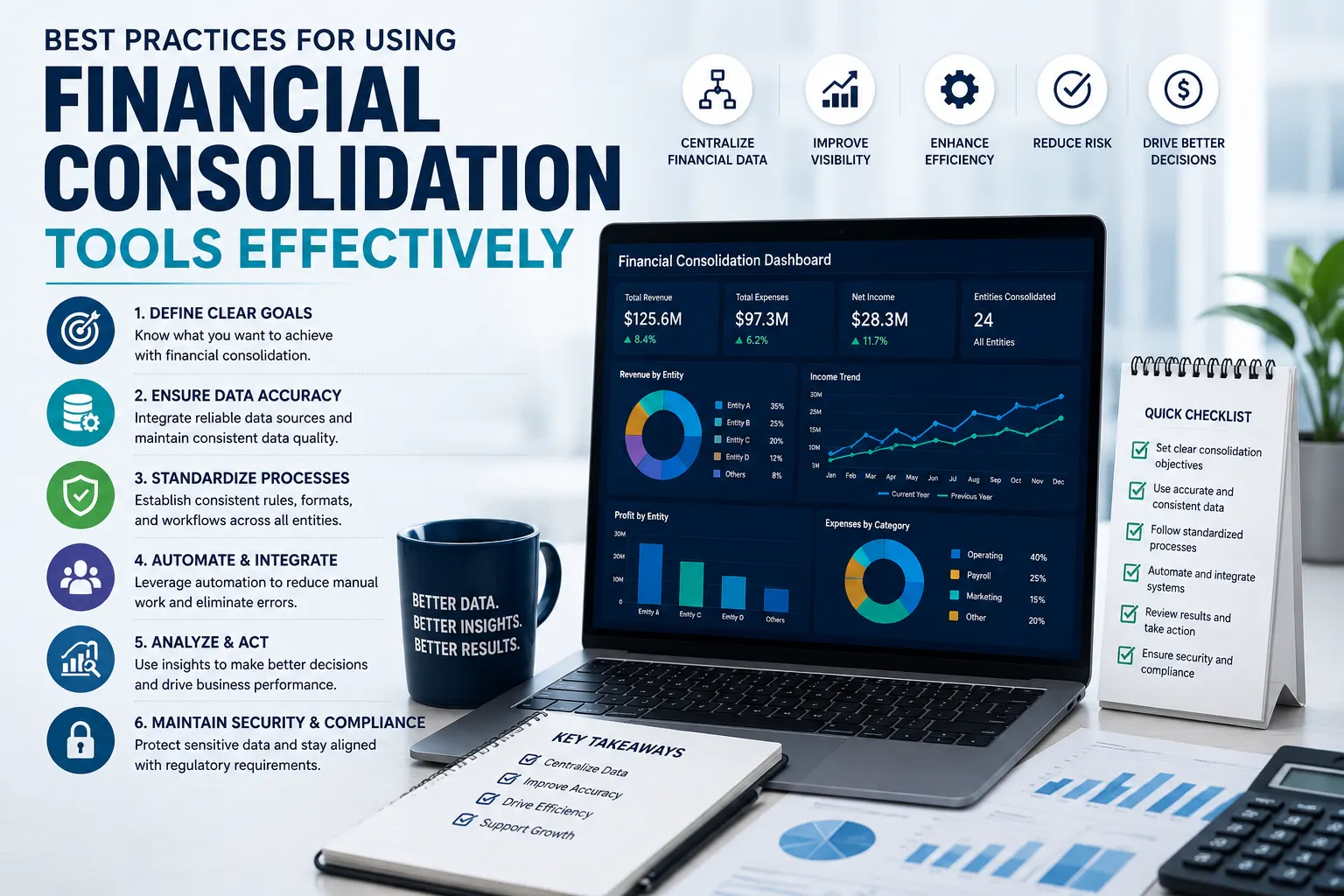
Updating financial data on a regular basis is one of the most crucial procedures. By keeping information up to date, users can precisely track their financial situation and steer clear of making judgments based on incomplete or out-of-date facts.
Although many financial consolidation programs include automated synchronization with credit cards, bank accounts, and investment platforms, users should still frequently check and validate data to make sure everything is correctly recorded and classified. Setting specific financial objectives is another crucial excellent practice. Financial consolidation programs function best when users specify their goals, whether they are debt reduction, emergency fund building, investment growth, or saving for a big purchase. Users can stay focused and make better effective use of the tool’s features when they have clear goals.
Users should also make the most of the analytics and reporting tools. These reports offer insightful information about income trends, spending habits, and long-term financial performance. Users can find opportunities to cut expenses, increase savings, and make better financial decisions by examining these insights. Another crucial step when utilizing financial consolidation solutions is ensuring data security.
Users should select tools with robust encryption, multi-factor authentication, and safe data storage since these platforms handle sensitive financial data. Additionally, it’s critical to avoid accessing financial information on unprotected networks and to use strong passwords. By adhering to these best practices, users may enhance financial planning, attain long-term financial success, and optimize the advantages of financial consolidation tools.
Challenges of Financial Consolidation Tools and How to Overcome Them
Despite the many benefits that financial consolidation tools offer, users may encounter certain difficulties when putting them into practice and utilizing them efficiently. Data integration is one of the most prevalent issues. There may be gaps in financial visibility since not all financial institutions, accounts, or software platforms work with all financial consolidation tools.
Users may have to manually enter data when some accounts cannot be linked automatically, which lowers productivity and raises the risk of mistakes. Because many platforms are constantly expanding their compatibility, users may overcome this difficulty by carefully evaluating tools that support a wide variety of connectors and routinely checking for updates. The learning curve is another difficulty, especially for people or small firms that are unfamiliar with financial management software.
Certain financial consolidation solutions include sophisticated capabilities that might appear complicated or intimidating at first. However, by choosing user-friendly platforms, utilizing integrated tutorials, and utilizing customer support resources, this difficulty may be overcome. Additionally, a lot of products include guided installations and dashboards that make the onboarding process easier. Cost is another crucial factor, particularly for companies that need sophisticated capabilities like reporting, forecasting, and multi-user access.
There may be implementation or subscription fees associated with some financial consolidation products. By comparing pricing plans, beginning with simple versions, and assessing the tool’s long-term usefulness, users may overcome this obstacle. Because financial data is so sensitive, security issues are also quite important. To guarantee that their data is secure, users should select tools with robust encryption, safe authentication procedures, and trustworthy data protection guidelines.
Small Businesses and Startups
For startups and small enterprises that must manage few resources while preserving financial control and transparency, financial consolidation solutions are very helpful. Organized financial management is crucial for these companies since they frequently have small staff, short budgets, and quickly shifting financial circumstances. All financial data, including bank accounts, spending, invoices, wages, and investments, may be combined into a single, consolidated platform by small enterprises and startups using financial consolidation tools.
Business leaders may better comprehend their financial situation and prevent misunderstanding brought on by dispersed financial data by using this unified perspective. One of the most important aspects of a startup’s survival and expansion is cash flow management. Startups may monitor their burn rate and make sure they have enough money to maintain operations by using financial consolidation tools, which offer real-time visibility into incoming income and exiting costs. Additionally, these technologies assist in identifying wasteful spending and more efficiently allocating resources, both of which are critical in the early phases of growth.
Because consolidation technologies automate chores like transaction tracking, report preparation, and budget monitoring, small firms also gain from improved financial procedures. By minimizing mistakes and reducing human labor, automation frees up business leaders to concentrate on strategic expansion plans.
Financial reporting and compliance are also enhanced by financial consolidation technologies. Small companies may more effectively prepare for tax filing, audits, and regulatory obligations with accurate and well-organized documents. Financial consolidation solutions enable startups and small enterprises to make well-informed choices, increase operational efficiency, and promote long-term company success through enhanced visibility, automation, and reporting capabilities.
Why Financial Consolidation Tools Are Essential in Modern Finance
Financial consolidation tools are becoming necessary rather than optional for both people and enterprises in the quickly changing financial landscape of today. Managing several sources of income, bank accounts, digital wallets, investments, loans, and operating costs are all part of modern finance, which may easily become overwhelming without adequate planning.
By combining all financial data onto a single, cohesive platform, financial consolidation technologies reduce this complexity. Users can comprehend their financial situation at any moment because of this consolidated perspective, which gives them more control and clarity over their finances. Users may monitor financial performance, spot possible dangers before they become major issues, and recognize expenditure trends with more visibility.
Additionally, these solutions offer insightful data and analytics that facilitate more intelligent financial decision-making. To be flexible and responsive in a cutthroat economic world, companies need rapid and accurate financial data.
Financial consolidation solutions assist firms swiftly adjust to shifting market conditions by providing real-time information, automatic reporting, and forecasting functions. These tools assist individuals in more effectively managing their own assets, savings objectives, and budgets. The capacity of financial consolidation technologies to increase productivity and decrease manual labor is another significant reason they are crucial to contemporary finance. Automation reduces human error and saves time, freeing up users to concentrate on growth and strategic planning.
Furthermore, the requirement for safe and integrated financial management grows even more urgent as financial institutions become increasingly digital. Financial consolidation tools are essential for reaching financial stability, enhancing planning, and maintaining competitiveness in the complicated financial environment of today since they offer both security and ease.
How Wealth Start Today Helps You Understand
At Wealth Start Today, we are dedicated to helping individuals and businesses make smarter financial decisions. Our platform provides valuable insights, guides, and resources on financial consolidation tools and other financial topics.
If you want to explore more about financial management and discover the best financial consolidation tools, visit our Financial Tools category page. We aim to simplify complex financial concepts and provide actionable advice that helps you achieve financial success.
By leveraging the knowledge available on Wealth Start Today, you can better understand how to use financial consolidation tools effectively and take control of your financial future.
Future Trends in Financial Consolidation Tools You Should Watch
As new technologies continue to transform how people and organizations handle their accounts, the future of financial consolidation tools is changing quickly.

The combination of machine learning and artificial intelligence is one of the biggest developments. Financial consolidation tools can now analyze massive amounts of financial data, spot trends, and produce forecast insights thanks to these technologies. Users may anticipate future cash flow, receive tailored advice, and identify unusual transactions or possible dangers before they become serious problems thanks to AI-powered features. Increased automation is another significant development.
Automating routine operations like budget adjustments, report preparation, and transaction classification is becoming increasingly possible using financial consolidation solutions. Automation increases accuracy, lessens manual labor, and frees up users to concentrate on strategic financial planning rather than regular data maintenance. The future of financial consolidation tools is being significantly shaped by cloud technology. More flexibility is offered by cloud-based services, which let customers access their financial data from any place or device.
Remote teams, multinational corporations, and those who handle money while on the road would particularly benefit from this accessibility. Furthermore, cloud solutions are scalable, allowing customers to add more features as their budget increases. Improved data visualization and real-time analytics, which employ interactive dashboards and visual reports to assist customers better understand financial performance, are another new trend. Financial consolidation tools will grow more sophisticated, safe, and user-friendly as technology develops, making them more crucial for effective money management and long-term financial success.
FAQs
What are financial consolidation tools used for?
Financial consolidation tools are used to combine financial data from multiple sources into one platform for easier management and analysis.
Are financial consolidation tools suitable for individuals?
Yes, financial consolidation tools are suitable for individuals who want to manage their finances, track expenses, and achieve financial goals.
Do financial consolidation tools improve financial accuracy?
Yes, financial consolidation tools reduce human errors by automating processes and ensuring consistent data across all accounts.
Can small businesses benefit from financial consolidation tools?
Absolutely, financial consolidation tools help small businesses manage finances, track cash flow, and improve decision-making.
Are financial consolidation tools secure?
Most financial consolidation tools offer strong security features, but users should choose trusted platforms and follow best practices for data protection.
Conclusion
By combining disparate financial data into a single, well-organized system, Financial consolidation tools are essential to contemporary financial management. These technologies offer clarity and control, whether people are keeping track of their own spending or corporations are handling several accounts, subsidiaries, or income sources. Users gain from automated procedures that lower the possibility of human mistake and guarantee higher accuracy rather than depending on spreadsheets or manual computations.
Users can swiftly make well-informed decisions, see patterns, and track their financial health in real time thanks to this consolidated method. The capacity to simplify data and provide trustworthy reports becomes not only advantageous but also necessary for sustaining stability and expansion in more complicated financial conditions.
Financial consolidation tools enable users to make more strategic and intelligent decisions in addition to streamlining procedures. They assist both people and companies in coordinating their financial activities with long-term objectives by providing comprehensive insights, forecasting skills, and performance analysis.
This entails more financial transparency, better resource allocation, and improved compliance for firms. It means improved investment planning, saving, and budgeting for individuals. Investing in the appropriate Financial consolidation tools are ultimately a deliberate move toward attaining financial security and long-term success rather than just being convenient. Users may develop a better, more robust financial future and gain confidence in their financial decisions by making appropriate use of these tools.
Relevant Topics: Unlock Success with the Financial Data Extraction Tool and MyUSFinance Financial Tools: The Ultimate Guide














Leave a comment