


One of the most important responsibilities for people, companies, and financial experts is managing financial data. Accurate collection, organization, and interpretation of financial data is necessary for anything from tracking spending to analyzing investments.
However, it can be time-consuming and labor-intensive to manually compile financial data from spreadsheets, reports, invoices, and bank statements. A financial data extraction tool becomes quite useful in this situation.
The process of gathering financial data from many sources can be automated with the use of a AI financial extraction software. Businesses and individuals can more effectively examine their finances because to its ability to extract important data elements like transactions, revenue numbers, expenses, and account balances.
Using a cutting-edge financial extraction solution can significantly improve financial management and enable data-driven decision-making.
You might find useful tactics in our tutorial if you’re already learning how to manage your finances. How to save money on a tight budget.
We’ll go over how these tools operate, their advantages, and how to pick the best one for your requirements in this extensive tutorial.
What Is a Financial Data Extraction Tool?
Software created to automatically extract financial data from documents, databases, or digital sources and transform it into structured data is known as a financial data extraction tool.
These tools make use of technology like:
- Artificial intelligence (AI)
- Optical character recognition (OCR)
- Machine learning
- Data parsing algorithms
These technologies allow a financial data extraction tool to accurately extract key figures and features from financial documents.
These tools can extract the following types of data:
- Bank transaction records
- Invoice details
- Expense reports
- Financial statements
- Investment data
Organizations can increase productivity and decrease human entry errors by automating data extraction.
Why Businesses Need a AI Financial Extraction Software
Every day, businesses deal with a lot of financial data. Managing this data becomes ineffective and prone to mistakes in the absence of automation.
There are a number of significant benefits to using a AI financial extraction software.
Faster Financial Data Processing
The process of managing massive amounts of financial data is greatly accelerated by financial data extraction tool. These solutions allow staff to spend more time on analysis and strategic financial tasks by capturing and organizing data in a matter of seconds rather than hours or days of manual data entry.
Improved Accuracy
Errors frequently result from manual data entering, particularly when dealing with intricate financial figures. By automatically extracting information straight from documents, a AI financial extraction software lowers these errors and guarantees that the recorded data is more accurate, dependable, and consistent for financial reporting.
Better Financial Decision-Making
Businesses can assess their financial performance more effectively when they have access to accurate and timely financial data. Businesses can improve their overall financial management and long-term business strategy by making well-informed decisions regarding budgeting, forecasting, and planning when they have access to trustworthy information.
You may also read our article to learn about financial tools and budgeting techniques: 50 30 20 rule in budgeting.
How a Data Extraction Platform Works
You can better appreciate a financial data extraction tool usefulness in financial management if you know how it operates.
| Tool | OCR | AI | Pricing | Best For |
|---|---|---|---|---|
| Docsumo | ✅ | ✅ | $$ | SMEs |
| Rossum | ✅ | ✅ | $$$ | Enterprise |
| Klippa | ✅ | ✅ | $$ | Accounting |
| Parseur | ✅ | ❌ | $ | Small Business |
Document Identification
First, the system identifies the type of document being processed. This may include:
- Bank statements
- Receipts
- Financial reports
- Tax documents
Data Recognition
The financial data extraction tool then recognizes numbers, labels, and financial information in the document using OCR and AI.
Data Structuring
The program arranges the data into organized representations like these after it has been extracted:
- Excel spreadsheets
- Accounting software
- Databases
Data Validation
Lastly, the system verifies that the extracted data matches expected formats and looks for discrepancies.
This method drastically cuts down on physical labor.
Key Features of a Data Extraction Platform
Knowing which aspects are most valuable is crucial when choosing a financial data extraction tool.
AI-Powered Data Extraction
Artificial intelligence is used by modern tools to identify intricate financial patterns and forms.
This guarantees precise data collection even when papers have different layouts.
Integration with Accounting Software
A strong data extraction platform should work with well-known systems like:
- QuickBooks
- Xero
- SAP
- Microsoft Excel
Transferring collected data automatically is made possible by integration.
Multi-Format Document Support
There are numerous formats for financial papers, such as:
- PDFs
- Images
- Scanned documents
- Emails
All of these formats are simply processed by a versatile financial data extraction tool.
Data Security and Compliance
Security is crucial because financial data is sensitive.
Seek out resources that provide:
- Data encryption
- Secure cloud storage
- Compliance with financial regulations
How Financial Consolidation Tools Improve Financial Reporting
Financial consolidation tools play an important role in simplifying financial reporting for businesses with multiple departments, subsidiaries, or accounts. Consolidation software creates a single, precise financial perspective when a financial data extraction tool gathers data from invoices, bank statements, and accounting records. This procedure guarantees uniformity across financial accounts, minimizes reporting errors, and cuts down on manual computations.
Modern financial consolidation tools also support real-time reporting, regulatory compliance, and faster month-end closing, allowing finance teams to make informed decisions with confidence. Organizations can save important time and operational resources while streamlining workflows, increasing data accuracy, and gaining deeper insights into their overall financial performance by combining automated data extraction with financial consolidation solutions.
Financial Document Automation for Personal Finance
Automation is very beneficial for corporations, but adopting a financial data extraction tool can also be advantageous for individuals.
These tools, for instance, can assist people:
- Track spending automatically
- Monitor investments
- Analyze bank transactions
- Create personal financial reports
Financial stability can be increased by combining these technologies with wise budgeting techniques.
Our Financial Tools category also explores additional resources that can help you manage money effectively:
How Myusfinance Financial Tools Support Better Financial Management
Financial data is only valuable when it is transformed into meaningful insights that support smarter decisions. This is where Myusfinance financial tools can complement a financial data extraction workflow. Using useful budgeting and planning tools, users may more effectively organize, evaluate, and track their financial performance after extracting data from invoices, bank statements, expenditure reports, and financial papers.
Combining automated data extraction with dependable financial management tools helps minimize human labor and increase accuracy, whether you are managing personal accounts or supervising business operations. Companies are able to track cash flow, spot expenditure trends, and develop better financial plans. Users can improve their financial control and make data-driven, confident decisions for long-term success by combining automation and smart financial tools.
Best Use Cases for a Financial Data Extraction Tool
Numerous financial activities and businesses employ financial data extraction tools.
Accounting Firms
These tools are used by accounting experts to automate:
- Invoice processing
- Tax document analysis
- Financial statement preparation
Investment Analysts
To obtain financial information from market data and corporate reports, investment firms use a financial data extraction tool.
Banks and Financial Institutions
Banks use these tools for:
- Loan processing
- Fraud detection
- Transaction analysis
Small Businesses
Automation can help small businesses focus on expansion while reducing administrative workload.
How to Choose the Best Financial Data Extraction Tool
A number of factors influence the choice of financial data extraction tool.
Accuracy and AI Capabilities
Accuracy should be the first consideration when selecting a financial data extraction technology. Choose a system that accurately extracts financial data from documents using cutting-edge AI and machine learning technologies, minimizing errors and guaranteeing accurate financial analysis findings.
Ease of Use
An excellent instrument for extracting financial data should be easy to use and straightforward. It should make it simple for users to set up and run the system without requiring sophisticated technical knowledge, allowing teams to save time and swiftly integrate the tool into their regular financial procedures.
Integration Capabilities
Make sure a data extraction platform is compatible with your current accounting or financial program before choosing one. When systems are properly integrated, extracted data can move between them automatically, increasing productivity and decreasing the need for manual data handling or modifications.
Pricing and Scalability
When selecting a data extraction platform, price is a crucial consideration. Companies should choose a solution that is both affordable and scalable, enabling the tool to manage growing volumes of financial data as the business expands.
Benefits of Using a Automated Financial Data Processing
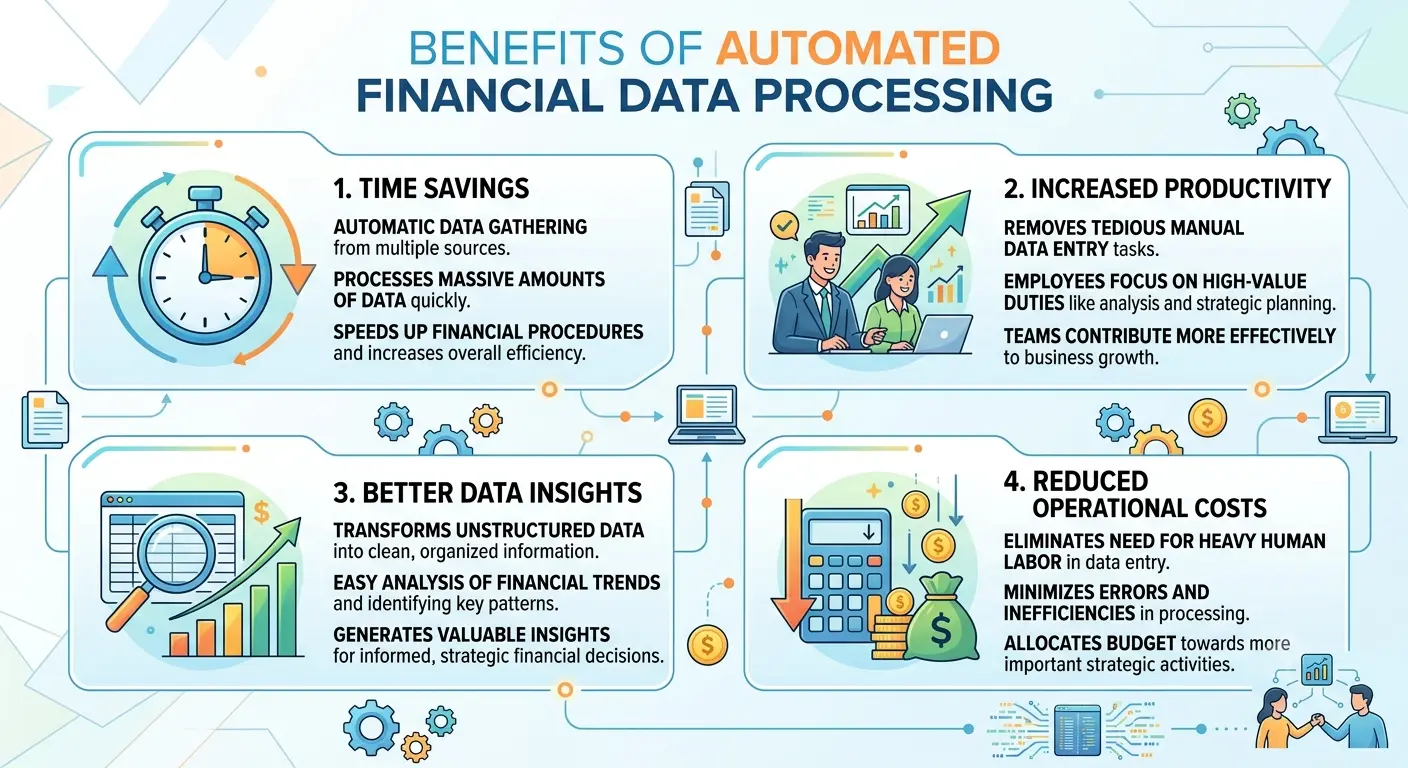
Beyond automation, there are many benefits to using financial data extraction technology.
Time Savings
By automatically gathering and arranging financial data from a variety of sources, a financial data extraction technology saves a substantial amount of time. Businesses can swiftly process massive amounts of data rather than manually entering figures and details, increasing productivity and speeding up overall financial procedures.
Increased Productivity
Employees can focus on more important financial duties by doing away with tedious manual data entering tasks. Planning, decision-making, and financial analysis are all included in this. Teams become more productive as a result, and they may more successfully contribute to the financial expansion of the company.
Better Data Insights
Unstructured financial data is transformed into clean, well-organized data using a financial data extraction tool. Businesses may more easily examine financial trends, spot patterns, and provide insightful information that helps them make wiser and more strategic financial decisions thanks to this organized style.
Reduced Operational Costs
By eliminating the need for a lot of human work, automation helps firms cut operating costs. With fewer errors and faster data processing, companies can minimize inefficiencies, save resources, and allocate their budget toward more important financial and strategic activities.
External Resources for Financial Data Automation
If you’re interested in learning more about financial data technologies, you might want to look at resources from reliable companies such as:
These groups offer insightful financial data.
FAQs
What is the purpose of a financial data extraction tool?
Financial data is automatically gathered and arranged from documents, reports, and digital sources using a financial data extraction tool.
Is a tool for extracting financial data appropriate for small businesses?
Indeed. These solutions are widely used by small firms to increase financial accuracy and automate accounting procedures.
Can accounting software be integrated with a tool for extracting financial data?
The majority of contemporary solutions interface with financial systems and accounting platforms like Xero and QuickBooks.
Is it safe to obtain financial data?
To safeguard sensitive financial data, trustworthy technologies include encryption, access controls, and compliance measures.
Do people require a tool for extracting financial data?
Automation solutions may be helpful for people who are in charge of numerous accounts, investments, or complicated finances.
Conclusion
Effective financial information management is more crucial than ever in the data-driven financial world of today. Accurate financial data is essential for decision-making for individuals, businesses, and investors.
Unfortunately, manual data entry is ineffective, slow, and prone to errors. Traditional approaches just cannot keep up with the increasing volume and complexity of financial data.
Automation becomes crucial in this situation.
The entire process of managing financial data is made simpler with the use of a financial data extraction tool. These solutions greatly reduce human error and eliminate repetitive labor by automatically extracting information from bank statements, reports, invoices, and other financial documents.
The advantages go well beyond mere automation.
Businesses that use cutting-edge financial instruments are able to understand their financial performance more quickly. Without spending hours manually entering data, they can track expenditure, examine revenue patterns, and provide precise reports.
Automation can also simplify financial planning and budgeting for people handling their own finances. Financial tools offer strong insights that support people in maintaining financial management when paired with tried-and-true tactics like the 50/30/20 budgeting guideline.
Investigating contemporary financial automation products is a wise move if you’re serious about enhancing your money management.
At Wealth Start Today, Our objective is to assist readers in learning useful tactics, financial resources, and wise financial practices that promote long-term financial success and follow us on Facebook and X.com to keep up with the most recent developments.














Leave a comment