


One of your brand’s most significant financial assets in the hyperconnected digital world of today is its reputation. Your income, customer trust, and long-term growth are all strongly impacted by how people view you online, regardless of whether you are an experienced investor, a fledgling entrepreneur, or a small company owner. Reputation monitoring tools have emerged as an essential category of software that empowers individuals and businesses to stay ahead of what is being said about them across the internet — from social media platforms and review sites to news outlets and financial forums.
With the help of these technologies’ real-time insights, automatic warnings, and thorough analytics, you can react swiftly to unfavorable material, magnify favorable comments, and create a strong, long-lasting brand identity.
What Are Reputation Monitoring Tools and Why Do They Matter?
Reputation monitoring tools are digital solutions or software platforms that track, evaluate, and control how a company, person, or brand is seen online. In order to gather mentions, ratings, and sentiment data into a single, understandable dashboard, they trawl millions of internet sources, including social media channels, news websites, blog postings, review systems like Google, Yelp, Trustpilot, and e-commerce marketplaces. In the current financial and corporate environment, the significance of these instruments cannot be emphasized.
Within hours, a single unfavorable review or widely shared social media post may seriously harm a business’s reputation, resulting in decreased brand equity, decreased investor confidence, and lost revenues. Businesses can identify these issues early and take effective action before the harm worsens thanks to reputation monitoring tools.
Your internet reputation has a direct impact on customer behavior from a financial standpoint. Research repeatedly demonstrates that before making a purchase, the great majority of consumers check online reviews, and that a company’s star rating on well-known review sites may have a quantifiable effect on its earnings.
Maintaining a reliable and credible online presence is crucial for financial service providers, wealth managers, fintech firms, and personal finance bloggers. The most effective tool for maintaining brand trust and the first line of defense are reputation monitoring tools.
How Reputation Monitoring Tools Work: Core Features Explained
Understanding the Technology
Web crawling, sentiment analysis, and natural language processing (NLP) are the main functions of reputation monitoring tools. These tools constantly search the internet and social media platforms for any reference to your company’s name, goods, executives, or particular keywords. The technology provides the user with notifications, reports, or visual dashboards after detecting a mention and analyzing the context and tone of the material to determine whether it is good, negative, or neutral.
There is much more to contemporary reputation monitoring software than just keyword alerts. They include tools like competitor benchmarking, which lets you assess how your brand is perceived in relation to competitors in your sector. They provide historical trend analysis, which lets you evaluate how your reputation has changed over time and spot trends that could be related to particular PR efforts, product launches, or business events. Additionally, some sophisticated platforms interface directly with email marketing platforms, social media management tools, and customer relationship management (CRM) systems. This facilitates prompt, coordinated response by marketing and communications teams in the event of a reputation issue.
Key Capabilities That Define
Every aspect of online brand management is covered by the extensive range of features that the top reputation monitoring tools provide. Perhaps the most important feature is real-time monitoring, which enables your team to react swiftly to both opportunities and disasters by instantly receiving notifications whenever your brand is discussed online. Equally crucial is review management capability, which allows companies to request, monitor, and reply to customer reviews on several platforms from a single interface, guaranteeing that no criticism is ignored.
Another distinguishing feature of the best reputation monitoring tools are sentiment analysis. These technologies evaluate the emotional tone of the material rather than merely gathering mentions, giving you insight into how people truly feel about your business as well as how frequently you are referenced. With social listening tools, you can keep an eye on real-time conversations taking place on social media sites like Facebook, Instagram, LinkedIn, TikTok, and X (previously Twitter), giving you a sense of popular opinion. Furthermore, competition analysis tools give you strategic insights that guide your marketing and company development choices by showing you how your brand’s reputation compares to that of your sector peers.
Top Reputation Monitoring Tools You Should Know in 2026
The Best Reputation Monitoring Tools for Businesses and Entrepreneurs
With dozens of platforms vying for the interest of companies of all kinds, the market for reputation monitoring tools have expanded dramatically in recent years. Brandwatch, a potent enterprise-level platform with deep social listening, sentiment analysis, and extensive brand intelligence capabilities, is one of the most well-known and well regarded choices. In order to help companies comprehend and react to their reputation in real time, Brandwatch tracks billions of online discussions and offers AI-powered insights. Larger companies with specialized marketing and communications teams are especially well-suited for it.
Another formidable competitor in the field of reputation monitoring tools is Mention, which provides small and medium-sized organizations with an easy-to-use interface and reasonable prices. Mention provides consumers with real-time notifications and comprehensive analytics to help them remain on top of their company’s online presence by tracking brand mentions throughout the web, social media, blogs, forums, and news sites. Teams can easily assign tasks, monitor response times, and assess the success of reputation management initiatives thanks to its collaborative capabilities.
Birdeye has made a name for itself as one of the top reputation monitoring tools created especially for small and large organizations. It integrates social media monitoring, customer experience data, and review management into one cohesive platform. While Birdeye’s reaction management features guarantee that unfavorable comments are handled quickly and expertly, its automatic review request function assists companies in proactively obtaining great evaluations.
Another great reputation monitoring tools is ReviewTrackers, which focuses mostly on managing online reviews on over 100 review venues. Businesses can easily discover areas for improvement and assess the effectiveness of their reputation management efforts thanks to its comprehensive statistics on review volume, average ratings, response rates, and sentiment trends. Businesses in the retail, financial services, and hospitality sectors are particularly fond of ReviewTrackers.
For people and small organizations that are just starting to manage their online reputation, Google Alerts is still a useful free reputation monitoring tools, albeit having less features than commercial systems. You may receive email notifications anytime new material that meets your criteria surfaces in Google’s search index by creating alerts for your name, brand, or particular keywords. It is a great place to start before spending money on a more complete premium solution.
Reputation Monitoring Tools for Financial Professionals and Wealth Builders
Why Financial Professionals Need Dedicated Reputation Monitoring Tools
Reputation monitoring tools are extremely important for financial professionals, such as wealth counselors, investment consultants, fintech entrepreneurs, and personal finance content producers. Credibility and trust are the cornerstones of any customer relationship in the financial sector. A single unfavorable article, deceptive review, or harmful social media post can undermine years of meticulously constructed professional reputation and result in serious financial repercussions, such as lost business alliances, regulatory investigation, and customer attrition.
In addition to generic brand references, financial professionals need to keep an eye on rival messaging, compliance-related information, and industry developments that may affect their posture. A comprehensive understanding of the elements influencing professional reputation is provided by reputation monitoring tools made specifically for the financial industry, which frequently include features like risk alert systems, regulatory compliance tracking, and interaction with financial news aggregators. Financial professionals may take proactive measures to address concerns, dispel misconceptions, and reaffirm their knowledge and reliability at every touchpoint by keeping up with what customers, prospects, and industry peers are saying.
Integrating Reputation Monitoring Tools into Your Financial Strategy
It is now essential to include reputation monitoring tools in your entire financial plan. Public opinion has a direct impact on stock prices, client acquisition, and regulatory interactions in the financial services sector. The ability to recognize and address reputational risks before they become financial problems gives businesses that invest in strong reputation monitoring technologies a competitive edge.
A financial company should take into account aspects like data coverage, alert speed, sentiment correctness, and integration capabilities when choosing reputation monitoring tools. Your reputation intelligence will have serious blind spots if you choose a solution that just tracks social media and excludes financial news websites, analyst reports, and industry forums. The top reputation monitoring tools for financial professionals offer thorough coverage across all pertinent internet platforms and give useful information that help with both immediate crisis management and long-term brand development.
About Wealth Start Today and Its Financial Tools Category
At Wealth Start Today, the mission is to empower individuals and businesses with the knowledge, strategies, and tools they need to build lasting financial success. The Wealth Start Today Financial Tools category is a dedicated hub that brings together in-depth reviews, expert guides, and practical resources covering the full spectrum of digital tools that support financial management, brand growth, and business intelligence. Reputation monitoring tools are a natural and important addition to this category, as they directly influence a business’s ability to protect its financial interests, maintain client trust, and drive sustainable revenue growth.
The materials on Wealth Start Today are intended to assist you in making well-informed choices about the most important tools, regardless of whether you are a financial firm managing intricate stakeholder relationships or a solopreneur developing your own brand. To remain up to speed on the most recent financial ideas, tool reviews, and insights from the Wealth Start Today community, you can also follow us on Facebook, Instagram, and X.com.
Previous Financial Tools Content: Building a Complete Digital Toolkit
Connecting Reputation Monitoring Tools to Your Broader Financial Toolkit
The Financial Tools category on Wealth Start Today has been steadily building a comprehensive library of resources that address every facet of modern financial and business management. Previously, the platform has published in-depth content on the Financial Data Extraction Tool, which explored how businesses can efficiently collect, process, and leverage structured financial data from diverse sources to inform strategic decisions. Another important piece covered MyUSFinance Financial Tools, providing a detailed look at the suite of resources available through that platform to help American consumers and businesses manage their finances more effectively.
The category has also featured a thorough guide on Financial Consolidation Tools, which examined how organizations can streamline their financial reporting by aggregating data from multiple systems, subsidiaries, or business units into a unified view that supports accurate and timely decision-making. Most recently, the platform published a comprehensive article on AI Visibility Analytics Tools Brand Mentions, which delved into how artificial intelligence is transforming the way brands track and analyze their digital presence, detect mentions across the web, and derive actionable intelligence from vast amounts of unstructured data. Reputation monitoring tools complement all of these previous topics beautifully, as they represent the practical application layer where financial data, brand intelligence, and business analytics converge to produce real-world outcomes that protect and enhance financial performance.
How to Choose the Right Reputation Monitoring Tools for Your Needs
Evaluating Reputation Monitoring Tools: A Strategic Framework
A careful assessment of your unique requirements, financial constraints, industry, and expansion goals is necessary before selecting the best reputation monitoring tools for your company. Determining what you need to monitor is the first stage in this approach. Do you care more about press coverage, internet reviews, social media mentions, or all of the above? You may reduce the number of possible tools to those that provide the coverage and features most pertinent to your circumstances by being aware of the extent of your monitoring requirements.
Budget is the second factor. Reputation monitoring tools come in a variety of forms, from business programs that cost thousands of dollars a month to free ones like Google Alerts. Mid-tier solutions that strike a mix between price and functionality are frequently the greatest place to start for small firms and individual entrepreneurs. You may scale up to more sophisticated systems that provide deeper insights, wider coverage, and more advanced response management capabilities as your company expands and your reputation management requirements become more complicated.
The third important aspect to take into account when assessing reputation monitoring tools is integration capacity. Coordinated efforts across several departments, including marketing, customer service, PR, and executive communications, are the most successful reputation management tactics. Compared to standalone solutions that need laborious data exports and disjointed processes, tools that interface with your current CRM, social media management, and analytics systems will yield far greater value. Seek out reputation monitoring systems that include strong APIs that enable the creation of bespoke interfaces or native integrations with well-known commercial software packages.
Lastly, think about how accurate and high-quality the tool’s reporting and sentiment analysis functions are. Your team will be overburdened and find it challenging to prioritize answers if a reputation monitoring solution produces a lot of alerts but has low sentiment accuracy. Seek out technologies that have shown to be accurate in sentiment categorization, industry-specific language processing, and reporting that can be customized to match your KPIs.
Best Practices for Using Reputation Monitoring Tools Effectively
Maximizing the Value of Your Reputation Monitoring Tools
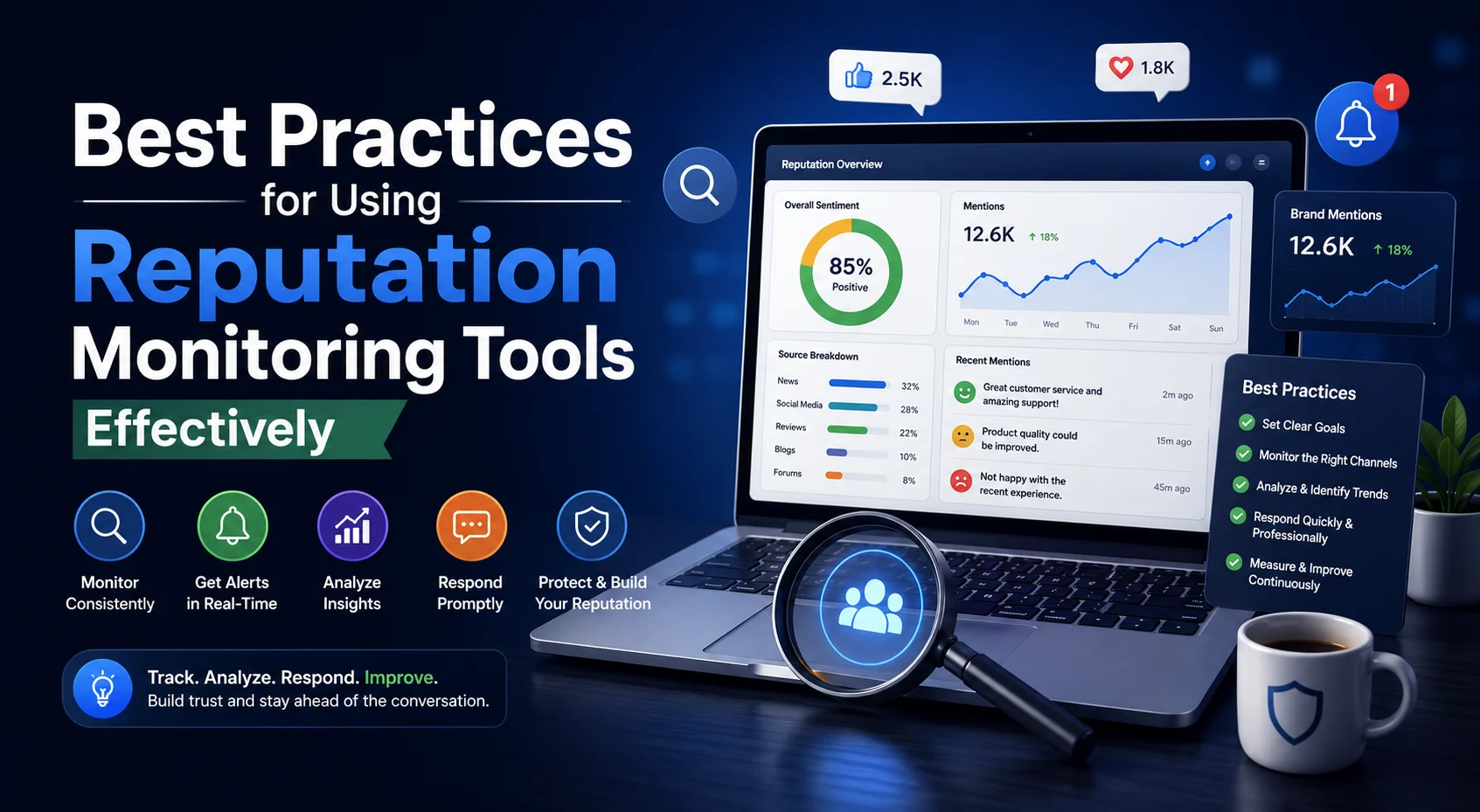
Purchasing reputation monitoring tools is only the first step; in order to use them successfully, your company must establish clear procedures, clearly defined roles, and a proactive reputation management culture. Establishing a response plan that outlines how your team will handle various kinds of reputation-related information is one of the most crucial best practices. Positive mentions should be reinforced through social sharing and interaction to optimize their influence, bad reviews should be addressed within a certain amount of time, and significant reputation crises should have escalation protocols in place.
To get the most out of your reputation monitoring tools, regular reporting and analysis are also crucial. Instead of only responding to specific warnings, make use of your platform’s analytics features to spot patterns, track the success of your reputation management initiatives over time, and compare your results to those of your rivals. Reputation reports, either monthly or quarterly, may be effective tools for persuading senior leadership of the commercial benefits of reputation management and obtaining continued funding for the skills you need to be successful.
Training your team on how to use reputation monitoring tools properly is another critical success factor. Many organizations invest in powerful platforms but fail to fully utilize their capabilities because team members lack the knowledge or confidence to navigate the tools effectively. Providing comprehensive onboarding, ongoing training, and clear guidelines for how reputation data should be interpreted and acted upon will ensure that your investment in reputation monitoring tools delivers the maximum possible return.
The Future of Reputation Monitoring Tools: AI, Automation, and Beyond
How Emerging Technologies Are Reshaping Reputation Monitoring Tools
Thanks to developments in artificial intelligence, machine learning, and natural language processing, the field of reputation monitoring tools is changing quickly. Predictive intelligence platforms that can foresee reputational threats before they arise are replacing reactive alarm systems in the next generation of reputation monitoring technologies. These sophisticated analytics may detect early warning signs that a certain issue is gaining traction by examining trends in social media conversations, news cycles, and customer behavior. This allows companies to take preventative measures to lessen the potential damage.
The capacity of AI-powered reputation monitoring tools to comprehend context, complexity, and sarcasm in human language—skills essential for precise sentiment analysis—is also growing. Previous iterations of these technologies had trouble accurately categorizing sarcastic or unclear text, which frequently resulted in incorrect classifications that decreased the accuracy of their conclusions. The intricacies of language are now much better captured by modern AI models trained on large datasets of human-generated text, producing sentiment analysis findings that are significantly more accurate and useful than those of their predecessors.
Another significant development influencing reputation monitoring tools in the future is automation. These systems are becoming more capable of taking significant actions on behalf of users without requiring human participation at every stage, from automated review response creation to AI-drafted crisis communication templates. Automation is significantly reducing the time and effort needed to manage large volumes of routine reputation management tasks, freeing teams to concentrate on strategic initiatives that drive long-term brand value, even though human judgment will always be necessary for handling complex or delicate reputation situations.
FAQs
Q1: What are reputation monitoring tools?
Reputation monitoring tools are software platforms that track, analyze, and manage how a brand, business, or individual is perceived across the internet, including social media, review sites, news outlets, and blogs.
Q2: Why do businesses need reputation monitoring tools?
Businesses need reputation monitoring tools to detect negative content early, respond to customer feedback promptly, benchmark against competitors, and maintain a positive brand image that supports customer trust and revenue growth.
Q3: Are there free reputation monitoring tools available?
Yes, tools like Google Alerts offer basic free reputation monitoring capabilities. However, most comprehensive platforms with advanced features such as sentiment analysis, competitive benchmarking, and multi-platform coverage are paid solutions.
Q4: How do reputation monitoring tools help financial professionals?
For financial professionals, reputation monitoring tools track client reviews, industry mentions, and compliance-related content, helping to protect professional credibility and maintain the trust that is essential for client relationships and business growth.
Q5: What features should I look for in reputation monitoring tools?
Key features to look for include real-time alerts, sentiment analysis, review management, social listening, competitive benchmarking, reporting and analytics, and integration with existing business tools such as CRM and social media management platforms.
Q6: How often should I check my reputation monitoring tools?
Best practice is to configure your reputation monitoring tools to deliver real-time or daily alerts for urgent mentions, while conducting in-depth analysis of trends and performance metrics on a weekly or monthly basis.
Q7: Can reputation monitoring tools help with crisis management?
Absolutely. Reputation monitoring tools are among the most valuable instruments for crisis management, as they enable businesses to detect emerging reputation threats early and coordinate rapid, strategic responses before issues escalate.
Q8: Which is the best reputation monitoring tool for small businesses?
Tools like Mention, Birdeye, and ReviewTrackers are widely regarded as excellent options for small businesses, offering a strong balance of functionality, ease of use, and affordability.
Conclusion
In today’s cutthroat digital world, reputation monitoring tools have become essential resources for any company or individual dedicated to creating and safeguarding a solid online presence. From AI-powered sentiment analysis and predictive reputation intelligence to real-time social listening and review management, these tools provide a full range of capabilities that enable brands to stay ahead of possible threats, react to criticism promptly and professionally, and continuously enhance the quality of their online reputation.
The stakes are considerably greater for wealth-focused entrepreneurs and financial experts since long-term business sustainability, client acquisition, and financial performance are all intimately correlated with a solid, reliable reputation. You can position yourself for long-term success in a market that is becoming more transparent and review-driven by investing in the appropriate reputation monitoring tools and utilizing them as part of an all-encompassing financial and brand management plan. Explore more expert guides, tool reviews, and financial strategies at Wealth Start Today and follow us on Facebook, Instagram and x.com for daily updates and insights.









Leave a comment