



Are you sick and weary of having nothing in your bank account at the end of the month? Do you struggle to accumulate any significant savings despite receiving a paycheck every two weeks? You’re not by yourself. Millions of people barely make ends meet, and there seems to be a huge gap between their desire and actual savings. That is exactly why the biweekly money saving challenge has become one of the most popular and effective saving strategies for everyday people.
A biweekly money saving challenge is a structured savings plan designed to align with a two-week pay cycle. This challenge divides your financial goals into digestible, paycheck-sized chunks rather than focusing on monthly savings, which can feel abstract and daunting. A biweekly savings strategy makes your objectives feel attainable, whether you’re saving for an emergency fund, a trip, a down payment on a home, or just attempting to improve your money habits.
At Wealth Start Today, our mission is to help people at every income level take their first — or next — step toward financial freedom. Over the years, we have published practical guides like How to Save Money Fast, Money Saving Tips for Families, Cash Saving Money Box, Money Saver Mini Storage, and Money Saving Binder — all designed to help you take real, actionable steps with your money. Today, we are adding another powerful tool to your financial toolkit: the complete guide to the biweekly money saving challenge.
Continue reading to learn how this challenge operates, which approach is best for you, how to maintain consistency, and how to maximize your outcomes.
What Is a Biweekly Money Saving Challenge?
Understanding the Biweekly Money Saving Challenge Structure
The biweekly money saving challenge is a savings system where you commit to setting aside a specific amount of money every two weeks — typically aligned with your pay schedule. The biweekly strategy capitalizes on the psychological boost of smaller, more regular accomplishments, in contrast to a monthly savings plan. In contrast to a monthly plan (12 months x 2 = 24 deposits, while 26 biweekly periods exist in a year), you make 26 deposits annually instead of a single large monthly payment.
Because each deposit is lower, you are naturally saving more without necessarily feeling the pinch. If you save $100 every two weeks, for instance, you will have saved $2,600 at the end of the year without significantly altering your way of living.
Why Biweekly Works Better Than Monthly for Most People
The majority of Americans receive their pay on a monthly basis. You are much more likely to stick to your savings strategy if it aligns with your pay schedule. The money hits your account, you transfer your savings amount immediately, and you live on what remains. The foundation of almost every successful savings journey is this “pay yourself first” strategy.
The biweekly money saving challenge also removes the temptation to spend that money. You never “see” that money as being available for spending when your savings transfer takes place on the same day your salary comes. It sits in your savings account, growing silently in the background, out of sight and out of mind.
Types of Biweekly Money Saving Challenges
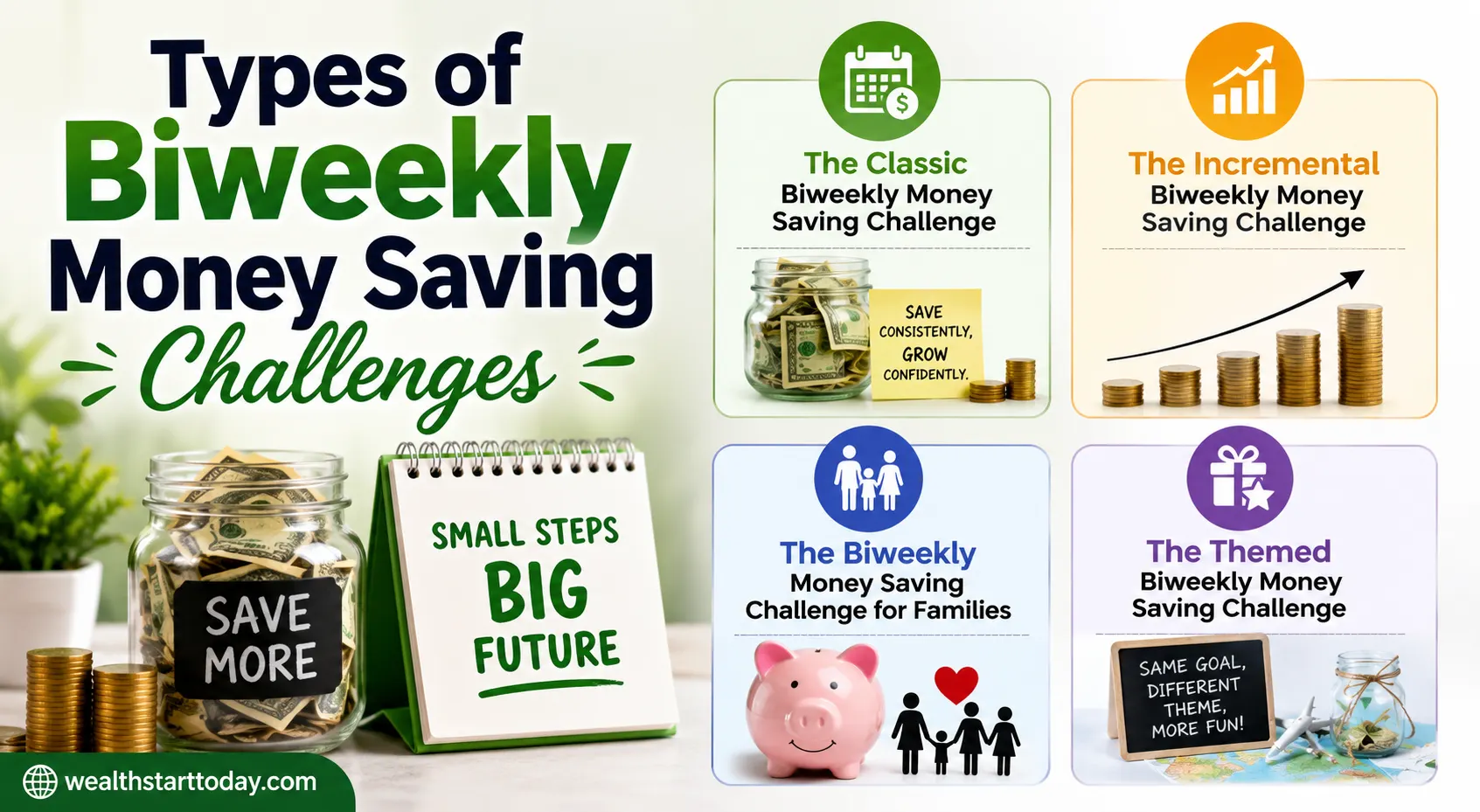
The Classic Biweekly Money Saving Challenge
The most straightforward version of the biweekly money saving challenge involves saving a fixed flat amount every two weeks. Based on income level, the following are some well-liked flat-rate options:
- Beginner Level: Save $25 every two weeks → $650/year
- Intermediate Level: Save $75 every two weeks → $1,950/year
- Advanced Level: Save $150 every two weeks → $3,900/year
- Power Saver Level: Save $250 every two weeks → $6,500/year
For novices who want simplicity, this flat-rate method is perfect. You choose a number, set it to run automatically, and then forget about it.
The Incremental Biweekly Money Saving Challenge
The incremental version of the biweekly money saving challenge starts small and increases by a fixed amount each period. For example:
- Week 1–2 (Period 1): Save $10
- Week 3–4 (Period 2): Save $20
- Week 5–6 (Period 3): Save $30
- …and so on up to Period 26
With this increasing strategy, you might start with just $10 and save up to $3,640 by the end of the year. This method’s brilliance lies in the fact that while each gain seems insignificant, the total over time is substantial.
The Biweekly Money Saving Challenge for Families
Families with multiple income streams can supercharge the biweekly money saving challenge by combining contributions. For example, every adult family member pledges to set aside $50 every pay period. That is $100 every two weeks for a household with two incomes, which comes to $2,600 annually per person or $5,200.
This strategy fits in nicely with our previously released guide, Money Saving Tips for Families, in which we discussed how family-based financial practices can build long-term wealth over time.
The Themed Biweekly Money Saving Challenge
A themed challenge gives your saving more enjoyment and meaning. Every two weeks, you set aside time for a certain savings objective:
- Periods 1–4: Emergency fund contributions
- Periods 5–10: Vacation fund
- Periods 11–16: Holiday gifts fund
- Periods 17–22: Home improvement fund
- Periods 23–26: Investment contributions
By assigning purpose to each deposit, you transform the biweekly money saving challenge from a chore into an exciting progress tracker.
How to Start Your Biweekly Money Saving Challenge
Step 1: Choose Your Biweekly Money Saving Challenge Amount
Evaluate your financial status before you start. Determine how much is actually left over by looking at your take-home salary, fixed expenses (such as rent, utilities, and loan payments), and variable expenses (such as groceries, entertainment, and clothing). As a general guideline, start by setting aside 10% of your biweekly take-home pay.
Try to save at least $200 every two weeks if your biweekly salary is $2,000. Start at 5% ($100) and gradually increase it if that seems too drastic.
Step 2: Open a Dedicated Biweekly Savings Account
Never mix your savings with your spending money. Open a separate savings account — preferably a high-yield savings account — and use it exclusively for your biweekly money saving challenge deposits. High-yield accounts offer significantly better interest rates than standard savings accounts, meaning your money works harder for you while you sleep.
Many online banks offer high-yield savings accounts with no monthly fees and easy setup. Some popular options include accounts from major online banks that offer APYs of 4% or higher. Over the course of a full biweekly money saving challenge year, that interest can add meaningful bonus dollars to your total.
Step 3: Automate Your Biweekly Money Saving Challenge
The most effective item in your savings toolbox is automation. On the day that your paycheck is deposited, set up an automated transfer from your checking account to your savings account. You never need to use willpower when saving is automatic because the system takes care of everything.
To arrange for recurrent transfers, get in touch with your bank or utilize their mobile app. To stay motivated each time you see the transfer in your transaction history, label it with your savings objective (e.g., “Emergency Fund,” “Vacation 2026”).
Step 4: Track Your Biweekly Money Saving Challenge Progress
Tracking is crucial for maintaining momentum. Use a Money Saving Binder as we detailed in our earlier guide — to record each deposit, calculate your running total, and visualize your progress. There is something deeply satisfying about watching your savings number grow on paper. You are less likely to miss a period because it strengthens the habit.
As an alternative, make use of a basic spreadsheet or a budgeting tool. Checking your savings progress at least once every pay period is crucial.
Step 5: Protect Your Biweekly Money Saving Challenge Fund
Using resources for non-emergencies is one of the biggest risks to any savings plan. Clearly define when you can access your savings and when you can’t. The small inconvenience of moving money between banks is frequently sufficient to deter impulsive withdrawals, so think about opening a dedicated savings account at a different bank than your checking account.
The physical and psychological separation of savings from spending money is a tried-and-true method for safeguarding your financial objectives, as we covered in our Cash Saving Money Box tutorial.
Biweekly Money Saving Challenge Printable Tracker
How to Create Your Biweekly Money Saving Challenge Chart
A printable tracker transforms your biweekly money saving challenge from an abstract commitment into a visible, tangible goal. Here is a simple structure you can create on paper or digitally:
Biweekly Money Saving Challenge — 26-Period Tracker
| Period | Date | Planned Amount | Actual Amount Saved | Running Total |
|---|---|---|---|---|
| 1 | $50 | |||
| 2 | $50 | |||
| 3 | $50 | |||
| … | … | |||
| 26 | $50 | Total: | $1,300 |
Put this chart wherever you can see it, such as the inside of your planner, your refrigerator, or your bathroom mirror. Check off or color in the appropriate box each time you make a deposit. The visual advancement is very inspiring.
Another option is the jar approach, which is based on our Money Saver Mini Storage tutorial and involves putting a penny or token into a jar for each biweekly period that is finished. You’ve finished your yearly biweekly money-saving challenge when the jar is filled after 26 periods.
Biweekly Money Saving Challenge: How Much Can You Actually Save?
Annual Savings Projections for the Biweekly Money Saving Challenge
Here is what your biweekly money saving challenge could look like across different saving amounts over one, three, and five years:
| Amount Per Period | 1 Year (26 Periods) | 3 Years | 5 Years |
|---|---|---|---|
| $25 | $650 | $1,950 | $3,250 |
| $50 | $1,300 | $3,900 | $6,500 |
| $100 | $2,600 | $7,800 | $13,000 |
| $150 | $3,900 | $11,700 | $19,500 |
| $200 | $5,200 | $15,600 | $26,000 |
| $300 | $7,800 | $23,400 | $39,000 |
Interest is not included in these figures. The five-year total for saving $200 every two weeks would be much higher with a 4.5% APY high-yield savings account, possibly adding $3,000 to $5,000 in interest returns.
Biweekly Money Saving Challenge Tips to Stay on Track
Make the Biweekly Money Saving Challenge Non-Negotiable
Think of your biweekly savings contribution as an obligatory, non-negotiable bill payment. Don’t neglect your savings transfer, just as you wouldn’t neglect paying your rent or power. This mindset shift is what separates people who complete the biweekly money saving challenge from those who give up after a few periods.
Use Windfalls to Supercharge Your Biweekly Money Saving Challenge
Tax refunds, work bonuses, birthday money, cash gifts, and side hustle income are all opportunities to give your biweekly money saving challenge a major boost. Make a commitment to put at least half of each unforeseen windfall straight into your savings account. You could immediately add almost six months’ worth of savings to your plan with just one $500 tax refund contribution.
Cut One Expense to Fund Your Biweekly Money Saving Challenge
As we explored in How to Save Money Fast, one of the quickest ways to find savings is to audit your recurring expenses and cut at least one. Cancel a streaming service you rarely use. Downgrade your cable package. Brew coffee at home instead of visiting a café daily. The money you free up goes directly into your biweekly money saving challenge fund.
Even cutting $30 per month in unnecessary expenses adds $360 per year to your savings — that is nearly seven extra biweekly periods at $50 each.
Celebrate Milestones in Your Biweekly Money Saving Challenge
Saving money should feel rewarding, not punishing. Set milestone celebrations at key points in your biweekly money saving challenge:
- After Period 5: Treat yourself to a small, free or low-cost reward (a movie night at home, a favorite meal you cook yourself)
- After Period 13 (halfway): Share your progress on social media and celebrate the halfway mark
- After Period 26: Plan a meaningful reward that aligns with your goals — perhaps it comes from the savings you have built
Making events affordable is crucial. Don’t use a costly reward to reverse your progress.
Involve Your Partner or Family in the Biweekly Money Saving Challenge
Shared goals are powerful motivators. When your partner or family understands and participates in the biweekly money saving challenge, You foster mutual drive and accountability. At the halfway point and conclusion of each period, review your progress as a group. Make checking in on your savings trip a household routine, maybe over dinner on payday.
Common Mistakes to Avoid in Your Biweekly Money Saving Challenge
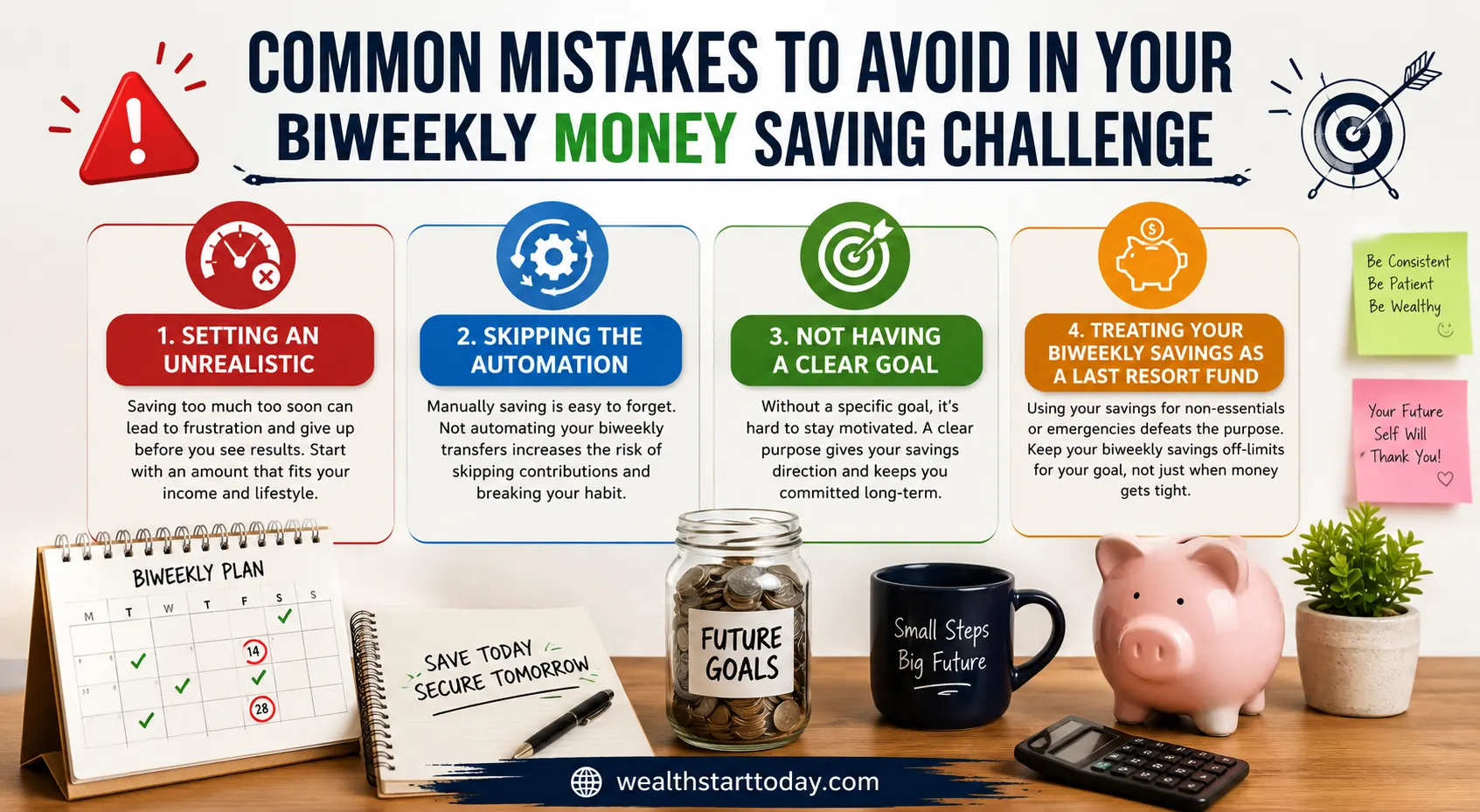
Setting an Unrealistic Biweekly Money Saving Challenge Amount
One of the most common reasons people abandon their biweekly money saving challenge is starting too aggressively. You will deplete your resources and feel like a failure if your savings are insufficient to pay for necessities. Be cautious at first. Instead of committing to $200, failing after five periods, and giving up completely, it is much better to continuously save $25 every period for 26 periods.
Skipping the Automation of Your Biweekly Money Saving Challenge
Every pay cycle, manual saving necessitates discipline. Life becomes hectic. There are emergencies. In the absence of automation, there’s always an excuse to “do it next time.” Automating your biweekly money saving challenge removes this friction entirely.
Not Having a Clear Goal for Your Biweekly Money Saving Challenge
Without a goal, saving is impersonal and uninspired. Clearly state the purpose of your savings. Put it in writing. Post a photo of it on your wall. Whether it is a $5,000 emergency fund, a family vacation, or a down payment fund, a clear goal turns your biweekly money saving challenge into a mission.
Treating Your Biweekly Savings as a Last Resort Fund
You shouldn’t use your savings account for small annoyances or impulsive purchases. You can legitimately use your emergency fund if your automobile requires new tires, but only if you have set aside money for emergencies. If your savings are earmarked for a vacation, protect that money. Use your biweekly money saving challenge structure to maintain financial boundaries.
Biweekly Money Saving Challenge for Different Income Levels
Low-Income Biweekly Money Saving Challenge Strategy
If your budget is tight, the biweekly money saving challenge is still within reach. Start with just $10–$20 per period. That is less than the price of a takeout meal. Even $10 every two weeks adds up to $260 over 26 periods, which might not seem like much, but it is a foundation for someone who has never saved money. The habit is then developed first, followed by the quantity.
Look for inventive ways to make extra money, such as selling things you no longer need, taking on occasional freelance work, or spending the money you save by using the library rather than purchasing books.
Middle-Income Biweekly Money Saving Challenge Strategy
For those in a comfortable income range, the biweekly money saving challenge at $100–$200 per period is achievable with a bit of planning. Every period, set aside at least $300 to $500 and put the extra money into retirement accounts, index funds, or exchange-traded funds (ETFs). Your biweekly challenge monies can be allocated to long-term wealth, such as down payments on real estate, taxable investment accounts, or a children’s college savings fund, since your emergency fund may already be set up.
High-Income Biweekly Money Saving Challenge Strategy
If you earn a strong income, the biweekly money saving challenge can be part of a larger wealth-building strategy. Every period, set aside at least $300 to $500 and put the extra money into retirement accounts, index funds, or exchange-traded funds (ETFs). Your biweekly challenge monies can be allocated to long-term wealth, such as down payments on real estate, taxable investment accounts, or a children’s college savings fund, since your emergency fund may already be set up.
How Wealth Start Today Can Help You Win the Biweekly Money Saving Challenge
At Wealth Start Today, we believe that financial transformation does not require a finance degree or a six-figure salary. It requires the right knowledge, the right tools, and the right mindset — applied consistently over time. Our Wealth Start Today’s Saving Money category is packed with guides, trackers, and strategies specifically designed to help you succeed in challenges like this one.
From our comprehensive guide How to Save Money Fast — perfect for those who need to build savings quickly — to Money Saving Tips for Families that help households save as a team, to practical physical tools like the Cash Saving Money Box, Money Saver Mini Storage, and Money Saving Binder, every resource we create is built around one core belief: everyone deserves a financial fresh start.
The biweekly money saving challenge is one of our most recommended strategies because it meets people where they are — in the natural rhythm of their pay cycle — and builds a savings habit that lasts long beyond the initial challenge period.
Biweekly Money Saving Challenge FAQs
What is a biweekly money saving challenge?
A biweekly money saving challenge is a structured savings plan where you commit to setting aside a fixed amount of money every two weeks — aligned with your pay schedule — to reach a specific savings goal by the end of the year. Even modest sums add up to substantial savings over 26 biweekly periods.
How much should I save in a biweekly money saving challenge?
The amount depends on your income and expenses. A common starting point is 10% of your biweekly take-home pay. If you earn $2,000 biweekly, aim to save $200 per period. If that is too much, start with $25–$50 and increase gradually.
How much money can I save with a biweekly money saving challenge in one year?
The annual totals over 26 periods are as follows, depending on your selected amount: $25/period = $650; $50/period = $1,300; $100/period = $2,600; $200/period = $5,200; and $300/period = $7,800.
Is a biweekly money saving challenge better than a monthly savings plan?
For people paid biweekly, yes. A biweekly money saving challenge aligns with your natural pay cycle, features 26 periods rather than 24 (two more donations annually), and because each payment is less than a monthly counterpart, saving feels more doable.
How do I stay motivated during a biweekly money saving challenge?
Set milestone celebrations, automate your transfers, utilize a printable tracker, share your goal with a friend or partner, and remind yourself every day of your savings objectives. Strong external responsibility is also provided by interacting with a savings community, such as individuals who follow Wealth Start Today on social media.
Can I do a biweekly money saving challenge if I am in debt?
Yes, but give high-interest debt top priority. If you have high-interest credit card debt (18%+ APR), you might want to divide your additional money into savings and debt repayment. While paying off debt, setting up even a small emergency fund ($500–$1,000) keeps you from accruing further debt in the event of unforeseen needs.
Do I need a special account for a biweekly money saving challenge?
Not special, but dedicated — yes. Open a separate savings account, ideally a high-yield savings account, exclusively for your biweekly money saving challenge deposits. One of the most frequent causes of savings plans failing is combining savings with expenditures.
What happens if I miss a biweekly money saving challenge period?
Don’t give up. It’s not a sign of failure to miss one period. Just save twice as much the next time around to make up for it, or take the loss and go on. It is more important to be consistent over time than to be flawless at any one time.
Can a biweekly money saving challenge help me build an emergency fund?
Of course. Depending on your rate of saving, you can build an emergency fund of $1,000 to $3,000, which is usually advised as a startup fund, in 10 to 30 biweekly intervals. This is one of the most powerful first uses of the biweekly money saving challenge.
What is the best biweekly money saving challenge for beginners?
The flat-rate challenge, which costs $25 to $50 per period, is the best option for beginners. For the following challenge year, either raise your quantity or switch to the incremental version after you have finished a full year and developed the habit.
Conclusion
The biweekly money saving challenge is more than a savings strategy —It’s a pledge to your future self. Regardless of your income level, you can grow wealth consistently and sustainably by automating the process, tracking your progress with purpose, and matching your savings strategy with your natural pay cycle.
This challenge provides you with a clear, practical framework, regardless of whether you are just starting out in your financial path or seeking to improve the structure of your current savings practices. Start with whatever quantity seems doable. Automate it. Keep track of it. Enjoy it. And above all, never give up.
At Wealth Start Today, we are here every step of the way. Explore our full library of saving resources at https://wealthstarttoday.com/saving-money/, follow our community on Facebook and X.com, and take the first step in your biweekly money saving challenge today
Because yesterday was the ideal time to begin saving. Right now is the second-best time.














Leave a comment