



Are you prepared to take charge of your money but unsure of where to start? You’re not by yourself. Every month, millions of people struggle to save money—not because they don’t make enough money, but rather because they haven’t figured out a method that works for them. That’s where the money saving challenge for beginners comes in — a simple, structured, and motivating way to build a savings habit from scratch, even if you’ve never saved a dime in your life.
Whether your goal is to build an emergency fund, pay off debt, go on vacation, or simply feel more financially secure, a money saving challenge for beginners gives you a clear roadmap to follow. No complicated spreadsheets. No financial degree required. Just a practical, proven method to start saving today and keep going — one week, one month, or one paycheck at a time.
At Wealth Start Today, our mission is to help everyday people like you begin their financial journey with confidence. From our popular guides like How to Save Money Fast, Money Saving Tips for Families, and our deep dives into tools like the Cash Saving Money Box, Money Saver Mini Storage, and the Money Saving Binder, we’ve helped thousands of readers transform the way they think about money. This guide is your next step — and we’re excited to walk it with you.
Let’s dive in.
What Is a Money Saving Challenge for Beginners?
A money saving challenge for beginners is a structured savings plan that guides you to set aside small, manageable amounts of money over a set period — usually 30 days, 52 weeks, or a specific pay-cycle schedule. Unlike generic advice to “spend less and save more,” a saving challenge gives you a concrete target for each day, week, or month, making the process tangible and trackable.
These challenges are specifically designed for beginners because they:
- Start with very small amounts (as low as $1 per day)
- Gradually increase contributions as you grow more confident
- Keep you motivated with visual progress trackers
- Build a sustainable saving habit over time
The beauty of a money saving challenge for beginners is that it removes decision fatigue. You don’t have to figure out how much to save each week — the plan tells you. You simply follow the steps, watch your savings grow, and build real financial momentum.
Why Every Beginner Should Start a Money Saving Challenge

The Psychological Power of a Money Saving Challenge for Beginners
Saving money is just as much about attitude as it is about numbers. Attempting to completely change one’s financial situation overnight is one of the main causes of people’s failure to save. Within two weeks, they burn out after cutting every expense and setting ambitious savings targets.
A money saving challenge for beginners works differently. It uses the psychology of small wins to keep you engaged. When you save just $5 in week one and put it in your Cash Saving Money Box or savings account, you feel accomplished. That small victory builds confidence, and confidence builds consistency. Over 52 weeks, those small wins compound into something extraordinary.
People are more likely to maintain their saving habits when they start small and monitor their progress graphically, according to behavioral economics research. The money saving challenge for beginners is engineered around exactly this principle.
Building a Financial Foundation That Lasts
Beyond the immediate savings, a money saving challenge for beginners teaches you discipline, delayed gratification, and awareness of your spending patterns. Regardless of how your money increases or decreases, these fundamental life skills will benefit you for many years.
By the time you complete even your first 30-day money saving challenge for beginners, by then, your relationship with money will have evolved from one of impulse to one of intentionality.
The Most Popular Money Saving Challenges for Beginners
The 52-Week Money Saving Challenge for Beginners
This is the most well-known money saving challenge for beginners, and for good reason — it’s simple, scalable, and results in over $1,378 saved by the end of the year.
Here’s how it works:
- Week 1: Save $1
- Week 2: Save $2
- Week 3: Save $3
- …and so on until…
- Week 52: Save $52
You set aside money equal to the week number each week. You will have a sizeable emergency fund or a lump sum ready for a significant financial objective by the time December arrives.
Pro Tip: Try the reverse 52-week challenge, which starts with $52 in week one and works your way down, if the end-of-year numbers seem excessive. Because expenditures are typically tighter over the holidays, these weeks are the easiest to save.
The $5 Money Saving Challenge for Beginners
This ultra-simple money saving challenge for beginners asks you to save every $5 bill you receive as change. Every time you get a $5 bill, instead of spending it, you set it aside in your Money Saver Mini Storage jar or savings envelope.
This challenge is very effective since it just reroutes one particular denomination of money rather than requiring you to drastically alter your purchasing habits. Most people use this strategy alone to save between $500 and $2,000 over the course of a year.
The 30-Day Money Saving Challenge for Beginners
Perfect for those who want quick results, the 30-day money saving challenge for beginners involves saving a small, fixed amount every day for one month. A common version looks like this:
- Days 1–10: Save $1 per day ($10 total)
- Days 11–20: Save $2 per day ($20 total)
- Days 21–30: Save $3 per day ($30 total)
You’ve saved $60 by the end of the month, which isn’t a huge sum but a real accomplishment that shows you that you can continuously save money.
The Biweekly Money Saving Challenge for Beginners
As we covered in detail in our comprehensive guide on the Biweekly Money Saving Challenge on Wealth Start Today, one of the best tactics for beginners is to save according to your paycheck cycle. When you get paid, you set aside a lump sum every two weeks in place of daily or weekly goals.
A simple biweekly money saving challenge for beginners might look like:
| Pay Period | Amount to Save |
|---|---|
| 1 | $25 |
| 2 | $30 |
| 3 | $35 |
| 4 | $40 |
| 5 | $45 |
| 6 | $50 |
You are saving $50 every paycheck by the sixth pay period (only 12 weeks in), and you have saved a total of $225. Syncing your money-saving challenge for beginners with your income has the advantage of eliminating the temptation to spend money before conserving it.
How to Set Up Your Money Saving Challenge for Beginners: Step-by-Step
Step 1: Define Your “Why” and Set a Savings Goal
Before you pick a specific money saving challenge for beginners, get crystal clear on WHY you’re saving. Is it for:
- A 3-to-6-month emergency fund?
- A vacation or big purchase?
- Getting out of debt?
- Starting an investment account?
Your “why” will keep you motivated when temptation strikes. Write it down and place it somewhere visible — your bathroom mirror, your phone wallpaper, or the front of your Money Saving Binder.
As we’ve explored in our Money Saving Tips for Families guide, having a clearly defined goal is the single biggest predictor of savings success. The same holds true for individuals taking on a money saving challenge for beginners.
Step 2: Choose the Right Money Saving Challenge for Beginners
The finest challenge is the one you’ll truly finish because not all tasks are made equal. Think about:
- Your income frequency: Weekly salary? Give the 52-week challenge a try. Every two weeks? Try the beginner’s biweekly money-saving challenge.
- Your starting budget: Extremely tight? Start with the $5-bill or $1-per-day challenge.
- Your personality: Do you prefer quick wins? Start with the 30-day challenge and work your way up to lengthier ones.
Don’t be scared to personalize. Cut all amounts in half if the typical 52-week challenge is too demanding. A beginner’s money-saving challenge should push you just a little, not break you.
Step 3: Open a Dedicated Savings Account or Container
Keeping savings and spending money in the same account is one of the most common blunders made by novices. When it comes to saving money, out of sight really is out of mind.
For your money-saving challenge for beginners, open a separate savings account, preferably one with a high yield. Alternatively, use a physical savings container like the popular Cash Saving Money Box we reviewed on Wealth Start Today. Physical cash saving has a strong psychological impact since it is incredibly motivating to watch the money grow in real time.
Step 4: Create a Tracking System Using a Money Saving Binder
A Money Saving Binder is one of the most powerful tools in a beginner’s financial toolkit. As covered in our dedicated guide on the Money Saving Binder, this simple organizational system lets you:
- Keep track of your monthly or weekly savings contributions.
- Track your progress toward your objectives.
- Keep track of spending categories and pinpoint areas that need to be reduced.
- Use sticker charts or checkboxes to commemorate accomplishments.
A calendar or chart where you may check off each week’s donation should be part of your money-saving challenge for beginners tracker. It is immensely fulfilling to watch those marks increase, and it acts as a daily reminder of your development.
Step 5: Automate Wherever Possible
Those who automate their savings are the most successful participants in any beginner’s money-saving challenge. On the day you are paid, set up an automated transfer from your checking account to your savings account. In this manner, the money is stored before you can spend it, so you never even see it.
Set a phone reminder to take your challenge contribution out of your wallet and put it in your savings container right away every week or pay period if you’re physically saving money.
Step 6: Review, Adjust, and Stay Consistent
Life takes place. Your savings plan will occasionally be derailed by an unforeseen expense. That’s alright. For novices, the objective of a money-saving challenge is consistency over time rather than perfection.
Just pick up where you left off if you are off for a week. Over the next few weeks, think about gradually adding the amount that was missed, or just skip it and go on. It’s important that you don’t give up on the challenge completely.
Money Saving Challenge for Beginners: Tips to Maximize Your Results
Find Hidden Savings in Your Current Budget
Look for savings in your current budget before making significant lifestyle adjustments or raising your salary. Beginners frequently discover rapid wins in the following areas:
- Subscription services: Anything you haven’t used in the previous 30 days should be cancelled.
- Dining out: You can save $50 to $100 a month even if you just eat at restaurants once or twice a week.
- Grocery shopping: Using store brands and meal planning can reduce food expenses by 20–30%.
- Energy bills: You can save $20 to $50 a month by making small adjustments like changing your thermostat and unplugging electronics.
As detailed in our How to Save Money Fast guide on Wealth Start Today, for novices, these tiny, focused cuts can produce unexpected sums of extra money to support your money-saving endeavor.
Use the Envelope or Cash Stuffing Method
If you struggle with digital overspending, consider using physical cash envelopes for different budget categories. This tried-and-true method, often paired with a Money Saving Binder, makes overspending physically impossible — once an envelope is empty, the spending stops.
Pair the envelope method with your money saving challenge for beginners by dedicating one special envelope (or your Cash Saving Money Box) exclusively to challenge contributions.
Gamify Your Money Saving Challenge for Beginners
Make saving a game. Make a visual thermometer chart that illustrates how far you’ve come toward your savings objective, then color it in every week. When you reach milestones, treat yourself to a free or inexpensive treat, such as a fun activity that doesn’t break the bank, a memorable dinner, or a movie night at home.
Gamification is one of the reasons the money saving challenge for beginners format has taken off on social media. A sense of community and accountability are added to the journey by the fact that many people publish their progress online.
How Wealth Start Today Can Help Your Financial Journey
At Wealth Start Today, we believe that building wealth isn’t reserved for the privileged few — it’s accessible to anyone who has the right knowledge, the right tools, and the right mindset. Wealth Start Today’s Saving Money category is packed with practical, beginner-friendly resources to help you every step of the way.
Whether you’re just discovering your first money saving challenge for beginners, or you’ve already completed the biweekly money saving challenge and are ready to level up, Wealth Start Today has a guide for you. We don’t use jargon or arrogance; instead, we provide honest, practical guidance that works because our content is created by actual individuals who understand real financial issues.
We also encourage you to become a part of our expanding community! You may follow us on X.com and Facebook, where we provide unique content, reader success stories, challenge updates, and daily money-saving advice. You never have to feel alone on your financial path when you’re a member of the Wealth Start Today community.
Common Mistakes to Avoid in Your Money Saving Challenge for Beginners
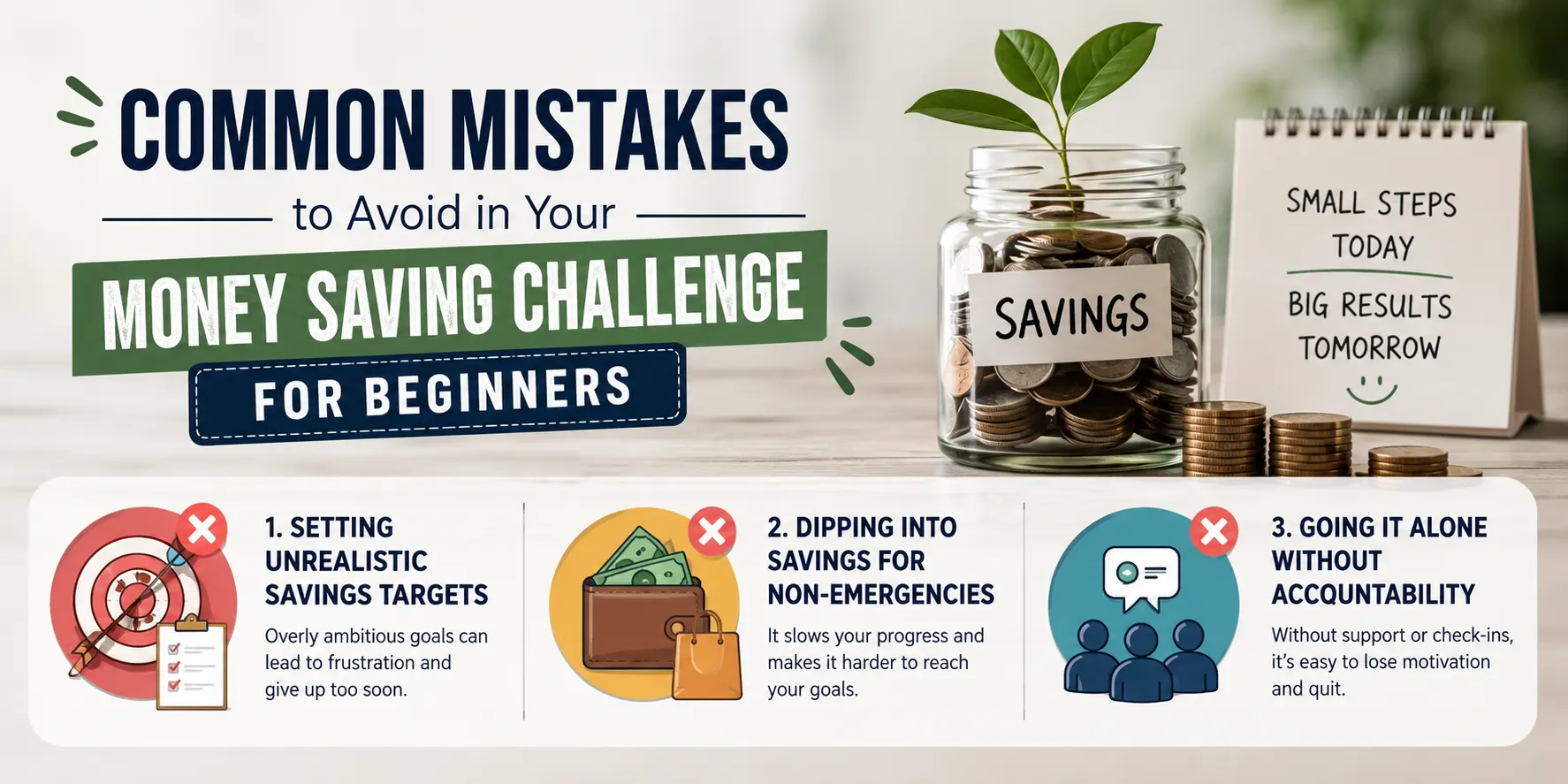
Setting Unrealistic Savings Targets
One of the most common reasons beginners abandon a money saving challenge for beginners is setting targets that are simply too high for their current income. You’re setting yourself up for failure and frustration if your take-home salary is $2,000 per month and you’re aiming to save $800 per month right away.
Be cautious at first. For someone who has never saved before, even saving $20 a week ($1,040 annually) is a real accomplishment. As your income rises or your expenses fall, you can always raise your contributions.
Dipping Into Savings for Non-Emergencies
You should consider your savings challenge fund to be off-limits. It can only be touched in an actual emergency, such as a medical emergency, a job loss, or a necessary auto repair. It doesn’t apply if you want a night out or a new pair of shoes.
A separate savings account is no longer negotiable at this point. You are less inclined to plunder your savings on impulse if there is more friction between you and them.
Going It Alone Without Accountability
People who discuss their goals with others have a much higher chance of achieving them, according to numerous studies. Tell a trusted friend or family member about your money saving challenge for beginners. Better yet, ask them to work with you. Partners in financial accountability keep you truthful and enhance the experience.
Money Saving Challenge for Beginners: Real Results to Inspire You
Here are realistic savings outcomes from popular money saving challenges for beginners:
| Challenge | Duration | Total Saved |
|---|---|---|
| 52-Week Challenge (standard) | 1 year | $1,378 |
| 52-Week Challenge (reversed) | 1 year | $1,378 |
| $5 Bill Challenge | 1 year | $500–$2,000 |
| 30-Day Challenge | 1 month | $60–$200 |
| Biweekly Challenge (26 pay periods) | 1 year | $300–$1,000+ |
| $1/Day Challenge | 1 year | $365 |
Even though each of these sums might seem small, keep in mind that the majority of Americans have savings of less than $1,000. Completing even one full money saving challenge for beginners puts you ahead of the majority of people financially.
Advanced Strategies: Level Up After Your First Money Saving Challenge for Beginners
Stack Multiple Challenges
Once you’ve successfully completed your first money saving challenge for beginners, consider stacking two challenges simultaneously. Run the $5 bill challenge in addition to the 52-week challenge, for instance. Without significantly altering your way of living, your total savings can surpass $3,000 in a single year.
Redirect Windfalls Into Your Savings
Opportunities to boost your savings include tax returns, bonuses, birthday money, and freelancing income. Make a strong commitment: before you may spend any windfall, a predetermined portion (between 30 and 50%) goes straight into your savings account.
Graduate to Investing
Once your money saving challenge for beginners has helped you build a 3-to-6 month emergency fund, it’s time to put your extra savings to work through investing. Compound interest allows even modest investments in inexpensive index funds to increase significantly over time.
Frequently Asked Questions (FAQs) About Money Saving Challenge for Beginners
Q1: What is the best money saving challenge for beginners?
The best money saving challenge for beginners depends on your budget and personality. If you desire a full-year commitment with a defined end, the 52-week challenge is perfect. For novices who wish to gain confidence fast, the 30-day challenge is ideal. For people who would rather save money passively, the $5 bill approach works effectively. Start with the most manageable option and work your way up from there.
Q2: How much money can I save from a beginner savings challenge?
You can save anywhere from $60 (for a 30-day challenge) to more than $1,378 (for a 52-week regular challenge) in a year, depending on the challenge you select. You can increase your savings by stacking challenges or rerouting windfalls.
Q3: Can I do a money saving challenge for beginners on a very tight budget?
Of course. The $5 bill approach and the $1-a-day challenge are made especially for those with very little extra money. For someone beginning from scratch, saving even $1 a day builds up to $365 over the course of a year, which is a significant financial cushion.
Q4: What tools do I need for a money saving challenge for beginners?
All you need is a tracking method, a specific savings container or account, and a savings goal. One excellent low-cost tool for monitoring progress is a Money Saving Binder. For cash-based difficulties, a Cash Saving Money Box is ideal. Wealth Start Today has gone into great detail about both of them.
Q5: How do I stay motivated during a money saving challenge for beginners?
Keep a visual record of your progress using a chart, jar, or notebook; acknowledge minor accomplishments; discuss your objective with a buddy or online group; and consistently remind yourself of your “why.” Keeping up with pages like X.com and Wealth Start Today on Facebook offers constant accountability and inspiration from a helpful group.
Q6: Should I use a bank account or cash for my money saving challenge for beginners?
Both are effective! Because it keeps your money apart from spending and generates interest over time, a high-yield savings account is perfect. However, because they can see and feel their savings increase, many novices find real cash jars and boxes to be very motivational. Choose the approach that you find most fulfilling and authentic for the habit.
Q7: What’s the difference between a biweekly money saving challenge and a weekly one?
By matching your savings contributions to your payment schedule every two weeks, a biweekly money-saving challenge facilitates budgeting and automation. Smaller, more frequent payments are needed for a weekly challenge. If you’re paid biweekly, the biweekly money saving challenge for beginners is generally easier to sustain — check out our detailed guide on this topic at Wealth Start Today.
Q8: When is the best time to start a money saving challenge for beginners?
At this moment. A perfect moment does not exist. Many people put off starting a savings habit until a new year, month, or significant life event, but today is always the perfect moment to do it. It is far preferable to begin mid-year, mid-month, or mid-week than to wait.
Conclusion
A money saving challenge for beginners is more than a financial tool — it’s a life-changing habit that teaches you the discipline, awareness, and confidence to build lasting wealth. The most crucial thing is that you start today, regardless of whether you choose the $5 bill technique, the 52-week challenge, the biweekly money-saving challenge, or a straightforward 30-day beginner plan.
Recall that every savings journey begins with a single step. High income, a degree in finance, or a complex system are not prerequisites. You have what you need right now: a strategy, a goal, and the will to see it through.
At Wealth Start Today, we’re here to walk every step of this journey with you. Explore our full library of saving guides — from How to Save Money Fast and Money Saving Tips for Families to Cash Saving Money Box and Money Saver Mini Storage reviews — all designed to make your financial life simpler, smarter, and more abundant.
Visit us at Wealth Start Today’s Saving Money category to explore every resource, and don’t forget to follow us on Facebook and X.com for daily tips, challenge updates, and community support.
Your wealth journey starts today. Let’s build it together.














Leave a comment