



If you’ve ever searched for “how do I make money while I sleep” on Google, you’ve most likely come across the same concept that thousands of others do every day: launching a passive income blog. On the surface, it seems easy: write a few pieces, relax, and watch the money come in. Although the reality in 2026 is more complex, it is also more attainable than most people think, particularly if you follow a tried-and-true method rather than trying to figure it out on your own.
We include this topic inside our Make Money Online category since blogging remains one of the few online business ideas that actually rewards patients with long-term, semi-automated income. This tutorial talks you through exactly what a passive income blog is, how it works in 2026, what it can actually generate, and how to establish one step by step, using current facts instead of old advice from 2019.
You can read this full guide on our site at Wealth Start Today, and once you are done, we will point you toward two related guides that pair perfectly with what you are about to learn.
What Is a Passive Income Blog?
A passive income blog is a website designed around content that keeps generating visitors, engagement, and revenue long after you hit publish. Unlike a job where you trade hours for dollars, a well-built passive income blog generates from adverts, affiliate links, digital products, and email subscribers on autopilot – even while you are asleep, on vacation, or working on your next project.
The definition of “passive” is not “effortless.” Real upfront labor is needed for any blog that generates passive income: writing, research, SEO optimization, and promotion. The ratio of effort to reward shifts throughout time. What distinguishes a passive income blog from freelance writing or a standard 9–5 revenue source is that a blog post you publish today can still be making you money in two, three, or five years.
Why Start a Passive Income Blog in 2026
The statistics about blogging in 2026 provide an honest and uplifting narrative. Today, there are more than 600 million blogs on the internet, and every day, about 7.5 million new blog entries are published. That seems like fierce competition, and in some ways it is, but it also shows that, despite the proliferation of AI tools on the internet, there is still a need for written content, lessons, and professional perspectives.
This is the most important information for anyone considering starting a blog for passive income: just a small percentage of bloggers make more than $1,000 per month, and less than 15% of bloggers ever make money from their site. That’s not meant to deter you; rather, it’s supposed to demonstrate why strategy, not chance, determines the winner. While amateur bloggers quietly disappear, bloggers that publish regularly, concentrate on truly helpful content, and manage their website like a legitimate business are the ones outperforming the competition.
The Numbers Behind a Profitable Passive Income Blog
The average monthly income of seasoned bloggers with a loyal following is in the thousands of dollars, and bloggers with more than a thousand articles typically make far more than those with a smaller following. Affiliate marketing continues to be the largest source of revenue for bloggers, accounting for over 40% of total revenue on average. Display advertising, sponsored content, and digital goods are next in line. This is precisely why a blog with a clear monetization strategy typically performs worse than a passive income blog centered around a niche with compelling affiliate offers.
Why 2026 Is Still a Good Time to Start
AI has “killed” blogging, according to some. The information indicates otherwise. Content marketers who prioritize blogging are far more likely to get a favorable return on investment, and businesses with active blogs still receive far more website views than those without. In 2026, the bloggers who produce superficial, AI-generated filler with no original insight are the ones who are struggling. Long-form, well-researched, genuinely helpful content is what makes bloggers successful; this is precisely the kind of content that a clever passive income blog plan is based on.
How to Start a Passive Income Blog Step by Step
Although creating a blog for passive revenue is not difficult, it must be done in the proper sequence. The most common cause of new bloggers quitting within the first six months is skipping steps.
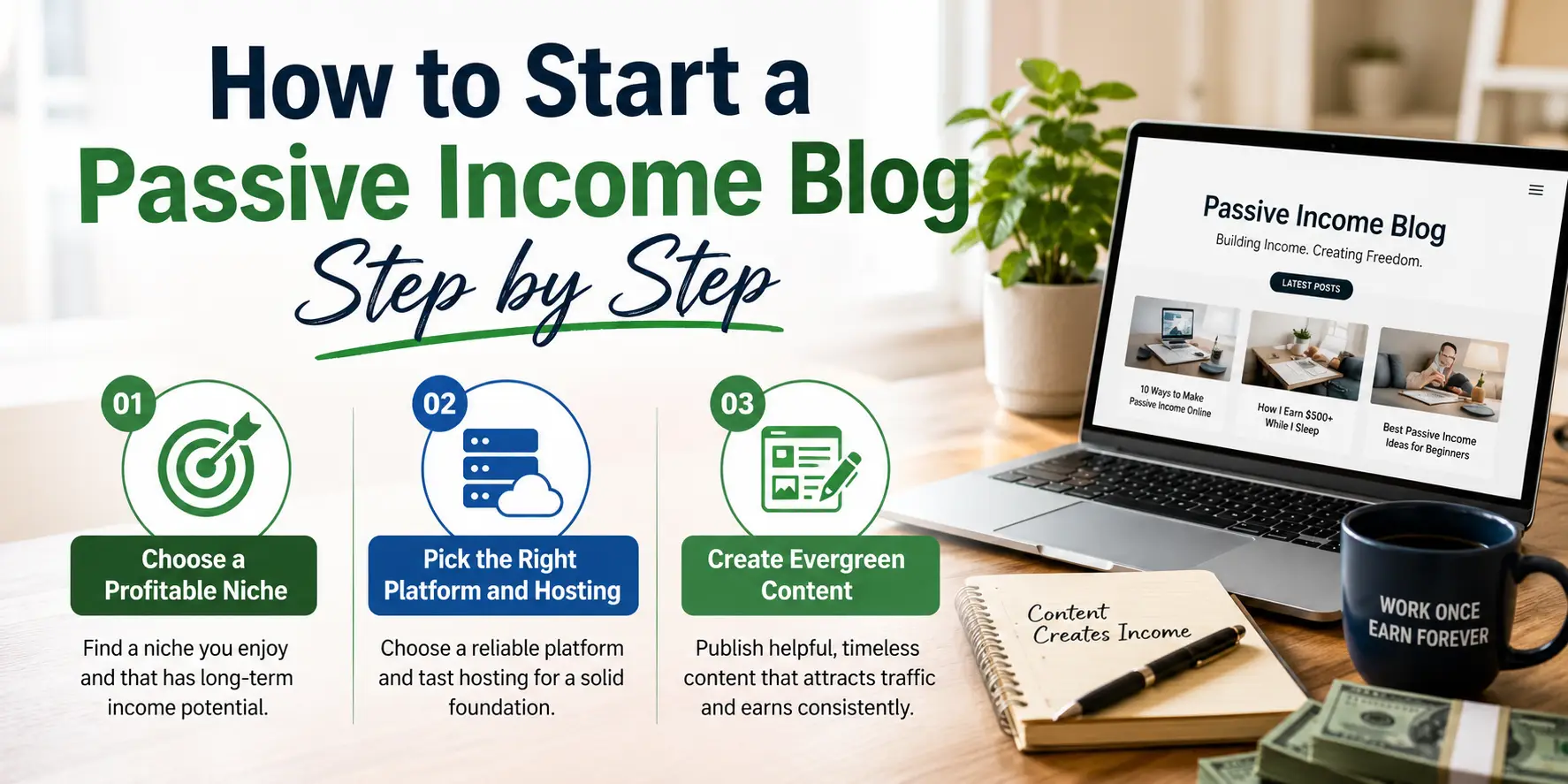
Step 1: Choose a Profitable Niche
Your audience, your alternatives for income, and your realistic growth rate are all determined by your niche. In 2026, personal finance, health and wellness, cuisine and recipes, technology reviews, and earning money online are the most lucrative categories for a passive income blog. Due in large part to significant ad revenue and recipe-related affiliate potential, food bloggers, for instance, have some of the highest median monthly revenues of any specialty.
Select a niche where you can create more than 50 articles without running out of ideas and where there are actual goods or services that you may suggest. Without a lucrative niche, a blog that generates passive revenue is only an extra-step hobby.
Step 2: Pick the Right Platform and Hosting
Because of its versatility, SEO plugins, and monetization options, WordPress continues to power a significant portion of blogs globally and is still the best option for anyone serious about creating a long-term passive income blog. Combine it with dependable hosting, a theme that loads quickly, and basic on-page SEO right away. If you want to make money, stay away from free blogging sites; you must have complete control over both your domain and your content.
Step 3: Create Evergreen Content That Keeps
The foundation of every blog for passive income is evergreen content, or information that remains relevant for years. Consider resource sites, tutorials, comparative blogs, and “how-to” tips instead of urgent news stories. These days, the typical high-performing blog post is well over 1,500 words long, and long-form, unique, research-backed posts routinely outperform short, thin material in terms of both income and ranks. Every item on WealthStartToday, including this one, adheres to the same methodology.
Best Passive Income Blog Monetization Methods in 2026
It’s time to convert your passive income blog’s visitors and content into income. Instead of depending solely on one of the following strategies, the majority of successful blogs use a combination of them.
Affiliate Marketing
For the majority of bloggers, affiliate marketing continues to be their primary source of income, frequently making up more than 40% of total revenue. You provide a monitored link, suggest a good or service, and get paid when someone makes a purchase with it. Affiliate revenue is particularly suitable for a passive income blog in the financial or product review industries.
Display Advertising
Ad networks insert native and banner advertisements into your content, and you get paid depending on clicks and impressions. Once they reach the necessary traffic thresholds, many bloggers making $2,000 or more a month depend on premium ad networks, which makes display ads a reliable supplementary revenue source for a well-established passive income blog.
Digital Products and Online Courses
You can market your own expertise directly without sharing profits with third parties by using ebooks, templates, printables, and mini-courses. Because there is no inventory, no shipping, and no third-party fee cut, this is one of the highest-margin methods to monetize a blog for passive revenue.
Sponsored Content and Brand Partnerships
Brands may pay you directly to highlight their goods or services after your passive income blog has a consistent readership. This revenue stream typically appears later, if you have established sufficient traffic and credibility to merit a brand’s interest.
Passive Income Blog Monetization Comparison Table
| Monetization Method | Effort to Set Up | Income Potential | Best For |
|---|---|---|---|
|
Affiliate Marketing |
Medium | High | Finance, product review, “best of” niches |
|
Display Advertising |
Low | Medium–High | High-traffic blogs of any niche |
|
Digital Products |
High (upfront) | High |
Bloggers with expertise or a personal brand |
| Sponsored Content | Low | Medium |
Established blogs with loyal audiences |
| Email Marketing / Courses | Medium | High (long-term) |
Blogs with an engaged subscriber list |
How Much Can a Passive Income Blog Really Earn?
This is the question that everyone genuinely wants addressed. Based on combined industry data, this is an honest breakdown for 2026:
|
Blogger Stage |
Typical Monthly Income | Notes |
|
New blog (0–6 months) |
$0–$100 | Building content and traffic foundation |
|
Growing blog (6–18 months) |
$100–$1,000 |
First affiliate sales and ad revenue |
| Established blog (1,000+ posts or 2+ years) | $1,000–$8,000+ |
Multiple income streams active |
| Top-tier niche blogs (finance, food) | $9,000+ |
Strong SEO, brand deals, premium ad networks |
Only about 1% to 2% of bloggers ever make six figures a year, but once their site reaches the two-year milestone, a significant and expanding proportion of bloggers can make a good living either full-time or part-time. What distinguishes the two groups is consistency, not chance.
Common Mistakes That Kill a Passive Income Blog
A few common blunders account for the majority of passive income blog failures: abandoning up to six months, picking a field with no way to monetize it, ignoring SEO fundamentals, publishing thin AI-generated content without any personal perspective, and neglecting an email list. In 2026, readers and search engines will be much more adept at identifying generic, low-effort content, making it difficult for any passive income blog to rank or convert if it ignores real research and unique viewpoints.
Treating the website as a side project rather than a business is another common error. The unglamorous practices that subtly distinguish a successful blog from one that never takes off include tracking your numbers, trying headlines, upgrading previous entries, and creating an email list.
Passive Income Blog vs. Other Passive Income Streams
While there are other ways to make money online, such as dividend investing, rental properties, or print-on-demand stores, a passive income blog has benefits that make it worthwhile to take into account. In contrast to many popular “passive income” plans, blogging offers more creative control than most gig platforms, requires significantly less initial capital than real estate, and is supported by decades of successful success stories. Time is a trade-off because it typically takes six to eighteen months for a passive income blog to generate significant revenue, rewarding patience over quick fixes.
Tools That Help Automate Your Passive Income Blog
A few tools, such as an email marketing platform to automatically nurture subscribers, an SEO plugin to maintain consistent on-page optimization, a scheduling tool to queue social posts ahead of time, and analytics software to track what content is actually earning, can help your passive income blog run with less daily effort once it’s up and running. Over time, automating these repetitive chores will enable the system to become truly passive rather than a full-time work disguised as a side gig.
A Realistic 12-Month Passive Income Blog Timeline
In the first month, most individuals overestimate the potential of a passive income blog, and by the twelfth month, they underestimate it. This is a practical route that many bloggers take: setup, topic research, and posting your first 15 to 20 articles take up months one through three, during which time you will make little to nothing. The first trickle of organic search engine traffic, a few early affiliate clicks, and possibly your first tiny commission usually appear in months four through six. If you have maintained consistency, by months seven and nine, your email list has several hundred members, your older pieces begin to rank higher, and your monthly revenue frequently into the low hundreds of dollars. Things typically begin to compound in months ten through twelve; older material continues to rank, new content builds upon it, and revenue becomes visibly more consistent from month to month.
Although this timeframe won’t perfectly fit everyone, it does represent the overall trend found in the majority of published blogger income surveys, and it’s a helpful benchmark to set reasonable expectations before you start rather than giving up in the third month because the results haven’t yet materialized. The most important factor in determining whether a new website becomes a legitimate, operational online business or is abandoned before it has a chance to expand is patience during the first six months.
Building an Email List Alongside Your Passive Income Blog
The majority of successful blogs combine their content approach with an email list from the outset because search traffic alone is insufficient to create a robust online business. With an email list, you have a direct line of communication with your audience that is independent of platform regulations, social media reach, or changes in search engine algorithms. Instead of waiting weeks for search engines to rank each new post you publish, you can send it directly to your subscribers, resulting in an instant surge of return visitors.
Even before you get a lot of traffic, start gathering emails as soon as you can. Often, all it takes to turn some of your visitors into subscribers is a straightforward sign-up form with a helpful checklist or brief instruction about your niche. As time goes on, this list turns into one of your most important resources. It can be used to advertise digital goods, affiliate deals, and any upcoming releases straight to an audience who already has faith in you.
Related Reading on WealthStartToday
If you are serious about building income online, two of our earlier guides pair perfectly with this one. In How to Earn Money From Blogging, we break down the exact monetization strategies bloggers are using right now to turn traffic into consistent income, including affiliate offers, ad networks, and product launches specific to 2026 trends. It is a natural next step once your passive income blog has its first few articles published.
We also recommend our broader guide, How to Make Money Online, which covers additional income streams beyond blogging — freelancing, e-commerce, and digital services — so you can see exactly where a passive income blog fits into a bigger picture of online income. Both articles live in our Make Money Online category, alongside this guide.
Real Authority: What the Data Says About Building a Passive Income Blog

Longer, more in-depth blog posts generate more organic traffic and backlinks than short, hurried content, according to yearly studies conducted by independent research organizations like Orbit Media Studios, which have been monitoring blogging trends for more than 10 years. This is consistent with what we have observed in every successful passive income blog we have researched: depth and uniqueness outweigh speed and volume, particularly now that AI has made shallow content inexpensive and widely available. Orbit Media’s study is a reliable, reputable source worth reading if you want to go deeper into the unprocessed data underlying blogging trends.
FAQs
Is a passive income blog still worth starting in 2026?
True. Businesses with active blogs continue to outperform those without in terms of traffic and leads, and the need for truly helpful, well-researched content remains high despite rising competition.
How long does it take for a passive income blog to make money?
Depending on their niche, regularity, and SEO efforts, most bloggers begin to generate significant revenue between six and eighteen months. A blog that generates passive revenue is a long-term asset rather than a fast profit.
What is the best niche for a passive income blog?
Due in large part to their strong affiliate and ad monetization, personal finance, food, health, technology, and make-money-online categories typically do the best.
Do I need to know SEO to run a passive income blog?
You must have a basic understanding of SEO. Knowing keywords, headers, and internal linking will greatly accelerate your growth, but you don’t have to be an expert.
How much traffic does a passive income blog need to earn money?
A defined monetization strategy and several thousand monthly visitors are usually necessary for steady income, however some bloggers can begin making modest affiliate income with just a few hundred monthly visits.
Can I run a passive income blog part-time?
Yes, and this is how most successful bloggers begin. One of the few online business concepts that works well with a full-time job is a passive income blog since content can be scheduled and created ahead of time.
Conclusion
Anyone who claims that a passive income blog is a quick way to become wealthy is not being truthful. What it really is: if you approach it like a legitimate business from the start, it’s one of the most practical, well-researched, and affordable ways to generate long-term revenue online. Select a lucrative area, post material that is actually helpful, add several revenue streams, and give it the twelve to eighteen months it usually takes to take off.
In order to help you avoid the trial-and-error stage that most bloggers experience, Wealth Start Today created this tutorial as well as our associated articles on blogging and earning money online. As we continue to post updated ideas throughout 2026, bookmark this page, begin implementing the following procedures, and return frequently to our Make Money Online category.
You can also follow us on Facebook and X.com for more updates, tips, and real income breakdowns as we continue growing WealthStartToday together.













Leave a comment