


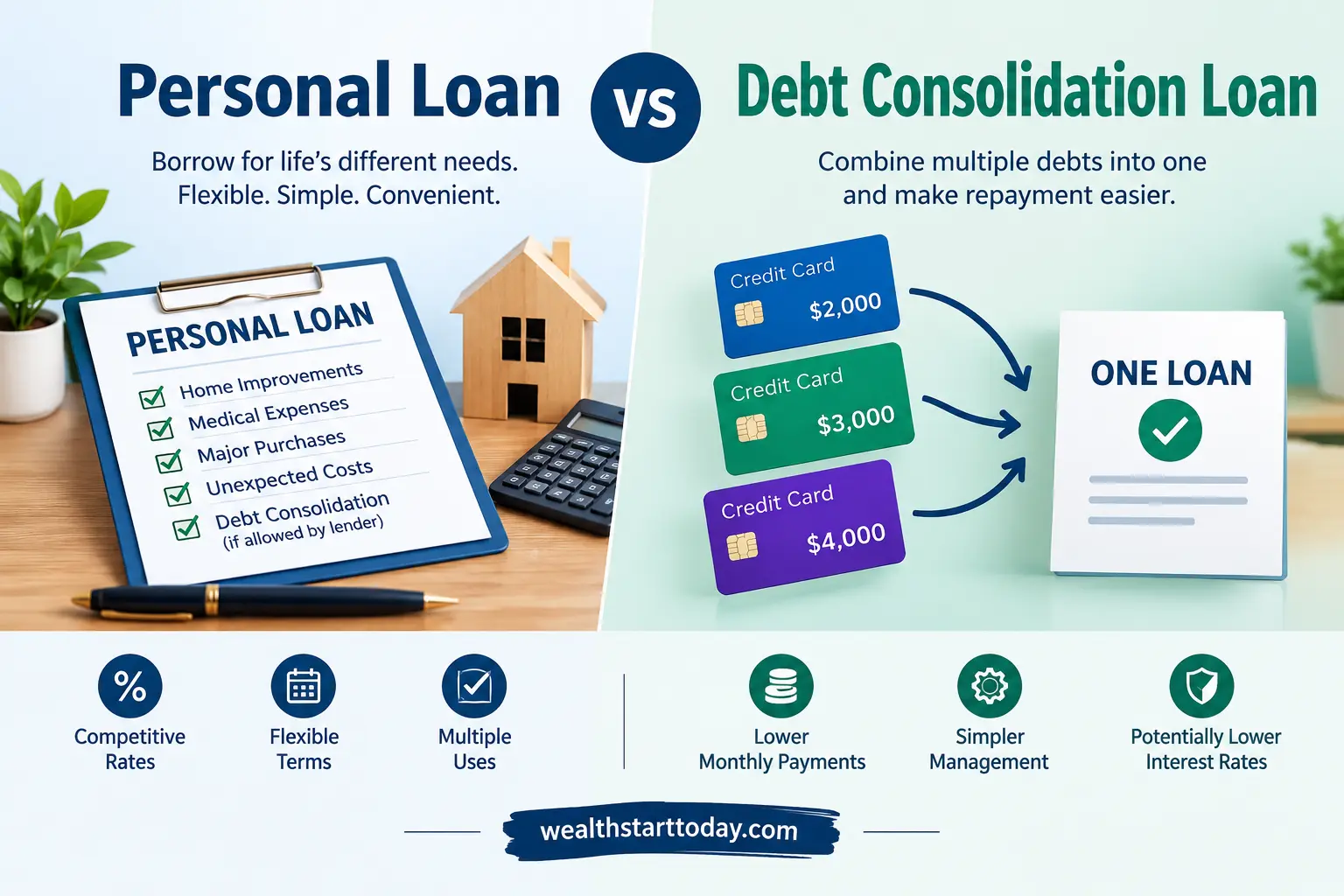
Managing multiple debts can become difficult when you have several monthly payments, different interest rates, and separate due dates. Two financing options that borrowers may consider are a personal loan vs debt consolidation loan.
Although these terms are sometimes used interchangeably, they do not always mean exactly the same thing. A personal loan is a type of installment loan that can often be used for different purposes, including debt consolidation. A debt consolidation loan, meanwhile, is generally designed or marketed specifically for combining multiple debts into one payment.
Understanding the difference between a personal loan vs debt consolidation loan can help you evaluate the interest rate, fees, repayment period, monthly payment, and overall cost before applying.
If you are already considering more than one personal loan, you may also want to read our guide on How Many Personal Loans Can You Have at Once? It explains how having multiple loans can affect your monthly obligations and debt-to-income ratio.
What Is a Personal Loan?
A personal loan is an installment loan that allows you to borrow a specific amount of money and repay it through scheduled payments over a set period.
Unlike some loans that are tied to a specific purchase, personal loans are often available for a variety of purposes. Depending on the lender and loan agreement, borrowers may use personal loan funds for expenses such as home improvements, major purchases, unexpected expenses, or debt consolidation.
Many personal installment loans are unsecured, meaning they generally do not require collateral such as a home or vehicle. However, loan terms vary by lender, so borrowers should check whether a particular personal loan is secured or unsecured before applying.
Personal loans generally have an interest rate, repayment term, and monthly payment established when the loan is issued. Some lenders may offer fixed-rate loans, which means the interest rate remains the same throughout the repayment period.
For example, imagine you have several credit card balances with different interest rates. You might qualify for a personal loan and use the proceeds to pay those balances. You would then make one monthly payment on the personal loan instead of making separate payments to several credit card companies.
This is one reason personal loans are sometimes used as a debt consolidation strategy.
What Is a Debt Consolidation Loan?
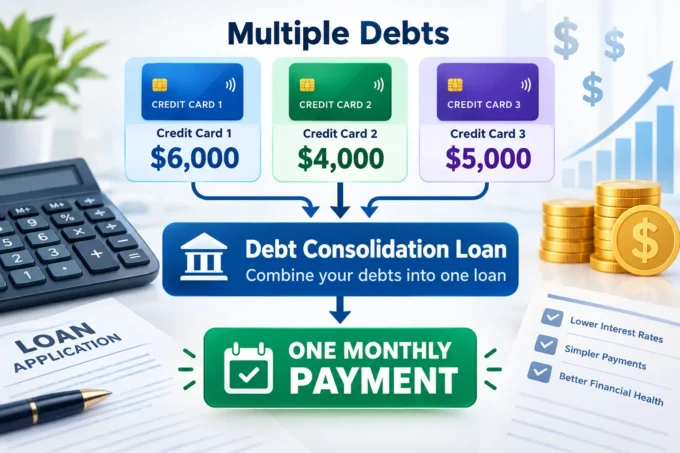
A debt consolidation loan is financing used to combine multiple debts into a single debt.
Instead of making separate payments on several credit cards, personal loans, or other eligible debts, you may use one consolidation loan to pay them off. Afterward, you typically make one scheduled payment on the new loan.
The goal is generally to simplify debt repayment. Depending on the loan’s terms and the debts being consolidated, borrowers may also be able to reduce the interest rate or establish a more predictable repayment schedule.
CFPB specifically explains that debt consolidation can combine multiple debts into one payment, while also warning that a lower monthly payment can result from a longer repayment period and may not mean lower total cost.
However, debt consolidation does not automatically reduce the amount of debt you owe. It changes how the debt is structured.
For example, suppose you have three credit card balances:
- Credit Card A: $2,000
- Credit Card B: $3,000
- Credit Card C: $4,000
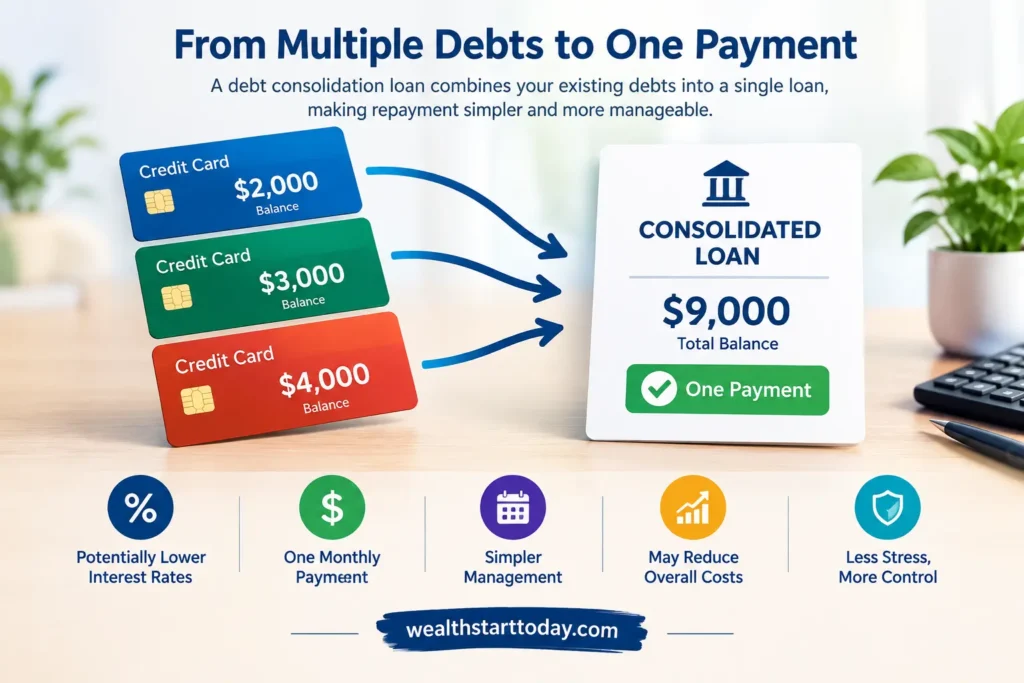
Your total debt is $9,000. A debt consolidation loan could potentially be used to pay those balances, leaving you with one $9,000 loan rather than three separate credit card balances.
The actual interest rate, fees, repayment period, and approval requirements depend on the lender and your financial circumstances.
A debt consolidation loan is used to combine multiple debts into one new loan, which can simplify repayment by leaving you with one monthly payment. Depending on the loan terms, a borrower may also receive a lower interest rate than on some of the debts being replaced. However, a lower monthly payment does not necessarily mean a lower total cost, especially if the new loan extends the repayment period.
Personal Loan vs Debt Consolidation Loan: What’s the Difference?
The main difference is usually purpose.
A personal loan is a broad type of financing that can potentially be used for several purposes. Debt consolidation is one possible use.
A debt consolidation loan is generally focused on combining existing debts into one payment.
This means a debt consolidation loan can sometimes be a personal loan in practice. The terminology used by lenders can vary, so borrowers should look beyond the product name and examine the actual loan agreement.
| Feature | Personal Loan | Debt Consolidation Loan |
| Main purpose | Can be used for various personal expenses | Primarily used to combine multiple debts into one loan |
| Typical use | Home improvements, major purchases, emergencies, or other eligible expenses | Paying off multiple credit card or other eligible debts |
| Interest rate | May be fixed or variable, depending on the lender and loan | May be fixed or variable, depending on the lender and loan |
| APR | Includes the interest rate plus certain fees | Includes the interest rate plus certain fees |
| Repayment | Usually involves fixed monthly payments for a set term | Usually involves fixed monthly payments for a set term |
| Credit impact | Applying may result in a hard credit inquiry | Applying may result in a hard credit inquiry |
| Main consideration | Compare the total borrowing cost and loan terms | Compare the consolidation loan cost with the debts being replaced |
The important point is that these categories can overlap. A personal loan can be used specifically for debt consolidation.
Personal Loan vs Debt Consolidation Loan: How Each Works
Understanding the process can make the comparison easier.
How a Personal Loan Works
With a personal loan, you typically apply for a specific amount. The lender may review factors such as your credit history, income, existing debts, and other information before making a lending decision.
If approved, you receive the loan according to the lender’s terms. You then repay the borrowed amount, plus interest and applicable fees, through scheduled payments.
If you use the loan for debt consolidation, you may use the proceeds to pay off eligible debts.
For example:
You have $8,000 in credit card debt and qualify for an $8,000 personal loan. If the loan allows debt consolidation, you could use the funds to pay the credit card balances and then make payments on the personal loan.
How a Debt Consolidation Loan Works
A debt consolidation loan follows a similar basic process, but its primary purpose is to combine debts.
You identify the debts you want to consolidate and determine whether the new loan can cover them. After approval, the loan proceeds may be sent to you or, depending on the lender, directly to creditors.
You then repay the consolidation loan according to its terms.
The main advantage is often simplicity: instead of tracking several debts, you may have one loan, one interest rate, and one regular payment.
However, consolidation only works as expected if the new loan’s terms are appropriate and you avoid building new balances on the debts you just paid off.
Is a Debt Consolidation Loan the Same as a Personal Loan?
Not necessarily, but there can be significant overlap.
A personal loan is a type of loan product. Debt consolidation describes a purpose or strategy for restructuring multiple debts.
For example, a lender may offer a personal loan that can be used for debt consolidation. In that situation, you are using a personal loan as a debt consolidation tool.
Another lender may market a product specifically as a debt consolidation loan.
Because terminology varies, it is important to check the lender’s terms rather than assuming that two products are different simply because they have different names.
Before applying, review the annual percentage rate (APR), fees, repayment term, monthly payment, prepayment rules, and any restrictions on how the funds can be used.
Personal Loan vs Debt Consolidation Loan: Interest Rates
Interest rate is one of the most important factors to compare.
A borrower may consider consolidation because existing credit card balances have relatively high interest costs. If a new loan has a lower APR than the debts being consolidated, it could potentially reduce the amount of interest paid over time.
However, a lower monthly payment does not necessarily mean a lower total cost.
For example, imagine someone has a high monthly payment on existing debt but replaces it with a consolidation loan offering a lower monthly payment over a longer repayment period. The monthly budget may become easier to manage, but the borrower could potentially pay more interest over the full term.
That is why you should compare the total repayment cost, not just the monthly payment.
APR can provide a broader measure of borrowing cost because it includes the interest rate plus certain fees charged with the loan. When comparing loan offers, borrowers should compare APRs along with the loan amount, repayment term, fees, and monthly payment.
Personal Loan vs Debt Consolidation Loan: Fees
Fees can affect the overall cost of borrowing.
Depending on the lender, you may encounter fees such as an origination fee or other charges. Some lenders may have no origination fee, while others may deduct a fee from the loan proceeds or add costs according to the loan agreement.
Suppose you are approved for a $10,000 loan but the lender charges an origination fee. The amount you actually receive could be less than $10,000 if the fee is deducted from the proceeds.
This matters when you are trying to pay off a specific amount of existing debt.
Before accepting an offer, look at the complete loan disclosure and determine how much money you will receive, how much you will repay, and what fees apply.
Which Loan May Fit Your Debt Consolidation Goals?
There is no single option that is appropriate for every borrower.
A personal loan may be considered when you want flexible financing and the lender permits the funds to be used for debt consolidation.
A debt consolidation loan may be considered when your primary objective is to combine several debts into one repayment arrangement.
The more important question is not simply which name sounds better. Instead, compare the actual terms.
Consider:
- APR
- Interest rate
- Loan amount
- Monthly payment
- Repayment period
- Origination fees
- Total repayment amount
- Prepayment terms
- Credit requirements
- Whether all of your existing debts can be consolidated
Two loans with similar names can have very different costs.
When a Personal Loan May Be Useful
A personal loan may make sense for borrowers who need financing for a specific purpose and qualify for terms that fit their budget.
For debt consolidation, it may be useful when:
- You have multiple high-interest debts.
- The new loan has a competitive APR compared with your existing debts.
- The monthly payment fits your budget.
- The repayment term is manageable.
- The total cost is reasonable after fees.
- You have a plan to avoid accumulating additional debt.
A personal loan does not eliminate debt. It replaces one form of debt with another.
That distinction is important.
When Debt Consolidation May Be Useful
Debt consolidation may be worth considering when managing several separate debts has become difficult.
Combining debts can potentially make repayment easier to organize because you may have one regular payment rather than several.
For example, someone with four credit card balances may find it easier to manage one consolidation loan payment.
However, consolidation is not a guarantee of lower costs or faster debt repayment. The outcome depends on the terms of the new loan and the borrower’s behavior after consolidation.
If you continue using credit cards after paying them off with a consolidation loan, you could end up with both the new loan and new credit card balances.
Does Debt Consolidation Hurt Your Credit Score?
Debt consolidation can affect your credit profile in several ways, and the effect can vary depending on your existing accounts and the credit-scoring model used. Applying for a new loan generally results in a hard credit inquiry, which can affect your credit score.
Opening a new loan account changes the information in your credit profile, and credit-scoring systems may consider factors such as recent applications, new accounts, existing debt, and payment history. The effect on an individual’s score can vary by scoring model and overall credit profile.
Paying down revolving credit card balances can also change the amount of debt you have compared with your available credit. Credit-scoring systems commonly consider how close a person is to their available credit limits, although scoring models can differ in the factors they use and how they weigh them.
Closing old credit card accounts can also have consequences depending on the circumstances.
Because credit scoring models are complex and individual credit profiles differ, there is no guarantee that consolidation will increase or decrease your score by a specific amount.
The primary reason to consolidate should generally be based on the overall financial terms and repayment strategy rather than assuming a particular credit-score outcome.
When you apply for a new loan, the lender will generally review your credit report. This is typically a hard inquiry, which can affect your credit score. The impact of a single inquiry is generally limited, and credit-scoring models may treat multiple inquiries for the same type of loan differently when consumers shop for rates within a relatively short period.
Can You Use a Personal Loan to Consolidate Debt?
Yes, some personal loans can be used to consolidate debt.
However, the lender’s rules determine how the loan can be used.
If you are considering a personal loan for debt consolidation, check whether the lender permits the intended use and whether it has any restrictions.
You should also calculate the total amount needed to pay off your existing debts. Borrowing too little could leave some balances behind, while borrowing more than necessary could increase your debt.
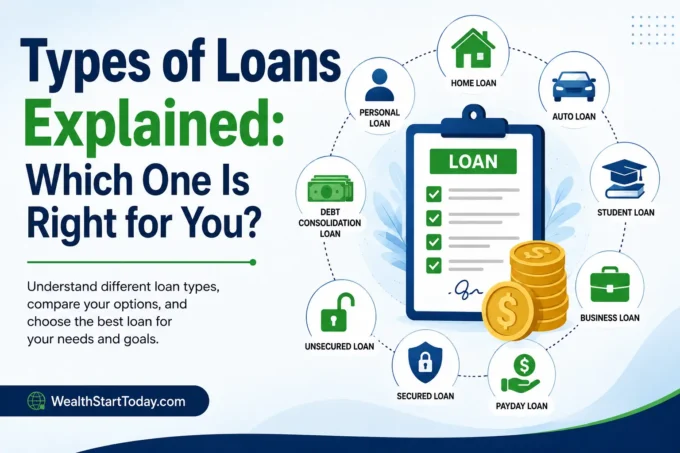
For a broader explanation of different loan categories, see our guide Types of Loans Explained: Which One Is Right for You?
Example: Comparing the Two Options
Consider a borrower with $12,000 spread across three credit cards.
The borrower currently has three monthly payments and different interest rates.
They consider a personal loan with a fixed repayment schedule and use it to pay off the three credit card balances.
After consolidation, they have:
Before consolidation:
Three credit card accounts
Three monthly payments
Multiple interest rates
Several payment due dates
After consolidation:
One loan
One monthly payment
One interest rate
One repayment schedule
This could make the debt easier to manage.
But the borrower should still compare the total amount they would repay under both arrangements.
If the new loan has fees or a much longer repayment period, the overall cost may not be lower even if the monthly payment is smaller.
This is why a simple monthly-payment comparison can be misleading.
Personal Loan vs Debt Consolidation Loan: A Numerical Example
Consider a borrower who has $10,000 in existing credit card debt with an average APR of 24%. The borrower is considering a new personal loan to consolidate the balance.
Suppose the borrower receives a consolidation loan with a 12% APR, a 3-year repayment term, and a 3% origination fee.
Here is a simplified comparison:
|
Cost |
Existing Credit Card Debt | New Consolidation Loan |
|
Debt balance |
$10,000 | $10,000 |
|
APR |
24% |
12% |
| Repayment period | Variable |
36 months |
|
Origination fee |
$0 | $300 |
| Approx. monthly payment | Varies |
About $332 |
|
Approx. principal + interest |
Depends on repayment behavior | About $11,957 |
| Fee | $0 |
$300 |
| Approx. total cost | Depends on how quickly debt is repaid |
About $12,257 |
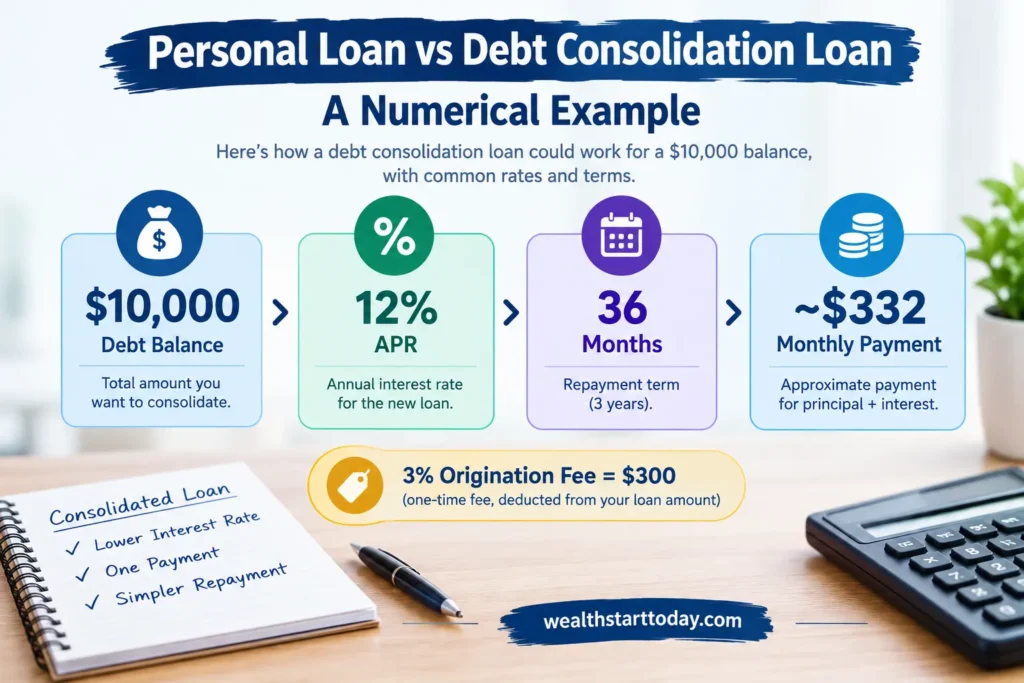
These figures are an illustration rather than a personalized loan offer. Actual payments and total costs depend on the lender, APR, fees, repayment schedule, and whether the borrower makes additional payments.
Why the Lower Monthly Payment Can Be Misleading
A lower monthly payment does not automatically mean that a loan will cost less overall.
For example, suppose a borrower has $10,000 of existing debt and qualifies for a new loan with a lower APR. If the new loan extends repayment over several years, the borrower may have a more manageable monthly payment but could still pay a significant amount of interest over the full term.
The opposite can also happen. A borrower may receive a loan with a lower APR and a shorter repayment period, potentially reducing interest costs, but the required monthly payment could be higher.
This is why borrowers should compare more than the monthly payment. The APR, fees, repayment term, monthly payment, and total amount repaid should all be considered together.
What This Example Shows
The main lesson is that the purpose of debt consolidation is not simply to obtain a lower monthly payment. A useful comparison should answer several questions:
- Is the new APR lower than the rates on the debts being replaced?
- Does the new loan charge an origination or other fee?
- How long will it take to repay the loan?
- How much will be paid in interest?
- What is the total amount that will be repaid?
- Is the new monthly payment affordable without creating additional financial pressure?
A consolidation loan may make repayment simpler and could reduce borrowing costs in some situations, but the numbers should be evaluated before accepting the offer. A lower monthly payment can result from a longer repayment period, so it should not be treated as proof that the new loan is cheaper overall.
What to Check Before Choosing a Loan
Before applying for either a personal loan or a debt consolidation loan, review the complete offer.
1. Compare APR
Look at the APR rather than focusing only on the advertised interest rate.
2. Check the Loan Term
A longer repayment term may reduce the monthly payment but can increase the total interest paid.
3. Calculate the Total Cost
Add interest and applicable fees to understand what the loan will actually cost.
4. Review the Monthly Payment
Make sure the payment fits comfortably within your budget.
5. Check for Fees
Look for origination fees and other charges in the loan agreement.
6. Understand Prepayment Rules
If you plan to pay the loan early, check whether the lender charges any prepayment penalty.
7. Review Your Existing Debt
Know exactly how much you owe before deciding how much to borrow.
8. Avoid Taking on New Debt
If consolidation pays off credit card balances, creating new balances afterward can undermine the purpose of consolidation.
Alternatives to Personal Loans and Debt Consolidation Loans
A personal loan is not the only way to manage multiple debts.
Depending on your circumstances, alternatives may include paying extra toward high-interest debt, contacting creditors about hardship options, using a balance transfer credit card if you qualify and the terms make sense, or working with a reputable nonprofit credit counseling organization.
Each option has different requirements, costs, and potential risks.
For example, a balance transfer may offer a promotional APR for a specified period, but borrowers should understand the promotional terms, fees, and what happens after the promotional period ends.
The right approach depends on the type and amount of debt, your income, credit profile, and ability to make payments consistently.
FTC explains debt-management options and recommends evaluating a credit counselor based on your individual financial situation.
Personal Loan vs Debt Consolidation Loan: Key Takeaway
The biggest difference between a personal loan vs debt consolidation loan is usually the purpose rather than the basic structure of the financing.
A personal loan is a broad installment-loan category that can be used for various purposes, including debt consolidation when permitted by the lender.
A debt consolidation loan is generally intended to combine multiple debts into one repayment arrangement.
Neither option is automatically cheaper or better for every borrower. The important factors are the APR, fees, repayment term, monthly payment, total repayment cost, and your ability to avoid taking on additional debt.
If you are considering consolidation, compare actual loan offers carefully rather than choosing based only on the product name or advertised monthly payment.
Frequently Asked Questions
Is a debt consolidation loan a personal loan?
It can be. Some debt consolidation loans are personal loans that are specifically used to combine existing debts. The exact terminology depends on the lender and product.
Is it better to get a personal loan or debt consolidation loan?
The answer depends on the loan terms and your financial situation. Compare APR, fees, repayment term, monthly payment, and total repayment cost before choosing.
Can I use a personal loan to pay off credit cards?
Many personal loans can be used for debt consolidation, including paying eligible credit card balances. However, you should confirm the permitted use with the lender before applying.
Does debt consolidation reduce your debt?
Debt consolidation generally restructures or combines existing debt rather than automatically reducing the amount you owe. You still have to repay the consolidated balance.
Can debt consolidation lower my monthly payment?
It may, depending on the new loan’s interest rate, fees, loan amount, and repayment period. A lower monthly payment does not necessarily mean a lower total borrowing cost.
Does taking a personal loan affect your credit?
Applying for a personal loan can involve a hard credit inquiry, and opening a new account can affect your credit profile. The overall effect varies by individual circumstances.
Can I consolidate multiple personal loans?
Depending on the lender and your eligibility, you may be able to use a debt consolidation loan or another personal loan to refinance or consolidate certain existing debts. Check the lender’s eligibility and permitted-use requirements.
For more information about having multiple personal loans at the same time, see our article How Many Personal Loans Can You Have at Once?
Final Thoughts
Choosing between a personal loan and a debt consolidation loan requires more than comparing the names of the products.
A personal loan may provide flexible financing and can sometimes be used for debt consolidation. A debt consolidation loan focuses more specifically on combining existing debts into a single repayment structure.
If you are considering either option, start by calculating how much you currently owe, comparing your existing interest rates, and determining how much you can realistically afford to pay each month. Then compare available loan offers based on APR, fees, repayment term, and total cost.
Most importantly, make sure the new loan supports a realistic debt-repayment plan. Consolidating debt can simplify payments, but long-term improvement also depends on controlling new borrowing and consistently making payments.
Understanding these differences can help you make a more informed decision about how to manage your existing debt.











Leave a comment