


Managing several credit card balances and loan payments at the same time can make debt feel more complicated than it needs to be. Different due dates, interest rates, minimum payments, and fees can make it difficult to see how much you are actually paying each month.
A debt consolidation loan can combine multiple debts into one new loan with a single monthly payment. The goal is usually to simplify repayment and, when the new loan has a lower overall cost, reduce the amount of interest you pay. However, consolidation does not make debt disappear. You are replacing several debts with a new one, so the loan’s interest rate, fees, repayment term, and monthly payment all matter.
The latest Federal Reserve consumer credit data illustrates why borrowing costs deserve attention. In July 2026, U.S. consumer credit outstanding was about $5.19 trillion. The same release reported a 22.15% rate for credit card accounts assessed interest and an 11.86% rate for 24-month personal loans at commercial banks. These figures are broad market measures, not the rate any individual borrower will receive.
What Is a Debt Consolidation Loan?
A debt consolidation loan is generally a new loan used to pay off multiple existing debts. Instead of making separate payments to several creditors, you use the new loan to pay those balances and then make one payment on the consolidation loan.
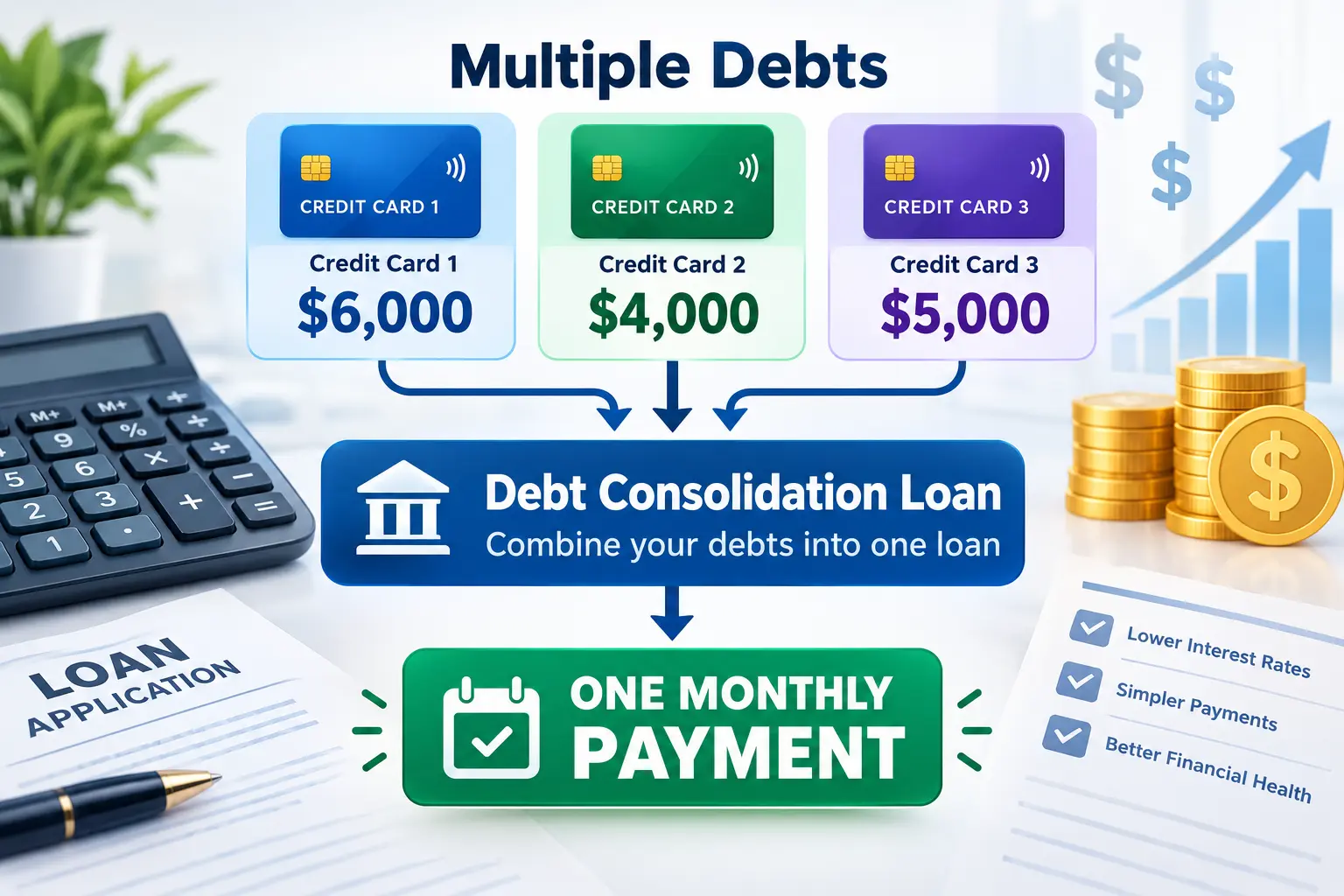
For example, imagine someone has:
- $6,000 on one credit card
- $4,000 on a second credit card
- $5,000 on another credit card
The total debt is $15,000. Instead of managing three separate balances, the borrower could potentially use a $15,000 personal loan to pay them off and then make one monthly payment on the new loan.
The important word is potentially. A consolidation loan only improves the financial picture if its terms make sense after considering the APR, origination fees, repayment period, and other costs.
The Consumer Financial Protection Bureau explains that a debt consolidation loan can simplify repayment by replacing separate debts with one amount to repay. It also warns that a lower monthly payment can sometimes result from extending the repayment period, which may mean paying more overall.
How Does a Debt Consolidation Loan Work?
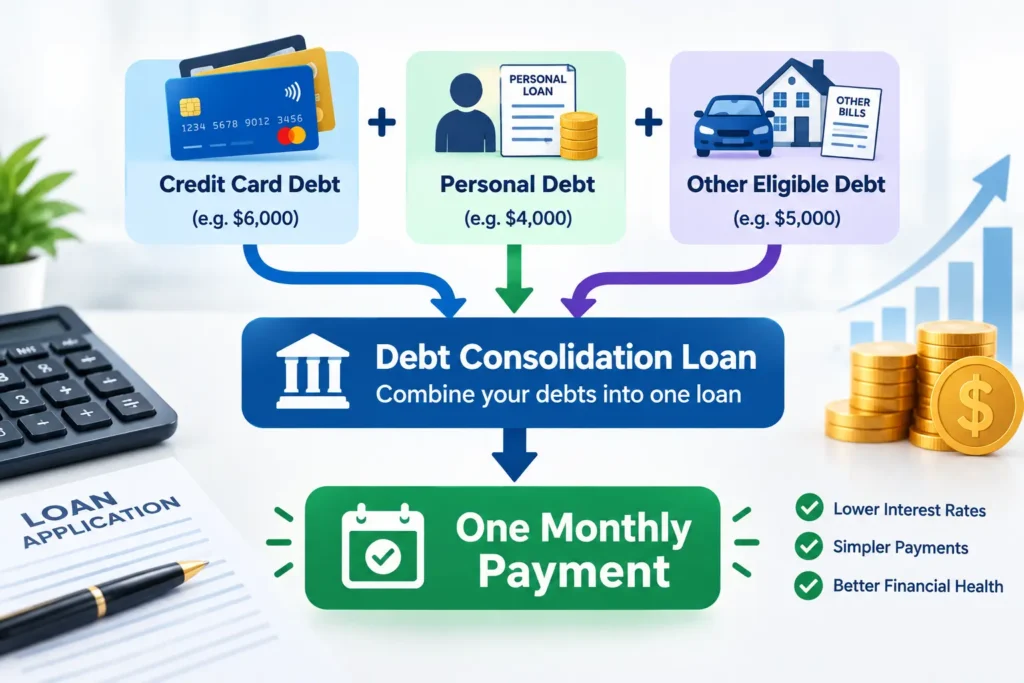
The process is relatively straightforward, but the financial comparison should happen before you apply.
1. Add up your existing debts
Start by listing every balance you want to consolidate. Record the outstanding balance, APR, minimum payment, and remaining repayment period.
Do not estimate. Use your latest statements or account information.
2. Determine the amount you need
Add the balances you intend to pay off. Then check whether the lender charges an origination fee or another upfront cost.
For example, if you need $15,000 to clear existing balances and the new loan has a 5% origination fee, the fee would be $750 if charged against the loan amount. That changes the effective cost of borrowing.
3. Compare loan offers
Look beyond the advertised interest rate. Compare the APR, monthly payment, loan term, fees, and total amount you will repay.
A loan with a lower monthly payment is not automatically cheaper.
4. Use the loan to pay the old debts
Depending on the lender, the funds may be deposited into your account or sent directly to creditors.
If the old credit card balances are paid off, avoid immediately rebuilding the same balances. Otherwise, you could end up with both the new consolidation loan and new credit card debt.
5. Make one payment on schedule
After consolidation, your main repayment obligation becomes the new loan. Making every payment on time is important for both the cost of the loan and your credit history.
Experian notes that applying for a new loan can create a hard inquiry and that opening a new account can temporarily affect credit-related factors. On the other hand, consistent on-time payments and lower revolving credit utilization can potentially help your credit profile over time.
Real Example: When a Debt Consolidation Loan Could Save Money
Consider a hypothetical borrower with $20,000 of credit card debt.
Assume the existing debt has an average APR of 22.15%, roughly matching the Federal Reserve’s July 2026 reported rate for credit card accounts assessed interest. Now suppose the borrower qualifies for a $20,000 personal loan at 11.86% APR for 36 months.
These are illustrative calculations, not a loan offer.
At 22.15%, $20,000 paid over 36 months would require a substantially higher monthly payment and result in considerably more interest than a comparable loan at 11.86%.
At 11.86%, a $20,000 loan over 36 months would have an estimated monthly principal-and-interest payment of about $663, with total payments of approximately $23,868 before any fees.
The key point is not simply that 11.86% is lower than 22.15%. The borrower must also compare fees and the exact repayment period.
For example, if a lender charges a $1,000 origination fee, the effective cost is higher than the simple $20,000 loan calculation suggests.
What this example teaches
A debt consolidation loan can make sense when the new borrowing cost is meaningfully lower than the debts being replaced and the borrower does not extend the repayment period unnecessarily.
It may make less sense if the new loan has a high APR, expensive fees, or a much longer term that increases total interest.
Graph: U.S. Consumer Credit Has Remained Above $5 Trillion
The Federal Reserve’s latest G.19 data shows how total U.S. consumer credit outstanding has changed:
|
Year/Period |
Consumer Credit Outstanding |
|
2021 |
$4.51 trillion |
|
2022 |
$4.86 trillion |
| 2023 |
$4.99 trillion |
| 2024 |
$4.95 trillion |
| 2025 |
$5.10 trillion |
| July 2026 |
$5.19 trillion |
Simple visual trend:
2021 █████████████████
2022 ███████████████████
2023 ████████████████████
2024 ████████████████████
2025 █████████████████████
2026 ██████████████████████
The figures above come from the Federal Reserve’s G.19 consumer credit release. The July 2026 figure is preliminary.
This graph does not mean that everyone should consolidate debt. It simply provides context for the scale of consumer borrowing in the U.S.
When Should You Consider a Debt Consolidation Loan?
A consolidation loan may be worth investigating when several conditions line up.
First, you should have a clear picture of your existing debt. If you do not know the balances, interest rates, and monthly payments, it is difficult to determine whether consolidation will actually help.
Second, the new loan should have a competitive APR and reasonable fees compared with your existing debt.
Third, the new monthly payment should fit comfortably within your budget.
Finally, you should have a plan for preventing the old balances from building up again.
Debt consolidation is a repayment strategy, not a spending solution. If the underlying problem is that monthly expenses consistently exceed income, replacing several debts with one loan may only postpone the problem.
When a Debt Consolidation Loan May Not Make Sense
There are several situations where consolidation deserves extra caution.
The new APR is not significantly lower
If your existing debt has an average APR of 18% and the consolidation loan costs 17%, the potential savings may be too small after fees to justify taking out a new loan.
The repayment period is much longer
A lower monthly payment can look attractive, but extending the loan from three years to seven years can increase the total interest you pay.
The CFPB specifically warns consumers to consider the full cost and loan length rather than looking only at the monthly payment.
Fees erase the savings
Origination fees, late fees, and other charges can reduce or eliminate the expected savings.
Always calculate the total cost rather than assuming a lower advertised APR automatically means a cheaper loan.
You continue using the paid-off credit cards
This is one of the biggest practical risks.
Suppose you borrow $15,000 to eliminate three credit card balances but then continue charging expenses to those cards without a repayment plan. You could eventually have a new personal loan plus new credit card balances.
That can make the financial situation worse rather than better.
Does a Debt Consolidation Loan Hurt Your Credit Score?
It can have a short-term effect on your credit, but the long-term outcome depends heavily on how the new loan is managed.
When you formally apply for credit, a lender may perform a hard inquiry. Experian reports that hard inquiries can temporarily lower credit scores, although the effect is generally small. Opening a new account can also reduce the average age of accounts. Click here to know how debt consolidation can affect your credit.
There can also be positive effects.
If a consolidation loan pays off high credit card balances, your revolving utilization on those cards may fall. Making every payment on time can also establish a positive payment history on the new account.
The important distinction is that consolidation itself does not automatically improve or damage your credit. Your application, new account, utilization, payment history, and future borrowing behavior all matter.
What Credit Score Do You Need for a Debt Consolidation Loan?
There is no single credit score that guarantees approval.
Lenders may consider your credit history, income, debt-to-income ratio, existing obligations, employment or income information, loan amount, and other factors.
Generally, stronger credit can make it easier to qualify for more competitive loan terms. Borrowers with weaker credit may still qualify with some lenders, but the interest rate and fees may be higher.
That is why comparing the actual APR you qualify for is more useful than focusing on a lender’s advertised minimum rate.
Debt-to-Income Ratio Matters
Your debt-to-income ratio, or DTI, compares your monthly debt obligations with your gross monthly income.
For example, if your gross monthly income is $5,000 and your monthly debt payments total $2,000:
DTI = $2,000 ÷ $5,000 × 100 = 40%
A lender may use DTI as part of its assessment of whether you can afford another loan.
However, lenders can calculate and interpret DTI differently, so do not treat one percentage as a universal approval rule.
Debt Consolidation Loan vs. Personal Loan
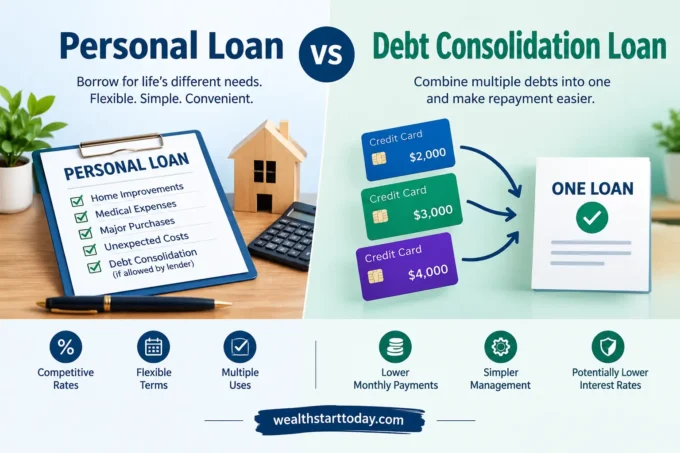
A debt consolidation loan is often structured as a personal loan specifically used to repay other debts.
A regular personal loan can be used for many purposes, while a debt consolidation loan focuses on replacing existing debts with one new repayment obligation.
For a broader explanation of different borrowing products, see our guide:
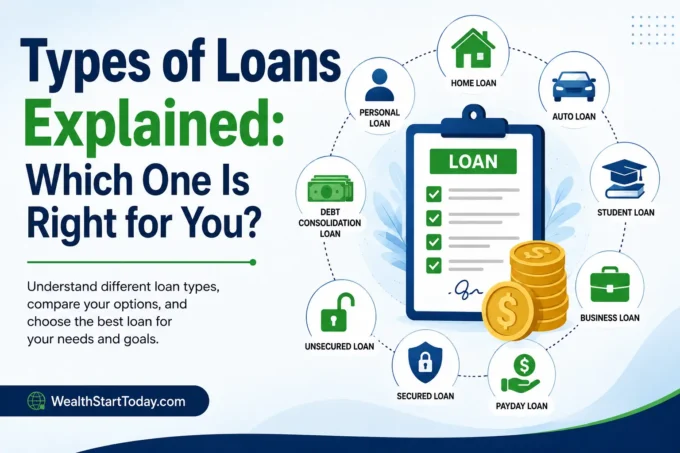
Types of Loans Explained: Which One Is Right for You?
For readers specifically comparing these two products, our detailed comparison also covers:
Personal Loan vs Debt Consolidation Loan: Key Differences
These internal links should be placed naturally rather than forcing them into every section.
Debt Consolidation Loan vs. Balance Transfer
A balance transfer moves eligible credit card debt to another credit card, often with a promotional interest rate for a limited period.
A debt consolidation loan, by contrast, uses a new loan to pay existing debts and normally has a fixed repayment schedule.
Neither method is automatically better. The right comparison depends on the APR, promotional period, transfer fees, loan fees, repayment period, and your ability to repay the balance.
If a balance transfer has a low introductory rate but the borrower cannot repay the balance before the promotional period ends, the long-term cost can change significantly.
Debt Consolidation Loan vs. Debt Management Plan
A debt management plan is different from taking out a new loan.
Under a debt management plan, a credit counseling organization may work with creditors to establish a repayment schedule. The FTC explains that reputable credit counseling organizations should provide information about their services and disclose fees before consumers commit. The FTC’s March 2026 consumer alert specifically warns against upfront-payment demands and promises of fast debt relief. FTC guidance on debt-relief scams.
A debt management plan can therefore be worth researching when taking out another loan does not fit your financial situation.
Umar’s Practical Author Insight
Author insight — Umar
When I look at debt consolidation, I would not start with the question, “How much can I borrow?” I would start with, “What will this debt cost me from today until the final payment?”
That means writing down every balance, APR, monthly payment, and fee before comparing a consolidation loan.
A lower monthly payment can be attractive, but it does not automatically mean you are saving money. The real comparison is the total cost of the old debt versus the total cost of the new loan.
Note for publication: this section is intentionally written from an author’s perspective, not as a fabricated claim that Umar personally took out a debt consolidation loan. Replace it with your actual experience if you have one.
How to Compare a Debt Consolidation Loan
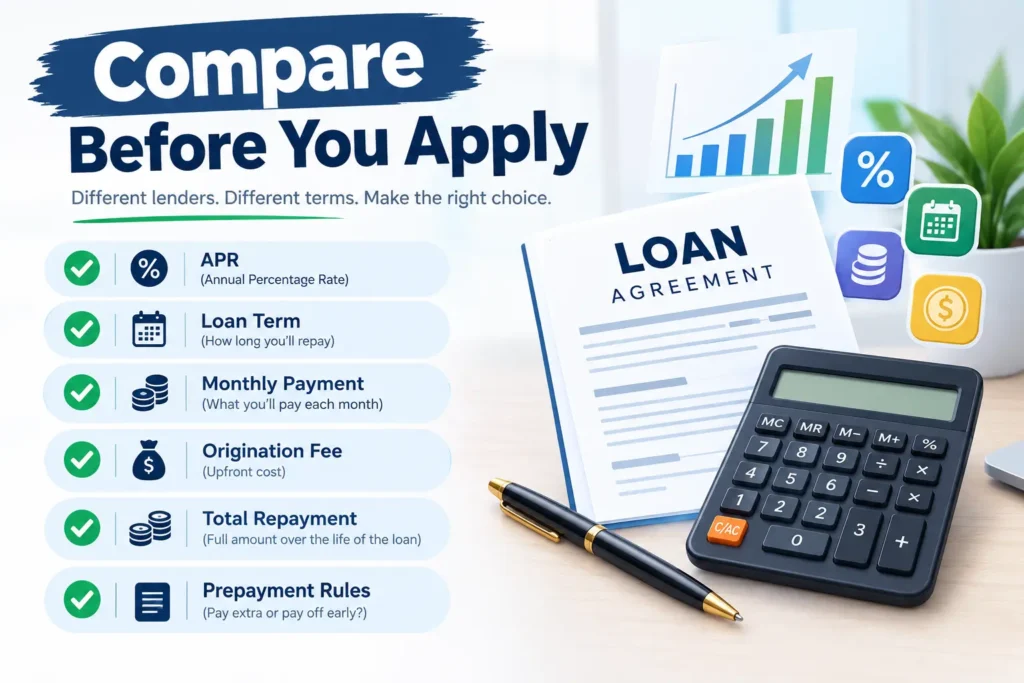
Before applying, compare these numbers side by side:
- Current debt balance: How much do you actually owe?
- Current APR: What interest rates are you paying?
- Current monthly payments: How much leaves your budget every month?
- New APR: What rate are you actually being offered?
- Origination fee: Is the lender charging a percentage or flat fee?
- Loan term: How many months will you make payments?
- Total repayment: How much will you pay from the first payment to the last?
- Prepayment rules: Can you pay the loan early without an additional charge?
The goal is to compare the total financial cost, not simply the monthly payment.
Debt Consolidation Scams to Watch For
Debt problems can make consumers vulnerable to companies promising quick solutions.
The FTC warns about debt-relief scams, including companies that demand upfront payment before providing promised services. It also warns consumers about unexpected calls or messages promising fast debt relief or loan forgiveness.
Be especially cautious if someone:
- Guarantees loan approval regardless of credit history
- Demands payment before providing the promised service
- Pressures you to act immediately
- Requests sensitive financial information unexpectedly
- Promises to erase debt without explaining the legal or financial process
A legitimate lender will evaluate your application rather than simply guaranteeing approval.
Frequently Asked Questions
Is a debt consolidation loan the same as a personal loan?
Often, a debt consolidation loan is a personal loan used for the specific purpose of paying off existing debts. However, not every personal loan is used for consolidation.
Can I consolidate credit card debt with a personal loan?
Yes. A personal loan can be used to pay eligible credit card balances, depending on the lender’s terms and your qualification.
Will debt consolidation lower my monthly payment?
It can, but a lower payment does not necessarily mean a lower total cost. A longer repayment period can increase the total interest paid.
Does debt consolidation hurt your credit?
Applying for a new loan can result in a hard inquiry and a temporary credit-score impact. Paying the new loan on time and reducing revolving balances can potentially help your credit profile over time.
What is the biggest mistake with debt consolidation?
One common mistake is paying off credit cards with a consolidation loan and then building new balances on those same cards. A successful consolidation strategy should include a plan to control new borrowing.
Should I consolidate all my debts?
Not necessarily. Compare each debt’s interest rate, fees, remaining term, and repayment conditions before deciding which balances, if any, should be consolidated.
Final Thoughts
A debt consolidation loan can simplify several debt payments into one and may reduce borrowing costs when you qualify for a significantly lower APR and reasonable fees.
But consolidation is not automatically a money-saving strategy. The new loan needs to be compared with your existing debts based on APR, fees, repayment period, monthly payment, and total cost.
Before applying, calculate your current debt, compare several loan offers, review the fine print, and make sure you have a realistic plan for avoiding new high-interest debt.
If the numbers show genuine savings and the new payment fits your budget, consolidation may be worth considering. If the new loan only lowers the monthly payment by stretching repayment over many additional years, the apparent savings may be misleading.
The best decision starts with the numbers—not simply with the promise of a lower monthly payment.











2 Comments