


Yrefy investment returns have attracted attention from investors looking for fixed-income opportunities outside traditional savings accounts, bonds, and publicly traded investments. The headline figure is particularly noticeable: Yrefy currently lists a stated fixed annual interest rate of up to 10.25% for its five-year investment class.
However, the 10.25% figure does not apply to every Yrefy investment option, and it should not be treated as a guaranteed investment return. Yrefy’s current investor information describes the opportunity as a private-placement promissory note available to eligible accredited investors. The company also states that the investment is not FDIC or SIPC insured and that investors could lose some or all of their principal.
So, how much could an investor earn from Yrefy?
The answer depends on the investment amount, selected term, stated interest rate, payment option, and whether interest is taken as income or allowed to accrue. This guide explains the current Yrefy investment returns, provides realistic calculations, and examines the risks investors should understand before considering the opportunity.
What Are Yrefy Investment Returns in 2026?
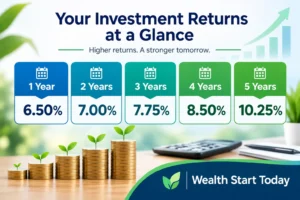
Yrefy currently lists five investment classes with terms ranging from one to five years. Each class has a different stated annual interest rate.
|
Investment Class |
Term | Stated Annual Rate |
|
Class 1 |
12 months | 6.50% |
|
Class 2 |
24 months | 7.00% |
| Class 3 | 36 months |
7.75% |
| Class 4 | 48 months |
8.50% |
| Class 5 | 60 months |
10.25% |
The most important detail is that 10.25% applies to the five-year class. It is not the rate offered across every Yrefy investment term.
Yrefy also currently states a generally applicable minimum investment of $50,000, although its disclosures indicate that the minimum may be waived for qualified investors at management’s discretion.
These are stated rates rather than guaranteed investment returns. Yrefy’s disclosures specifically explain that there is no guarantee of income or return of principal.
How Does Yrefy Generate Investment Returns?
Yrefy’s investment structure is different from purchasing a stock or putting money into a bank certificate of deposit.
The current offering involves private-placement promissory notes issued by Yrefy SLP4, LLC. According to Yrefy’s investor information, investment proceeds can be used in connection with refinancing distressed private student loans, managing the loan portfolio, operating expenses, fees, and other corporate purposes.
Yrefy’s business model focuses on private education loans rather than federal student loans. The company describes its model as refinancing defaulted or delinquent private student loans under new repayment arrangements.
For investors, this means the stated interest rate needs to be considered together with the financial and credit risks associated with the issuer and underlying business.
A fixed rate tells you the contractual interest rate of the note. It does not eliminate the possibility that an issuer could experience financial difficulties or fail to meet its obligations.
How Much Can You Earn With a $50,000 Yrefy Investment?
A $50,000 investment provides a useful example because it is the generally stated minimum for the current offering.
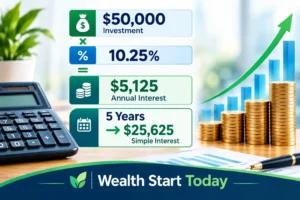
Suppose an investor places $50,000 into the five-year class at the stated annual rate of 10.25%.
A simple annual-interest calculation would be:
$50,000 × 10.25% = $5,125
That means the stated annual interest would be $5,125 before taxes and other considerations.
Over five years, if you simply calculate the stated interest without compounding:
$5,125 × 5 = $25,625
The total would therefore be:
$50,000 principal + $25,625 interest = $75,625
This is a mathematical illustration based on the stated rate. It is not a prediction or guarantee of what an investor will actually receive.
The actual investment agreement, payment structure, accrued interest, taxes, fees, and performance of the issuer all matter.
What If You Take Interest Monthly?
Yrefy states that investors can choose to receive interest payments or allow interest to accrue, subject to the terms of the offering documents.
Using the same $50,000 example at 10.25%, the simple annual interest is $5,125.
Dividing that amount by 12 gives approximately:
$5,125 ÷ 12 = $427.08 per month
So, a simplified illustration would be approximately $427 per month before taxes, assuming the full principal remains invested and the stated rate applies throughout the relevant period.
This should not be interpreted as a guaranteed monthly income of $427.
The actual payment mechanics are governed by the promissory note and Private Placement Memorandum (PPM).
What If the Investment Is $100,000?
The same calculation can demonstrate how the potential interest changes with a larger investment.
At a stated annual rate of 10.25%:
$100,000 × 10.25% = $10,250 per year
Using simple interest over five years:
$10,250 × 5 = $51,250
The mathematical total would be:
$151,250
Again, this assumes the stated rate remains applicable and that all scheduled payments are made. It does not account for taxes, potential fees, reinvestment effects, or the possibility of default.
The example demonstrates the relationship between principal and the stated rate; it should not be presented as an expected investment outcome.
Yrefy Investment Returns: Comparing All Five Terms
Looking only at the annual rate can make the five-year option appear dramatically different from the shorter terms. But investors should also consider how long their money may remain committed.
For example, consider a hypothetical $50,000 investment and simple annual interest.
One-Year Class at 6.50%
$50,000 × 6.50% = $3,250 annual interest
If held for one year, the mathematical interest would be $3,250.
Two-Year Class at 7.00%
$50,000 × 7.00% = $3,500 per year
Over two years using simple interest:
$3,500 × 2 = $7,000
Three-Year Class at 7.75%
$50,000 × 7.75% = $3,875 per year
Over three years:
$3,875 × 3 = $11,625
Four-Year Class at 8.50%
$50,000 × 8.50% = $4,250 per year
Over four years:
$4,250 × 4 = $17,000
Five-Year Class at 10.25%
$50,000 × 10.25% = $5,125 per year
Over five years:
$5,125 × 5 = $25,625
These calculations are useful for understanding the stated rates, but they do not account for the risks associated with a private investment.
Does Yrefy Compound Interest?
Yrefy says investors can choose between receiving interest income and allowing interest to accrue, subject to the terms of the offering.
This distinction matters.
For example, if $50,000 generated $5,125 of annual interest and the interest were simply paid to the investor, the original $50,000 principal would remain the basis for the simple calculation.
If interest is allowed to accrue or is reinvested under the applicable terms, the calculation can become different.
For example, using a purely mathematical annual-compounding illustration at 10.25%:
$50,000 × (1.1025)^5 ≈ $81,373
That represents approximately $31,373 of growth under an annual-compounding assumption.
However, this is not the same thing as saying a Yrefy investor will receive $81,373. Actual Yrefy investment mechanics are controlled by the note documents and the selected payment arrangement.
This distinction is especially important when writing about high-yield private investments because a compound-interest calculator can show theoretical growth without accounting for credit, liquidity, tax, or contractual risks.
Yrefy Investment Returns vs. Yrefy Investment Risk
A high stated rate can attract attention, but return should always be evaluated alongside risk.
If you have already read our Yrefy Investing Review, you will have seen that the investment is structurally different from buying a publicly traded stock or keeping money in an FDIC-insured bank account.
Our separate Yrefy Investment Risk guide also examines the risks associated with the investment structure.
The key point is simple:
A higher stated interest rate does not automatically mean a higher-quality investment.
Private-placement investments can involve risks that are less visible when someone focuses only on the advertised rate.
Yrefy’s own disclosures state that the notes are not FDIC or SIPC insured, do not have a public trading market, have limited liquidity, and may expose investors to the risk of losing some or all of their principal.
How Liquid Is a Yrefy Investment?
Liquidity is one of the most important differences between Yrefy and many publicly traded investments.
Yrefy states that there is no secondary trading market for the securities and that investors should be prepared to hold the notes until maturity.
The company does describe an early-withdrawal feature, but it is limited. According to its disclosures, an investor can request early redemption, but Yrefy may approve, decline, or delay the request, and an early-redemption penalty may apply.
That means investors should not treat the five-year investment as money that can necessarily be withdrawn whenever needed.
For example, someone investing $50,000 should consider whether they could continue paying their regular expenses and handle an emergency without relying on that $50,000.
Who Can Invest in Yrefy?
Yrefy’s current SLP4 offering is described as a Regulation D Rule 506(c) private placement for accredited investors.
Another important consideration is whether you qualify as an accredited investor. The SEC’s accredited investor requirements include several qualification routes. For an individual, common financial criteria include annual income above $200,000 individually, or above $300,000 jointly with a spouse or spousal equivalent, in each of the previous two years with a reasonable expectation of reaching the same level in the current year.
Another common route is a net worth above $1 million, excluding the value of the person’s primary residence.
There are also professional and other qualification categories.
Therefore, someone should not assume that having $50,000 available automatically makes them eligible to invest.
Yrefy states that accredited-investor verification is required for the offering.
Is the 10.25% Yrefy Return Guaranteed?
No.
This is one of the most important facts to understand about Yrefy investment returns.
The word “fixed” describes the stated interest rate attached to the specific note or class. It does not mean the investment is risk-free or that the investor is guaranteed to receive every scheduled payment.
Yrefy’s current disclosures state that there is no guarantee of income or return of principal and that the investment carries the risk of total loss.
Therefore, an article discussing Yrefy should avoid phrases such as:
- “Guaranteed 10.25% return”
- “Risk-free 10.25% investment”
- “You will definitely earn $25,625”
- “Your money is guaranteed after five years”
A more accurate description is:
“Yrefy currently states a fixed annual interest rate of up to 10.25% for its five-year investment class, but the return and principal are not guaranteed.”
That wording is much more appropriate for financial content.
Yrefy Regulatory History Investors Should Know

Investors researching Yrefy should also look beyond the advertised rate.
In February 2025, the Massachusetts Securities Division issued a consent order involving Yrefy, LLC and Yrefy SLP4, LLC. The order described the company’s Regulation D offering and addressed advertising and disclosure issues.
The regulatory record is relevant because it demonstrates why investors should review primary documents instead of relying solely on promotional material, online reviews, or testimonials.
The existence of a regulatory filing or enforcement action does not by itself determine whether an investment will succeed or fail. It is one part of due diligence.
Investors should read the current PPM, risk disclosures, subscription documents, and relevant SEC filings before making a decision.
A Realistic Yrefy Investment Example
Consider an investor with $50,000 who is eligible for the offering.
The investor has three important questions:
First: What is the stated rate?
If the investor selects the five-year class, the current stated rate is 10.25%.
Second: How much could the stated rate produce mathematically?
At 10.25%, $50,000 produces $5,125 of simple annual interest.
Third: Can the investor afford the risk and lack of liquidity?
This is much more difficult to answer.
If the $50,000 represents the investor’s emergency fund, the investment could create a serious liquidity problem. If it represents a small portion of a diversified portfolio and the investor fully understands the possibility of loss and limited liquidity, the circumstances are different.
The calculation is objective. The suitability question depends on the investor’s individual financial situation.
Investors researching Yrefy should also look beyond the advertised rate. Our Yrefy Investment Reviews 2026 guide provides additional context for investors comparing the current Yrefy offering and its stated returns.
What Should You Check Before Considering Yrefy?
Before committing money, an investor should review the current Private Placement Memorandum and related documents rather than relying on a headline return.
Important questions include:
- What exactly does the promissory note promise?
- What security or collateral arrangements apply?
- What are the conditions for early withdrawal?
- What fees and expenses apply?
- How is interest paid or accrued?
- What happens if Yrefy misses a payment?
- What happens if the underlying borrowers perform worse than expected?
- How much of the investor’s overall portfolio would be committed?
- What tax treatment applies to the interest?
- Can the investor comfortably hold the investment until maturity?
The goal should not be to focus on the 10.25% number alone.
Conclusion
Yrefy investment returns can look attractive, particularly because the current five-year investment class lists a stated annual interest rate of 10.25%. Based on a simple calculation, a $50,000 investment at that rate would produce $5,125 in annual interest before taxes and other considerations.
Yrefy is a private-placement investment for eligible accredited investors. Unlike bank deposits that may qualify for FDIC deposit insurance, Yrefy’s notes are not FDIC or SIPC insured, have limited liquidity, and carry the possibility of loss of principal. Yrefy’s own disclosures emphasize that there is no guarantee of income or return of principal.
For investors researching Yrefy investment returns, the most important step is therefore to look beyond the advertised percentage. Review the current Private Placement Memorandum, understand the investment term and withdrawal conditions, consider the possibility of losing principal, and determine whether the investment fits your own financial circumstances.
The 10.25% figure explains the potential contractual interest rate; it does not guarantee the final investment outcome. Anyone considering Yrefy should review the current offering documents and obtain appropriate professional financial, legal, or tax advice before investing.











Leave a comment