


Cryptocurrency is often associated with dramatic price changes. Bitcoin and Ethereum can gain or lose significant value in a short period, making them difficult to use for everyday payments. Stablecoins were developed to address part of this problem by linking the value of a digital token to an asset such as the US dollar.
But what are stablecoins, how do they maintain their value, and are they actually safe to use?
Stablecoins are an important part of the cryptocurrency market in 2026. People use them to transfer money, trade digital assets, make international payments, and temporarily hold funds without being directly exposed to the daily price movements of Bitcoin.
However, a stable price does not mean zero risk. The company issuing a stablecoin, the assets backing it, and the technology supporting it all matter.
This guide explains how stablecoins work, their different types, real-world uses, benefits, and risks so beginners can understand what they are dealing with before using them.
What Are Stablecoins?
Stablecoins are cryptocurrencies designed to maintain a relatively consistent value by being linked to another asset. Most popular stablecoins are connected to the US dollar, although some track other currencies, commodities, or financial assets.
For example, a US dollar-pegged stablecoin aims to maintain a value of approximately $1 per token. This makes it different from Bitcoin, whose market price changes according to supply, demand, and investor activity.
Popular examples include:
- Tether (USDT): A widely used dollar-pegged stablecoin.
- USD Coin (USDC): A dollar-backed stablecoin issued by Circle.
- Dai (DAI): A crypto-backed stablecoin designed to maintain a dollar peg.
- PayPal USD (PYUSD): A dollar-linked stablecoin issued through PayPal’s stablecoin arrangements.
The purpose is not necessarily to increase in price. Instead, stablecoins aim to provide a more predictable digital representation of money.
Imagine someone holds 100 USDC. Under normal market conditions, those tokens are intended to represent approximately $100. However, the actual value can move above or below that level, and redemption depends on the issuer’s terms and applicable restrictions.
How Do Stablecoins Work?
Stablecoins maintain their intended value through different mechanisms. The method depends on the type of stablecoin and the assets or systems supporting it.
For a dollar-backed stablecoin, the issuer generally creates tokens when customers provide money or other accepted assets. The issuer holds reserve assets intended to support the value of tokens in circulation.
Here is a simplified example:
- A customer deposits $1,000 with an issuer.
- The issuer creates 1,000 dollar-pegged stablecoins.
- The customer receives the tokens in a compatible digital wallet.
- The tokens can be transferred to another wallet or used on supported cryptocurrency platforms.
- When an eligible holder redeems the tokens through the issuer, the issuer removes the corresponding tokens from circulation and provides the redemption amount under its terms.
Blockchain technology records the movement of these tokens. Depending on the network, transactions may be processed on Ethereum, Solana, Tron, or other supported blockchains.
The important point is that blockchain technology handles the digital transfer, while the backing mechanism helps support the stablecoin’s price.
Not every stablecoin offers the same redemption rights, reserve quality, or level of transparency. That is why understanding the issuer matters as much as understanding the token.
What Are the Main Types of Stablecoins?
Not all stablecoins work in the same way. Their backing mechanisms determine how they attempt to maintain a stable value.
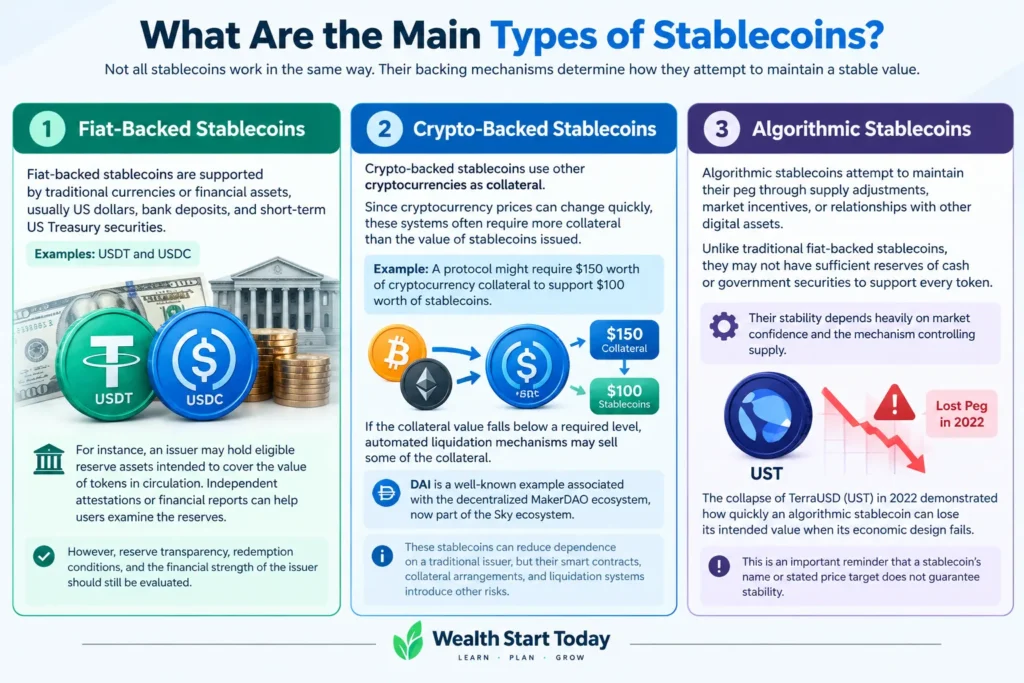
1. Fiat-Backed Stablecoins
Fiat-backed stablecoins are supported by traditional currencies or financial assets, usually US dollars, bank deposits, and short-term US Treasury securities.
USDT and USDC are two major examples.
For instance, an issuer may hold eligible reserve assets intended to cover the value of tokens in circulation. Independent attestations or financial reports can help users examine the reserves.
However, reserve transparency, redemption conditions, and the financial strength of the issuer should still be evaluated.
2. Crypto-Backed Stablecoins
Crypto-backed stablecoins use other cryptocurrencies as collateral.
Since cryptocurrency prices can change quickly, these systems often require more collateral than the value of stablecoins issued.
For example, a protocol might require $150 worth of cryptocurrency collateral to support $100 worth of stablecoins. If the collateral value falls below a required level, automated liquidation mechanisms may sell some of the collateral.
DAI is a well-known example associated with the decentralized MakerDAO ecosystem, now part of the Sky ecosystem.
These stablecoins can reduce dependence on a traditional issuer, but their smart contracts, collateral arrangements, and liquidation systems introduce other risks.
3. Algorithmic Stablecoins
Algorithmic stablecoins attempt to maintain their peg through supply adjustments, market incentives, or relationships with other digital assets.
Unlike traditional fiat-backed stablecoins, they may not have sufficient reserves of cash or government securities to support every token.
Their stability depends heavily on market confidence and the mechanism controlling supply.
The collapse of TerraUSD (UST) in 2022 demonstrated how quickly an algorithmic stablecoin can lose its intended value when its economic design fails.
This is an important reminder that a stablecoin’s name or stated price target does not guarantee stability.
Popular Stablecoins: USDT vs USDC
USDT and USDC are among the most widely used dollar-pegged stablecoins. Both aim to maintain a value close to $1, but they have different issuers, reserve arrangements, and operating structures.
|
Feature |
USDT | USDC |
|
Full name |
Tether | USD Coin |
|
Issuer |
Tether | Circle |
|
Target value |
$1 |
$1 |
| Main purpose | Trading and transfers |
Payments and digital finance |
| Reserve model | Disclosed reserve assets |
Disclosed reserve assets |
| Transparency | Published reserve reports |
Published reserve information and attestations |
As of October 30, 2026, market data from DefiLlama showed approximately $180.2 billion in USDT market capitalization and $71.4 billion in USDC market capitalization. These figures are snapshots and can change as tokens are issued or redeemed.
USDC’s official transparency page reported approximately $71.0 billion in circulation against $71.2 billion in total reserves on October 26, 2026.
Neither coin should automatically be considered risk-free. Users should review the issuer’s latest reserve information, redemption requirements, supported networks, and applicable restrictions.
Why Are Stablecoins Important in 2026?
Stablecoins have developed beyond their original role as a convenient way to move between cryptocurrency trades.
They are increasingly discussed as a payment technology and a connection between traditional finance and blockchain-based services.
According to DefiLlama’s stablecoin market data, the total stablecoin market capitalization was approximately $297.2 billion on October 30, 2026.
The Federal Reserve also published research in April 2026 examining stablecoin developments during 2025. Its analysis reported that stablecoins grew by approximately 50% in market capitalization during that year.
This growth shows that stablecoins are becoming an important part of the digital financial system. However, market capitalization should not be confused with actual everyday payment adoption.
Stablecoin Regulation in the United States
Regulation is another important development.
The United States passed the GENIUS Act in July 2025, establishing a federal framework for payment stablecoins.
The legislation addresses issues such as permitted issuers, reserve requirements, and regulatory supervision.
In October 2026, the Office of the Comptroller of the Currency issued a final rule implementing parts of the legislation. The rule is scheduled to become effective on January 18, 2027.
These developments are intended to establish clearer requirements for eligible payment stablecoin issuers. However, regulation does not eliminate every financial, technological, or market risk.
What Are Stablecoins Used For?
Stablecoins have several practical applications in the digital economy.
1. Cryptocurrency Trading
Traders often use stablecoins to move between cryptocurrency positions without converting every transaction into traditional bank money. What is cryptocurrency? Complete information about it is available here.
For example, someone selling Bitcoin may exchange it for USDT rather than immediately withdrawing dollars to a bank account.
This can make trading operations more convenient, although exchange and wallet risks remain.
2. International Money Transfers
Stablecoins can move between compatible digital wallets across borders without relying entirely on traditional banking transfer systems.
For example, a business may use a supported stablecoin payment service to send digital dollars to an overseas supplier.
This can reduce processing delays in some situations, but users must consider network fees, exchange costs, local regulations, and the recipient’s ability to convert the tokens into local currency.
3. Online Payments
Some businesses and payment providers accept stablecoins for online transactions.
Customers can transfer supported tokens directly from their wallets, depending on the payment provider and blockchain network.
However, acceptance is not universal, and transaction mistakes can be difficult or impossible to reverse.
4. Decentralized Finance (DeFi)
Stablecoins are widely used in decentralized finance applications.
Depending on the platform, users may deposit stablecoins into lending protocols, provide liquidity, or use them as collateral.
These activities can generate potential returns, but they also involve smart contract vulnerabilities, liquidation risks, platform failures, and changing market conditions.
A promised return should never be treated as guaranteed income.
Benefits of Stablecoins
Stablecoins offer several advantages compared with cryptocurrencies that experience frequent price fluctuations.
More predictable value: Dollar-pegged stablecoins aim to maintain a value close to one US dollar, making them easier to use for pricing and payments.
Faster transfers: Blockchain networks can process transactions outside conventional banking hours, depending on network conditions and service availability.
Access to digital finance: People with compatible wallets and access to suitable services can participate in certain blockchain-based financial activities.
Convenient cryptocurrency trading: Traders can hold stablecoins between transactions without constantly moving funds into traditional bank accounts.
Potentially lower transfer costs: Some networks offer relatively inexpensive transactions, although fees vary depending on congestion, network selection, and service providers.
These advantages are useful, but they do not make stablecoins a replacement for insured bank deposits or traditional currency in every situation.
Risks of Stablecoins You Should Understand
Stablecoins are designed to reduce price volatility, but they introduce several risks that beginners should understand.
1. Depegging Risk
A stablecoin can lose its connection to the asset it is designed to track.
For example, a dollar-pegged token might temporarily trade at $0.97 instead of $1 because of market pressure, concerns about reserves, or problems with redemption.
If confidence does not return, the loss of the peg may become more serious.
2. Reserve and Issuer Risk
Fiat-backed stablecoins depend on their issuers and the quality of their reserves.
If an issuer holds insufficient, inaccessible, or risky assets, it may struggle to meet redemption requests.
Users should examine reserve reports and understand whether they have direct redemption rights.
3. Regulatory Risk
Stablecoin rules differ between countries and can change over time.
A token or service available in one country may face restrictions in another. Users should check local regulations before purchasing or transferring stablecoins.
4. Wallet and Cybersecurity Risk
A compromised wallet, stolen private key, phishing attack, or fraudulent website can result in permanent financial losses.
Never share your private keys or recovery phrase with anyone.
5. Blockchain and Smart Contract Risk
Transactions depend on the underlying blockchain and, in some cases, smart contracts.
Technical failures, network congestion, malicious code, or unsupported transfers can create financial problems.
A stablecoin can maintain its dollar peg while the platform or wallet holding it experiences a serious failure.
Are Stablecoins Safe for Beginners?
Stablecoins can be useful for beginners who want to understand digital payments and cryptocurrency markets without directly holding highly volatile assets.
However, safe usage requires more than choosing a token that displays a $1 price.
Before using a stablecoin, consider these checks:
- Research the company or organization responsible for issuing it.
- Read the latest reserve disclosures and independent attestations.
- Understand how redemption works and whether you are eligible.
- Check whether the wallet and blockchain network support the exact token.
- Review transaction fees before sending funds.
- Avoid platforms promising guaranteed or unusually high returns.
- Keep private keys and recovery phrases secure.
For beginners, it is generally sensible to understand how a stablecoin works before transferring a meaningful amount of money.
Stablecoins should not be treated as automatically insured savings accounts or guaranteed investments.
Real-Life Example: How a Stablecoin Transfer Works
Imagine a small online business in the United States needs to pay a supplier in another country.
The business agrees to send $500 worth of USDC through a supported payment service.
The process may look like this:
- The business obtains 500 USDC through an eligible exchange or service.
- The supplier shares a compatible wallet address.
- The business checks the blockchain network and confirms the address.
- It sends the USDC transaction.
- After the network confirms the transfer, the supplier receives the tokens.
- The supplier can hold the tokens or use a supported service to convert them into local currency.
This example illustrates how stablecoins can support international digital payments.
However, the transaction is not automatically free. Network charges, service fees, currency conversion costs, and local compliance requirements may apply.
The sender must also verify the recipient’s wallet address because blockchain transfers are generally irreversible.
Stablecoins vs Bitcoin: What Is the Difference?
Although both are cryptocurrencies, stablecoins and Bitcoin serve different purposes.
|
Feature |
Stablecoins | Bitcoin |
|
Main purpose |
Maintain a stable reference value | Decentralized digital asset |
|
Price behavior |
Designed for lower volatility | Market-driven volatility |
| Supply | Depends on the stablecoin model |
Limited to 21 million BTC |
| Issuer | Often has an issuing organization or protocol |
No central issuer |
| Common use | Payments, trading, transfers |
Investment, transfers, and value storage |
Stablecoins aim to maintain a predictable value, while Bitcoin’s price is determined by market demand and supply.
Neither asset is guaranteed to increase in value or protect users from every type of financial loss.
Frequently Asked Questions About Stablecoins
1. Are stablecoins always worth $1?
No. Dollar-pegged stablecoins aim to maintain a value of $1, but market prices can move above or below that level. A loss of the peg can create significant financial losses.
2. Can you make money with stablecoins?
Stablecoins are not generally designed to increase in price. Some platforms offer lending, liquidity, or reward opportunities, but these involve additional risks and do not guarantee returns.
3. Is USDT better than USDC?
Neither is automatically better for every user. The choice depends on availability, supported networks, reserve transparency, redemption conditions, and the intended use.
4. Are stablecoins legal in the United States?
Stablecoin activities are subject to applicable federal and state laws. The GENIUS Act established a federal framework for payment stablecoins, with implementation and regulatory requirements developing through 2026 and 2027.
5. Can stablecoins lose their value?
Yes. Stablecoins can lose their peg because of reserve problems, market pressure, technical failures, or a loss of confidence in the issuer or protocol.
6. Are stablecoins the same as digital dollars?
No. Stablecoins are privately issued digital assets designed to track a currency such as the US dollar. They are not the same as physical dollars, bank deposits, or a US central bank digital currency.
Conclusion
Stablecoins have become an important part of the cryptocurrency ecosystem by offering a digital asset designed to maintain a more predictable value than traditional volatile cryptocurrencies.
They can support trading, international transfers, online payments, and decentralized finance applications. USDT and USDC are two major examples, but their backing arrangements, issuers, and redemption conditions are not identical.
The growth of the stablecoin market and the development of US regulation in 2026 show that this area of digital finance continues to evolve.
Still, a stable price does not mean a risk-free asset. Reserve quality, issuer reliability, wallet security, blockchain technology, and local regulations all deserve attention.
For anyone exploring cryptocurrency, understanding stablecoins is a useful starting point. Take time to research the asset and the service behind it before making financial decisions.
Disclaimer: This article is for educational purposes only and does not constitute financial or investment advice. Cryptocurrency and stablecoins involve financial risks.











Leave a comment