

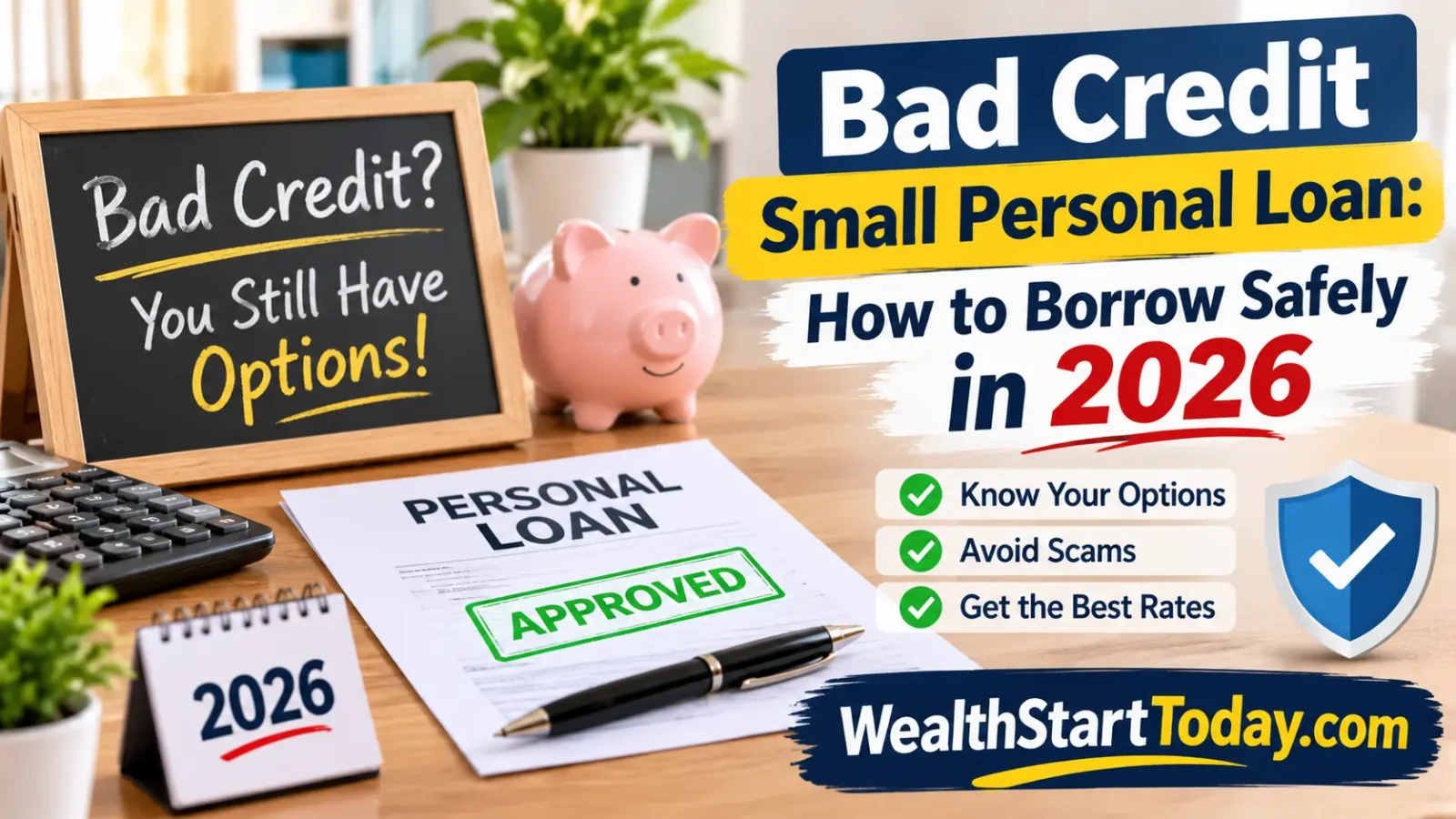
Having bad credit can make borrowing money more difficult, especially when an unexpected expense cannot wait. A car repair, medical bill, overdue utility payment, or emergency household expense can create financial pressure when your savings are limited. In these situations, a bad credit small personal loan may be one option worth exploring.
The good news is that a low credit score does not automatically mean every lender will reject your application. Some banks, credit unions, and online lenders consider additional factors, including income, employment history, existing debts, and your ability to make monthly payments.
However, getting approved is only part of the decision. A loan with a high annual percentage rate (APR), expensive fees, or an unaffordable repayment schedule can make an already difficult financial situation worse.
In this guide, we will explain how small personal loans for bad credit work in the United States, where to look for affordable borrowing options, what lenders consider, and how to avoid expensive loan traps. We will also use a practical example involving Umar to show how someone can approach a small loan decision responsibly.
What Is a Bad Credit Small Personal Loan?
A bad credit small personal loan is a relatively small amount of money borrowed by someone whose credit history may include late payments, high credit card balances, collections, or previous financial difficulties.
These loans are commonly offered as installment loans. This means the borrower receives money upfront and repays it through scheduled payments over an agreed period.
Depending on the lender, loan amounts may range from a few hundred dollars to several thousand dollars. However, there is no universal loan amount or minimum credit score that applies to every lender.
Some lenders consider applicants with credit scores below 580, while others may require stronger credit profiles.
A lender may evaluate:
- Credit score and payment history.
- Monthly income and employment stability.
- Existing loan and credit card payments.
- Debt-to-income ratio.
- Bank account and recent financial activity.
- State-specific lending requirements.
One important point: Bad credit does not mean guaranteed approval. Every legitimate lender has its own eligibility requirements.
Can You Get a Small Personal Loan With Bad Credit?
Yes, it is possible to get a small personal loan with bad credit, but approval depends on your complete financial situation rather than your credit score alone.
For example, someone with a 550 credit score and stable employment may receive a different decision from someone with the same score who has irregular income and several unpaid debts.
Lenders want evidence that you can repay the borrowed amount without creating additional financial problems.
Before applying, consider these three factors:
- Your monthly income
A consistent source of income can strengthen your application. Lenders may request pay stubs, bank statements, or other proof of income.
- Your existing debt
If most of your income already goes toward credit cards, auto loans, and other personal loans, a lender may consider another monthly payment too risky.
- Your repayment history
Recent missed payments, defaults, and collections can affect your eligibility. Some lenders may be more flexible, but flexibility often comes with higher borrowing costs.
There is no guarantee that a lender will approve you simply because you have a job or receive regular income.
Where Can You Find Small Personal Loans for Bad Credit?
Finding a lender is not particularly difficult. Finding one with reasonable terms is the more important challenge.
Here are some options worth researching before accepting an offer.
1. Credit Unions
Credit unions are worth considering because they may offer smaller loans and personalized lending services.
Unlike many commercial lenders, credit unions are member-owned financial institutions. Some offer products designed to help members manage unexpected expenses without relying on expensive payday loans.
One example is the federal credit union Payday Alternative Loan (PAL) program.
Under the original PAL program, qualifying federal credit unions may offer loans between $200 and $1,000, generally with repayment terms of one to six months. PAL II loans can reach $2,000, with terms between one and twelve months, subject to program requirements.
Eligibility and membership rules apply, so contact a participating credit union directly.
You can learn more through the National Credit Union Administration (NCUA):
2. Online Personal Loan Lenders
Online lenders allow borrowers to research and compare loan offers without visiting a physical branch.
Some online lenders consider applicants with poor or limited credit histories. However, their interest rates, loan amounts, origination fees, and repayment terms can vary significantly.
Before submitting an application, check:
- Whether the lender operates legally in your state.
- The minimum and maximum loan amounts.
- The APR and origination fee.
- Whether checking eligibility involves a soft or hard credit inquiry.
- The total amount you will repay.
- Whether early repayment carries a penalty.
Do not choose an online lender simply because its advertisement promises fast approval.
3. Banks and Existing Financial Institutions
If you already have a checking or savings account with a bank, ask whether it offers small personal loans or other emergency borrowing options.
An existing banking relationship may make it easier for the institution to understand your income and account activity.
However, being an existing customer does not guarantee approval or a lower interest rate.
4. Community-Based Financial Assistance
Sometimes the best financial decision is not to borrow money.
If you need funds for rent, utilities, food, or medical expenses, investigate local assistance programs before taking out a high-cost loan.
Depending on your circumstances, you may qualify for nonprofit assistance, community action programs, utility payment assistance, or hospital financial assistance.
This can reduce the amount you need to borrow or eliminate the need for a loan altogether.
How Much Can You Borrow With Bad Credit?
The amount available depends on the lender, your income, outstanding debts, credit history, and state regulations.
For illustration, a borrower might research the following loan amounts:
|
Loan amount |
Possible purpose |
|
$300 |
Small household emergency |
|
$500 |
Essential car repair |
| $1,000 |
Medical or unexpected expense |
| $1,500 |
Several urgent bills |
| $2,000 |
Larger emergency expense |
These are examples, not guaranteed loan offers or approval limits.
Borrow only the amount necessary to handle the expense. Taking out $2,000 when you only need $500 means paying interest and potentially fees on money you did not need.
What Does a Small Personal Loan Actually Cost?
The interest rate is one of the most important factors when comparing bad credit personal loans.
However, do not look at the interest rate alone. The annual percentage rate (APR) generally provides a more useful comparison because it reflects the interest rate and certain loan fees.
Consider this hypothetical example:
|
Loan detail |
Example |
|
Amount borrowed |
$1,000 |
|
APR |
24% |
|
Repayment period |
12 months |
| Estimated monthly payment |
$94.56 |
| Estimated total repayment |
$1,134.72 |
| Estimated borrowing cost |
$134.72 |
These figures assume a fixed-rate loan with monthly amortization and no additional fees.
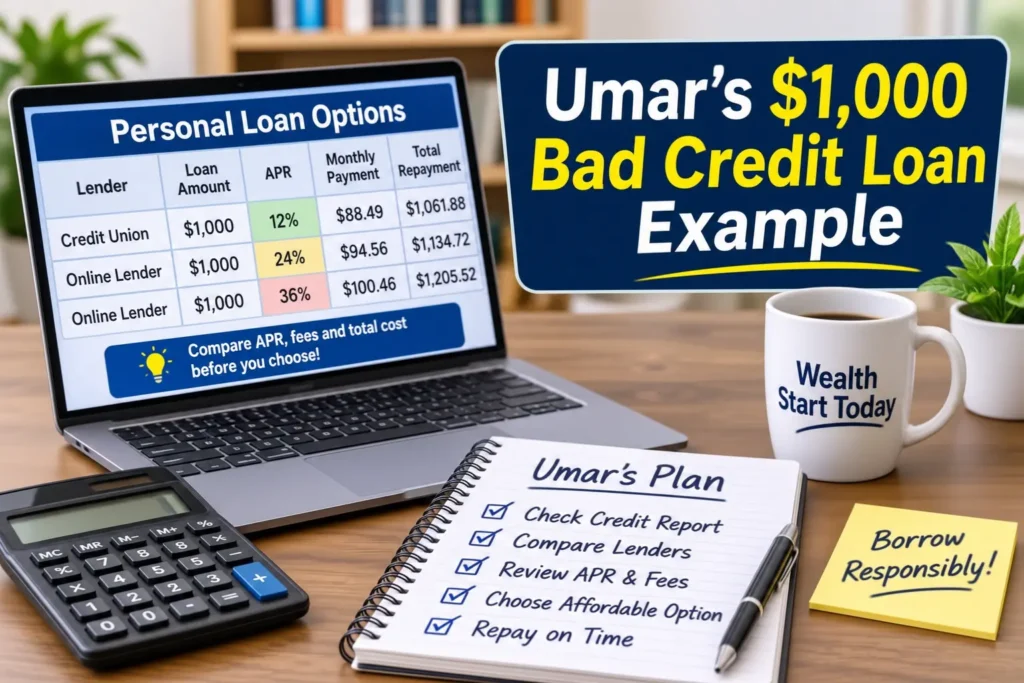
Now imagine another lender offers the same $1,000 loan at a 36% APR over the same period. The estimated monthly payment would be approximately $100.46, and the total repayment would be approximately $1,205.52.
That is around $70.80 more in borrowing costs.
The lesson is simple: comparing APRs and total repayment amounts can help you avoid paying more than necessary.
Actual loan offers may differ, particularly when origination fees or other charges apply.
Real Example: How Umar Could Plan a $1,000 Loan With Bad Credit
Let’s consider a practical situation.
Umar lives in the United States and works full-time. His car unexpectedly needs repairs, and the mechanic estimates that the work will cost $1,000.
Umar has a credit score of 560 because he previously missed several credit card payments. He currently earns $3,200 per month after taxes.
His monthly expenses look like this:
|
Expense |
Monthly amount |
|
Rent |
$1,000 |
|
Food and groceries |
$400 |
|
Transportation |
$250 |
| Utilities |
$180 |
| Existing debt payments |
$300 |
| Other essential expenses |
$400 |
| Total expenses |
$2,530 |
After these expenses, Umar has approximately $670 remaining.
However, that does not mean he should automatically accept a $100 monthly loan payment. He still needs to consider unexpected expenses, savings, and other financial responsibilities.
Here is how Umar could approach the situation:
Step 1: Confirm the actual expense
He asks the mechanic for an itemized estimate and checks whether a less expensive repair option is available.
Step 2: Review his credit reports
Before applying, Umar checks his credit reports for inaccurate late payments, unfamiliar accounts, or incorrect balances.
Step 3: Compare at least three options
He contacts his bank, checks local credit unions, and researches reputable online lenders.
Step 4: Compare the complete borrowing cost
Instead of choosing the lender advertising the lowest monthly payment, he compares APR, fees, repayment period, and total repayment.
Step 5: Check affordability
If the loan payment fits his budget without preventing him from paying rent, utilities, and existing debts, he can consider the offer.
If the payment creates financial pressure, he should look for a cheaper repair option or another source of assistance.
Umar’s example demonstrates an important principle: a small personal loan should solve a financial problem, not create another one.
How to Improve Your Chances of Getting Approved
If your credit score is low, taking a few steps before applying may improve your overall financial position.
Check Your Credit Reports
Visit Annual Credit Report to request free credit reports from Equifax, Experian, and TransUnion.
You can review your reports weekly at no cost.
Look for incorrect account balances, payments reported late by mistake, unfamiliar accounts, and other errors. If you identify inaccurate information, dispute it with the relevant credit reporting company.
The Consumer Financial Protection Bureau (CFPB) also provides guidance on understanding credit reports.
Reduce Existing Debt
If you have high credit card balances, paying down some of that debt may improve your credit utilization ratio.
Your debt-to-income ratio may also become more favorable when you reduce outstanding monthly obligations.
Avoid Multiple Unnecessary Applications
Submitting several full loan applications within a short period can result in multiple hard inquiries.
Ask lenders whether they offer prequalification using a soft credit inquiry before proceeding with a formal application.
Remember that prequalification is not final approval, and a formal application may still require a hard inquiry.
Consider a Smaller Loan
If you only need $500, do not apply for $2,000 without a genuine reason.
A smaller loan may be easier to manage and could reduce your total interest expense.
Consider a Creditworthy Co-Signer Carefully
Some lenders permit co-signed personal loans. A financially stronger co-signer may improve eligibility, but this creates responsibility for both parties.
If you miss payments, the co-signer’s credit can also suffer, and the lender may pursue them for repayment.
Never ask someone to co-sign unless both parties understand the financial and legal obligations.
Bad Credit Small Personal Loan vs. Payday Loan: Which Is Safer?
Borrowers facing emergencies sometimes consider payday loans because they appear convenient.
However, payday loans can become extremely expensive when fees and short repayment periods are considered.
For example, a $100 payday loan with a $15 fee due in two weeks represents an APR of approximately 391%.
By comparison, a fixed-payment installment loan may provide a longer repayment schedule and more predictable monthly payments.
This does not mean every installment loan is affordable. Some bad credit installment loans also carry very high APRs and fees.
Before borrowing, compare the total cost and check your state’s lending laws.
The NCUA’s Payday Alternative Loan program is another option worth researching if you are eligible through a participating federal credit union.
When Should You Avoid a Bad Credit Personal Loan?
A loan is not always the right solution, even when a lender is willing to approve you.
Consider avoiding a new loan if:
- You cannot comfortably afford the monthly payment.
- You are borrowing to make payments on several existing loans.
- The lender refuses to disclose the APR or fees.
- You need another loan to repay the first one.
- Your income is unstable and you have no repayment plan.
- The loan terms are confusing or change unexpectedly.
If you are struggling with multiple debts, another borrowing option may be worth considering.
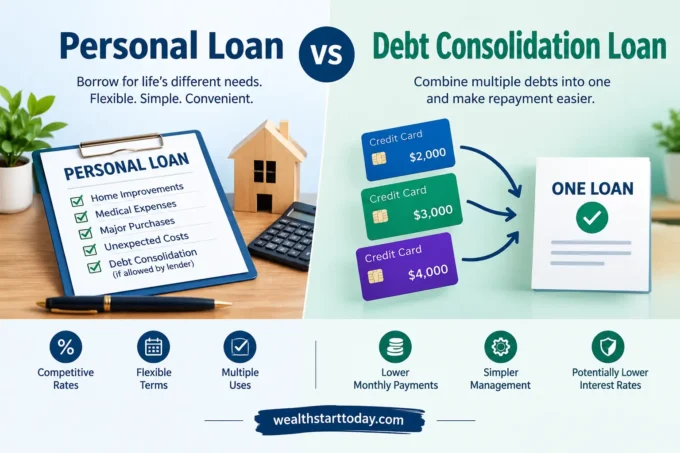
For example, read our guide on personal loan vs. debt consolidation loan to understand how these two options differ.
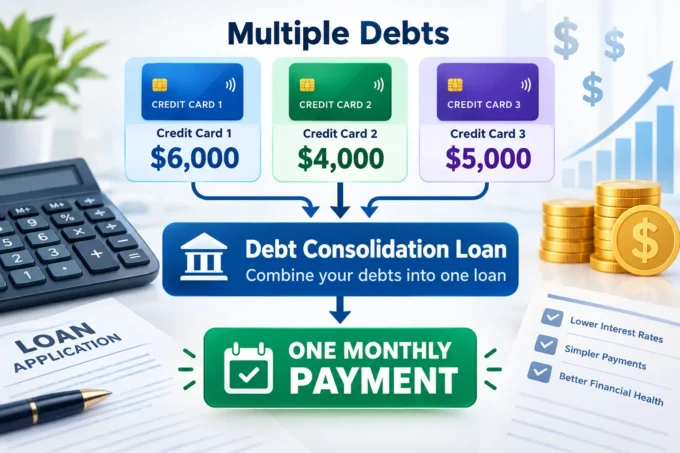
A debt consolidation loan may combine eligible debts into one payment, but it is not automatically cheaper. Compare the APR, fees, repayment period, and total cost before making a decision.
You can also explore our guide to how many personal loans can you have at once? if you are already managing another personal loan.
For a broader understanding of borrowing options, visit our types of loans guide.
Warning Signs of Bad Credit Loan Scams
People searching for small loans with bad credit can become targets of financial scams.
The Federal Trade Commission (FTC) warns consumers about advance-fee loan scams.
Be especially careful when a company:
- Guarantees approval regardless of credit history.
- Demands an upfront payment to release your loan.
- Requests gift cards, cryptocurrency, or wire transfers for supposed loan insurance.
- Refuses to provide a written loan agreement.
- Hides its physical business information or licensing details.
A legitimate lender may charge disclosed application or origination fees where permitted, but paying someone in advance does not guarantee that you will receive a loan.
Read the FTC’s official guidance:
Always verify the lender’s licensing and registration requirements with your state financial regulator.
Frequently Asked Questions
1. Can I get a $500 loan with bad credit?
Possibly. Some credit unions and lenders offer small-dollar loans to borrowers with less-than-perfect credit. Approval depends on income, existing debts, lender requirements, and state regulations.
2. What credit score is needed for a small personal loan?
There is no universal minimum credit score. Some lenders consider applicants below 580, while others require higher scores. Your income, repayment history, and debt obligations may also influence the decision.
3. Can I get a $1,000 personal loan with a 500 credit score?
It may be possible with certain lenders, but approval is not guaranteed. Compare credit union options and reputable lenders, and carefully review the APR and repayment terms before applying.
4. Are small personal loans for bad credit safe?
They can be safe when offered by a legitimate, properly licensed lender with transparent terms and affordable payments. However, high-cost loans can create further financial difficulties. Always check the complete loan agreement.
5. Do bad credit personal loans require collateral?
Not necessarily. Many personal loans are unsecured, meaning you do not pledge an asset as security. However, some lenders offer secured loans that require collateral.
6. Can I get a personal loan without a hard credit check?
Some lenders offer initial prequalification through a soft credit inquiry. However, a full application may involve a hard inquiry. Confirm the process directly with the lender before applying.
7. Are credit unions better than online lenders for bad credit?
Credit unions are worth comparing because some offer affordable small-dollar loan programs. Online lenders may provide more convenient applications, but costs vary. The best option depends on the actual terms you qualify for.
Conclusion: Borrow Carefully When You Have Bad Credit
Finding a bad credit small personal loan in the United States is possible, but the decision deserves careful consideration.
A low credit score does not tell your entire financial story. Your income, existing debt, payment history, and ability to manage monthly expenses also matter.
Before accepting a loan, compare credit unions, banks, and reputable online lenders. Review the APR, origination fees, repayment schedule, and total amount you will pay.
Most importantly, borrow only what you genuinely need and what your budget can comfortably repay.
As Umar’s example shows, responsible borrowing begins with understanding your financial situation, comparing alternatives, and choosing a repayment plan that does not put your essential expenses at risk.
Building better credit takes time, but making informed financial decisions today can help create a stronger foundation for tomorrow.
Disclaimer: This article is for educational and informational purposes only. It does not constitute financial, legal, or lending advice. Loan availability, interest rates, fees, eligibility requirements, and consumer protection laws vary by lender and state in the United States. Loan examples are hypothetical and do not represent actual offers or guaranteed approval. Always review the complete loan agreement, verify the lender’s licensing, and consider consulting a qualified financial professional before borrowing.






Leave a comment