


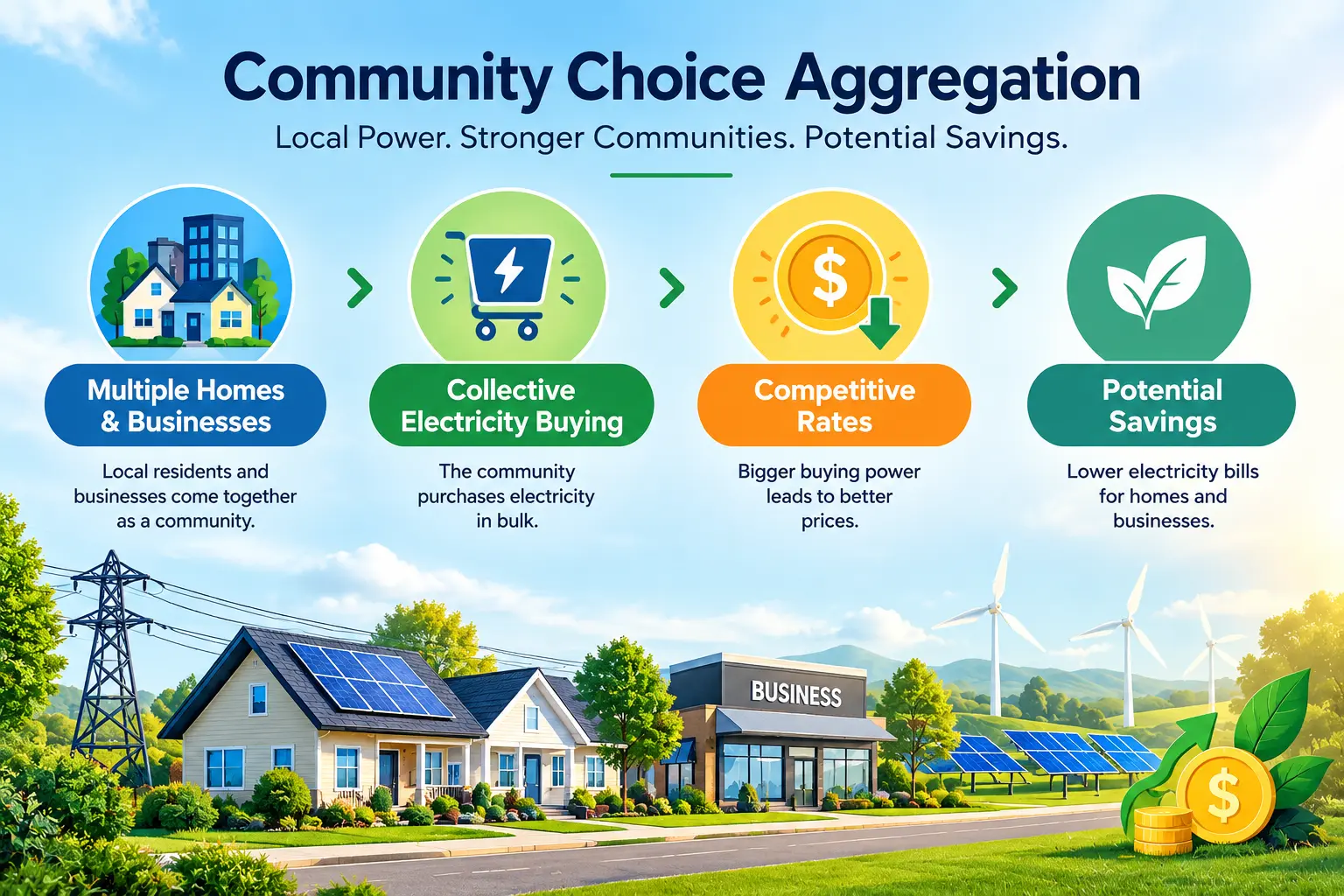
This content discusses how Community Choice Aggregation save money. Community Choice Aggregation (CCA) can help some households and businesses reduce electricity costs, but it does not automatically guarantee savings for every customer. A CCA allows a local government or qualifying public entity to purchase or generate electricity on behalf of participating residents and businesses. The existing utility generally continues to deliver electricity through its transmission and distribution system.
The potential financial benefit comes from combining the electricity demand of many customers. Instead of each customer purchasing electricity generation separately, a CCA can negotiate supply arrangements for a larger group. This collective purchasing power may result in competitive electricity-generation rates and can also give communities more control over their energy choices.
However, the answer to the question “Does community choice aggregation save money?” depends on several factors. Your location, current utility rate, CCA generation rate, electricity usage, program terms, and market conditions can all affect the final cost. A lower generation rate does not necessarily mean that every part of your electricity bill will be lower.
This guide explains how community choice aggregation works, where the potential savings come from, how to compare a CCA with your utility, and what customers should check before participating.
What Is Community Choice Aggregation?
Community Choice Aggregation, commonly called CCA, is a model that allows local governments or qualifying governmental entities to purchase electricity for residents, businesses, and municipal customers.
The CCA generally takes responsibility for procuring electricity generation, while the existing utility continues providing transmission and distribution services. In other words, customers usually do not need a new set of power lines or other physical infrastructure to participate.
The U.S. Environmental Protection Agency explains that CCA programs allow local governments to procure electricity from an alternative supplier while customers continue receiving transmission and distribution service from their existing utility.
This distinction is important because joining a CCA does not necessarily mean replacing your local utility. The electricity generation supplier can change while the company responsible for delivering electricity through the local grid remains the same.
How Does Community Choice Aggregation Work?
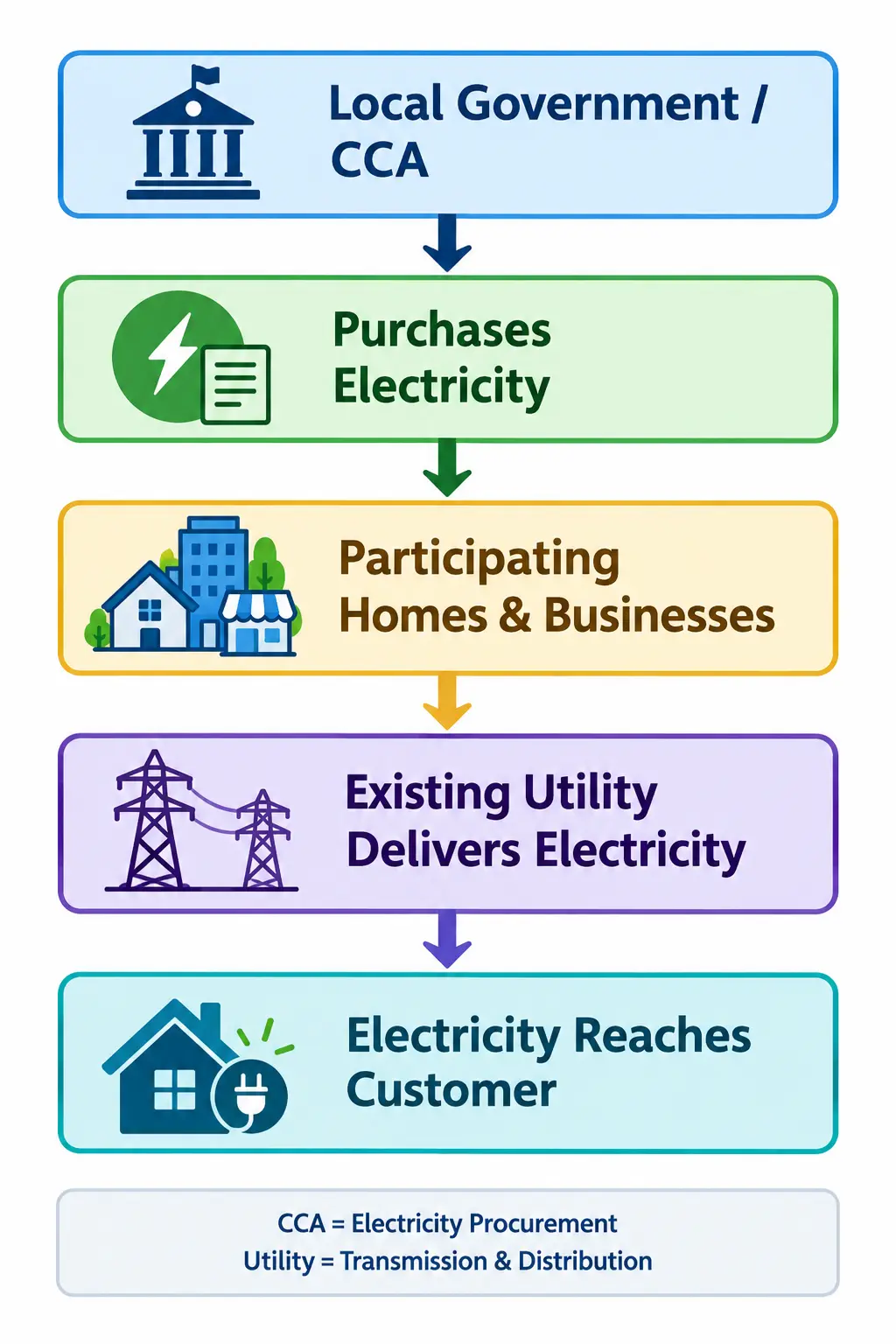
The basic structure is easier to understand when it is divided into several steps.
1. A Community Creates or Joins a CCA
A city, county, or group of local governments establishes a community choice aggregation program where state law allows it.
The exact legal structure varies by state. For example, California allows cities and counties to establish CCAs, including joint programs involving multiple jurisdictions.
2. The CCA Purchases Electricity
The CCA negotiates electricity supply arrangements on behalf of participating customers. It may purchase electricity from different generators or suppliers depending on the program’s goals and contracts.
Because the CCA represents many customers, it can negotiate based on aggregated demand rather than the electricity needs of a single household.
3. The Existing Utility Continues Delivering Electricity
Customers normally continue using the same local electricity infrastructure. The utility remains responsible for transmission and distribution, and in many programs it also continues billing customers through a consolidated bill.
For example, the California Public Utilities Commission states that investor-owned utilities continue to provide transmission, distribution, metering, billing, collection, and customer service for participating CCA customers in California.
4. Customers Pay for Generation and Delivery
An electricity bill can contain several different charges. The CCA generally relates to the generation portion, while the utility continues charging for delivery and other applicable services.
This is why customers should not compare only the advertised CCA generation rate with their entire electricity bill.
Does Community Choice Aggregation Save Money?
Community choice aggregation can save money when the CCA’s electricity-generation costs are lower than the comparable utility generation costs and other applicable charges do not eliminate the difference.
The potential savings come largely from collective purchasing. A community representing thousands of customers may have more negotiating leverage than individual customers purchasing electricity separately.
The EPA notes that CCA electricity prices may be lower than residential retail electricity prices in some circumstances, although the actual savings depend on market conditions and the individual program.
That means customers should avoid assuming that every CCA is cheaper.
A better question is:
“Is this specific CCA cheaper than the comparable utility option for my electricity usage and customer type?”
That comparison provides a more useful answer.
A Simple Example of Potential CCA Savings
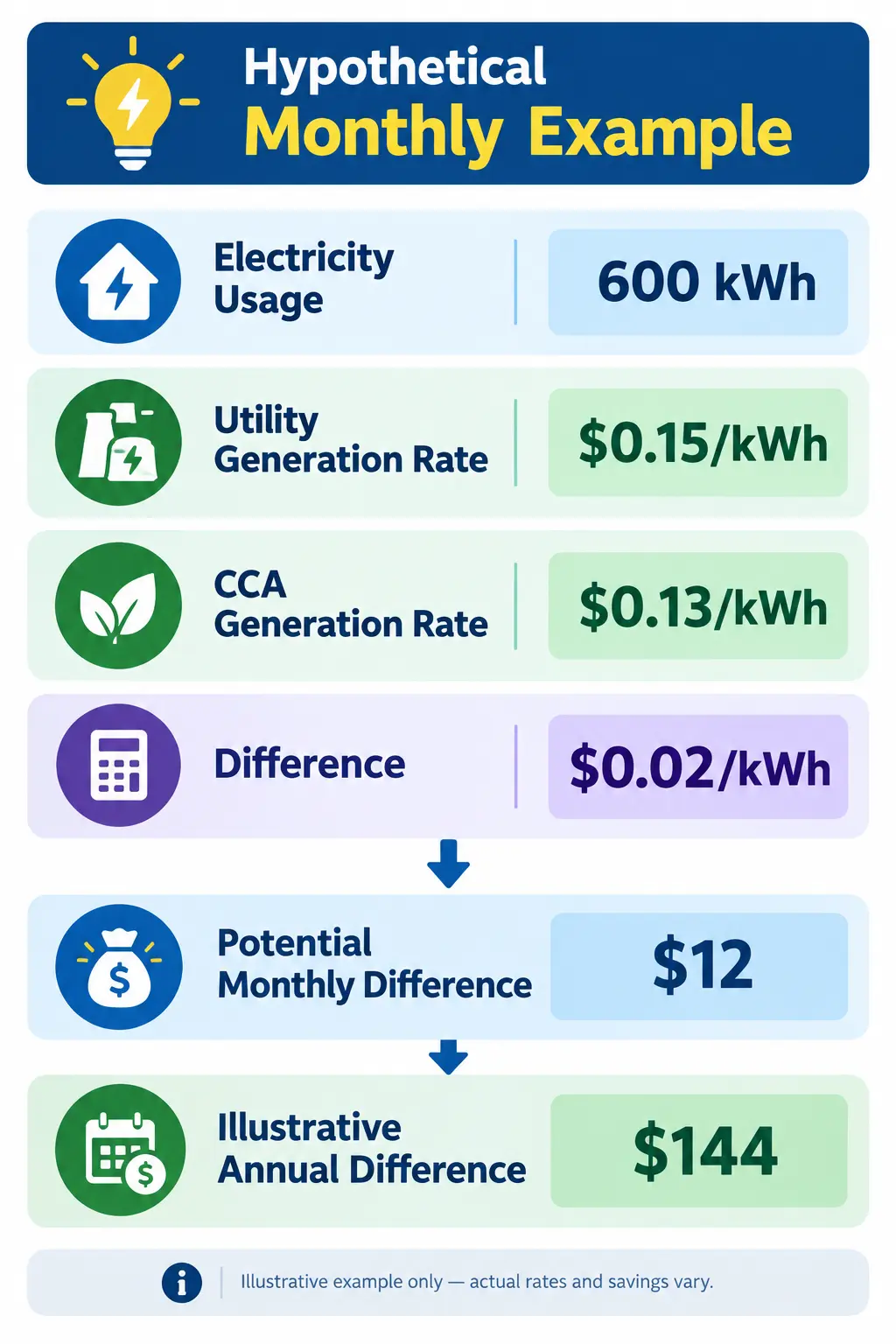
Consider a hypothetical household that uses 600 kilowatt-hours (kWh) of electricity in one month.
Suppose the comparable electricity-generation rate from the utility is:
$0.15 per kWh
Suppose the CCA generation rate is:
$0.13 per kWh
The difference is:
$0.02 per kWh
At 600 kWh of monthly usage:
600 × $0.02 = $12
The potential generation-cost difference would therefore be $12 for that month.
Over 12 months, if the rates and electricity usage remained exactly the same:
$12 × 12 = $144
This is only an illustration, not a guaranteed CCA saving. Actual electricity bills can include delivery charges, taxes, adjustments, fees, and other costs. CCA and utility rates can also change.
The example demonstrates why customers should compare the applicable generation rates and understand which charges actually change when joining a CCA.
What Determines How Much You Can Save?
Several factors influence whether a CCA will reduce your electricity costs.
Your Location
CCA programs are not available everywhere. State laws determine whether communities can establish aggregation programs, and local governments determine which areas participate.
The EPA lists CCA-enabling legislation in states including California, Illinois, Maryland, Massachusetts, New Hampshire, New Jersey, New York, Ohio, Rhode Island, and Virginia. Availability and program structure can change, so consumers should verify the current situation in their state and community.
Your Electricity Usage
Your electricity consumption affects the dollar value of a per-kWh price difference.
For example, if two customers receive the same $0.02-per-kWh generation-rate difference, a customer using 800 kWh would have a larger potential dollar difference than someone using 300 kWh.
That does not mean high-use customers always receive a better deal. It simply means that a per-kWh difference affects more electricity when consumption is higher.
The CCA Generation Rate
The CCA’s current generation rate is one of the most important numbers to examine.
A customer should compare the CCA generation rate with the utility’s comparable generation or supply rate rather than assuming that a CCA is automatically cheaper.
Utility Delivery Charges
Switching electricity generation providers does not necessarily eliminate utility delivery charges.
The existing utility can continue providing transmission and distribution services. Therefore, a customer may see a lower generation rate while still paying similar delivery-related charges.
Market Conditions
Wholesale electricity prices, fuel costs, renewable-energy procurement, long-term contracts, and other market conditions can affect electricity pricing.
A CCA that provides competitive rates at one point in time may have a different price relationship with the utility later.
For this reason, customers should review current rates rather than relying on an old savings claim.
CCA vs. Traditional Utility: What’s the Difference?
The biggest difference is generally who procures the electricity generation.
With a traditional utility arrangement, the utility may provide both electricity generation and delivery services.
With a CCA, the community program can procure electricity generation for participating customers, while the existing utility continues providing transmission and distribution services.
This means customers generally continue receiving electricity through the same physical grid.
The change is primarily related to the source and price of electricity generation rather than the physical delivery infrastructure.
Can a CCA Offer Renewable Energy?
Yes, some CCA programs offer renewable-energy options.
The EPA explains that CCAs can choose renewable electricity as part of their supply arrangements, although renewable energy is not automatically required for every CCA program. Some programs may offer renewable electricity as a default option, while others may provide additional renewable choices.
This can make CCA programs relevant to customers who care about both electricity costs and the sources of their electricity.
However, customers should check exactly what a particular program offers. A renewable option can have different pricing from a standard electricity product, and the percentage of renewable energy can vary.
Real-World Example of CCA Savings
CCA savings can vary considerably from one location to another.
For example, the City of Cleveland’s Sustainable Ohio Public Energy Council (SOPEC) currently reports a supply rate of 10.457 cents per kWh for its August 2026 through July 2027 program year, compared with The Illuminating Company’s listed Price to Compare of 11.16 cents per kWh for July through September 2026. The city also reports that the program has saved participating residents and small businesses an estimated $21 million compared with the utility’s default rate or Price to Compare.
This example shows why CCA savings should be evaluated using the actual rates available in a specific community.
It should not be interpreted as evidence that every CCA will produce the same result.
Where Is Community Choice Aggregation Available?
CCA availability depends on state law and local participation.
The EPA identifies several states with CCA-enabling legislation, including California, Illinois, Maryland, Massachusetts, New Hampshire, New Jersey, New York, Ohio, Rhode Island, and Virginia.
California provides a particularly developed example. The California Public Utilities Commission maintains information on registered CCAs, service areas, and rate comparisons.
The California Energy Commission also lists multiple active community choice aggregators and the communities they serve.
Because CCA availability is local, consumers should check their city, county, state energy agency, utility, or CCA website before assuming they are eligible.
How Are CCA Customers Enrolled?
Enrollment rules depend on the program and jurisdiction.
Some CCA programs use an opt-out model. Under this structure, eligible customers may be automatically enrolled after receiving advance notification, while customers who do not want CCA service can opt out.
Other programs may use different enrollment structures.
The EPA notes that many CCAs have opt-out provisions, while some programs use opt-in arrangements.
California provides a specific example of an opt-out framework. The CPUC states that eligible customers in a participating jurisdiction are generally enrolled unless they choose to opt out, with required customer notifications.
Therefore, never assume that the enrollment or opt-out deadline for one CCA applies to another.
What Are the Potential Benefits of a CCA?
A CCA may provide several potential benefits depending on the program.
Potentially Competitive Electricity Rates
Collective purchasing can give communities greater negotiating power and may result in competitive generation rates.
More Energy Choices
Some CCAs offer different electricity supply options, including renewable-energy choices.
Local Decision-Making
CCA programs can give local governments greater involvement in electricity procurement and energy planning.
Potential Savings
When the CCA generation rate is lower than the comparable utility generation rate, participating customers may reduce their electricity costs.
The key word is potential. Savings are not guaranteed across every community or every period.
What Are the Risks or Drawbacks?
CCA programs also have considerations that customers should understand before participating.
Rates Can Change
A CCA’s rate may not remain below the utility’s rate forever. Electricity markets and supply contracts change over time.
Delivery Charges Still Apply
Customers may continue paying utility delivery and other charges even after changing electricity generation providers.
Program Terms Differ
Enrollment, opt-out deadlines, renewable options, contract terms, and pricing structures vary by program.
Comparing Bills Can Be Confusing
Customers should compare equivalent charges rather than simply looking at the total bill from one month.
Savings Are Not Guaranteed
A CCA should not be viewed as an automatic way to lower every customer’s electricity bill.
How to Compare a CCA With Your Utility
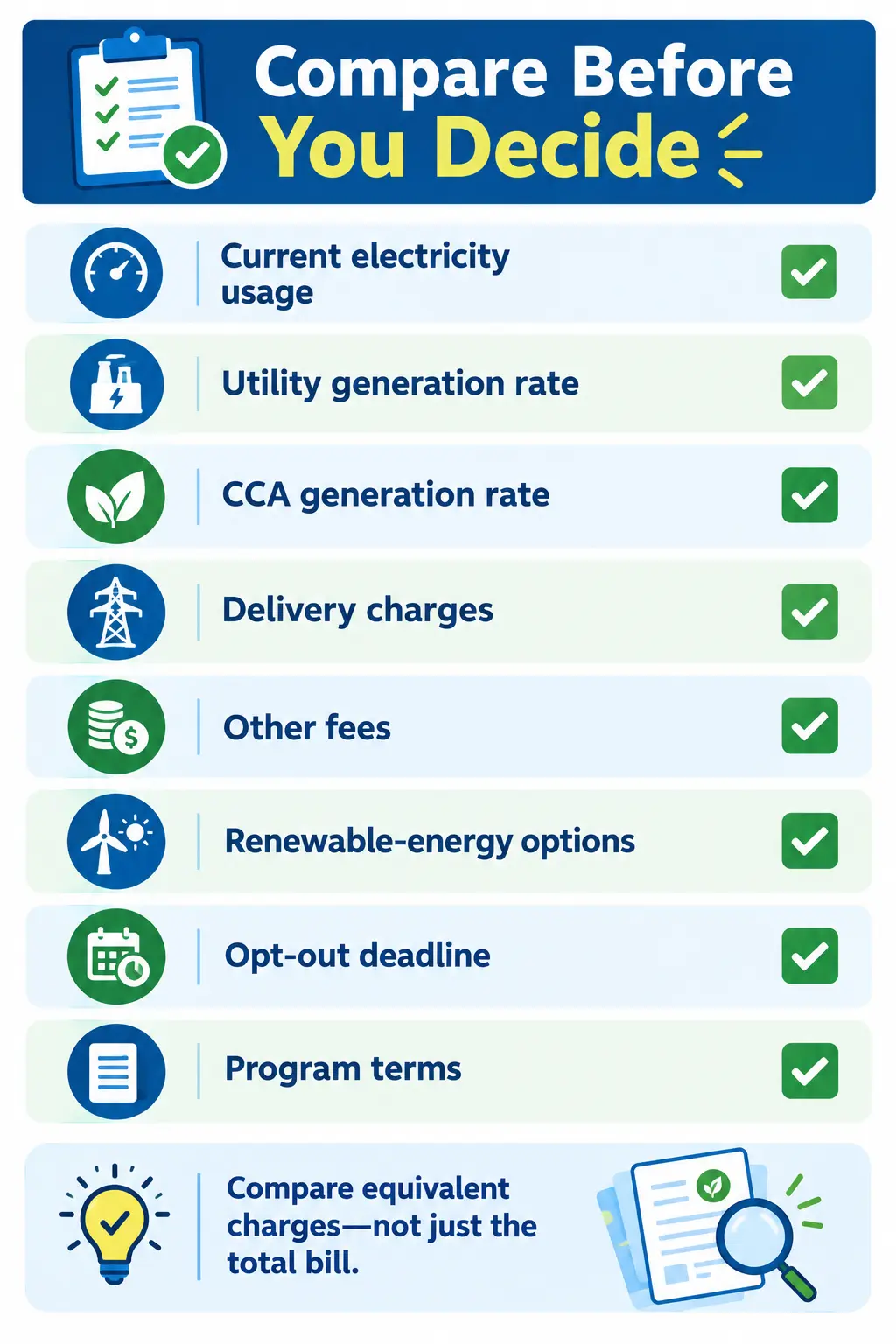
Before deciding whether a CCA can save you money, use a simple comparison process.
Step 1: Find Your Current Electricity Usage
Look at your recent electricity bills and identify your average monthly kWh usage.
Step 2: Identify the Generation Rate
Find the utility’s applicable electricity-generation or supply rate for your customer type.
Step 3: Find the CCA Rate
Check the official CCA website or current customer information for its applicable generation rate.
Step 4: Check Additional Charges
Review delivery charges, adjustments, fees, taxes, and any other charges that may apply.
Step 5: Check Renewable Options
If renewable energy is important to you, find out how much renewable electricity is included and whether a higher-renewable option costs more.
Step 6: Check the Opt-Out Rules
If you do not want to participate, verify the deadline and procedure for opting out.
Step 7: Recheck Rates Periodically
Electricity prices can change. A comparison that was favorable several months ago may not produce the same result later.
How to Maximize Potential Savings
If a CCA is available in your area, there are several practical ways to evaluate its financial value.
First, compare rates using your actual electricity consumption rather than relying on a generic savings percentage.
Second, compare the CCA’s current generation rate with the utility’s current comparable rate.
Third, read the program’s terms carefully. Look for information about rate changes, renewable-energy options, enrollment, opt-out procedures, and contract periods.
Fourth, continue reducing unnecessary electricity consumption. A lower electricity rate can help, but using less electricity can also reduce the amount you spend.
Finally, use official sources whenever possible. Your utility, CCA, state utility commission, or state energy agency is generally more useful for current rates and program terms than an old article or generalized savings claim.
Frequently Asked Questions
Does community choice aggregation save money?
It can. Some CCA programs offer electricity-generation rates below the comparable utility rate, but savings vary by location, electricity usage, program terms, and market conditions. A CCA should not be assumed to be cheaper without comparing current rates.
Does a CCA replace my electric utility?
Usually, no. A CCA generally changes who procures electricity generation, while the existing utility continues providing transmission and distribution services. The exact structure depends on the jurisdiction.
Will I receive electricity through different power lines?
Generally, no. CCA customers continue using the existing electricity grid and utility delivery infrastructure.
Can I opt out of a CCA?
In many CCA programs, yes, but the rules vary. Some programs automatically enroll eligible customers unless they opt out, while others use opt-in structures. Check the official program for the current deadline and requirements.
Does a CCA always provide renewable energy?
No. Some CCAs offer renewable electricity, but the amount and type of renewable energy vary by program. Customers should review the specific CCA’s supply information.
How can I know whether a CCA is cheaper?
Compare the current CCA generation rate with the comparable utility generation rate for your customer type. Then review other applicable charges before estimating your potential savings.
Are CCA savings guaranteed?
No. CCA savings depend on current rates, market conditions, electricity consumption, and program-specific terms. A lower rate today does not guarantee that the CCA will remain cheaper in the future.
Final Takeaway
Community Choice Aggregation can provide a way for communities to purchase electricity collectively and potentially obtain competitive generation rates. It can also give customers additional choices around renewable energy and local electricity procurement.
However, the phrase “community choice aggregation save money” should not be interpreted as a guarantee. The financial result depends on the specific CCA, the utility rate, electricity usage, applicable charges, and current market conditions.
The most reliable way to determine whether a CCA can reduce your electricity costs is to compare current rates using your own electricity consumption and review the program’s terms. Customers should also understand that the existing utility may continue providing transmission, distribution, billing, and other services.
For consumers researching ways to reduce everyday expenses, understanding the actual numbers is more useful than relying on a general savings claim. Compare the rates, check the terms, and use official local information before making a decision.
For more practical guides on reducing expenses and improving your financial habits, visit Wealth Start Today and explore the Saving Money category.














Leave a comment