


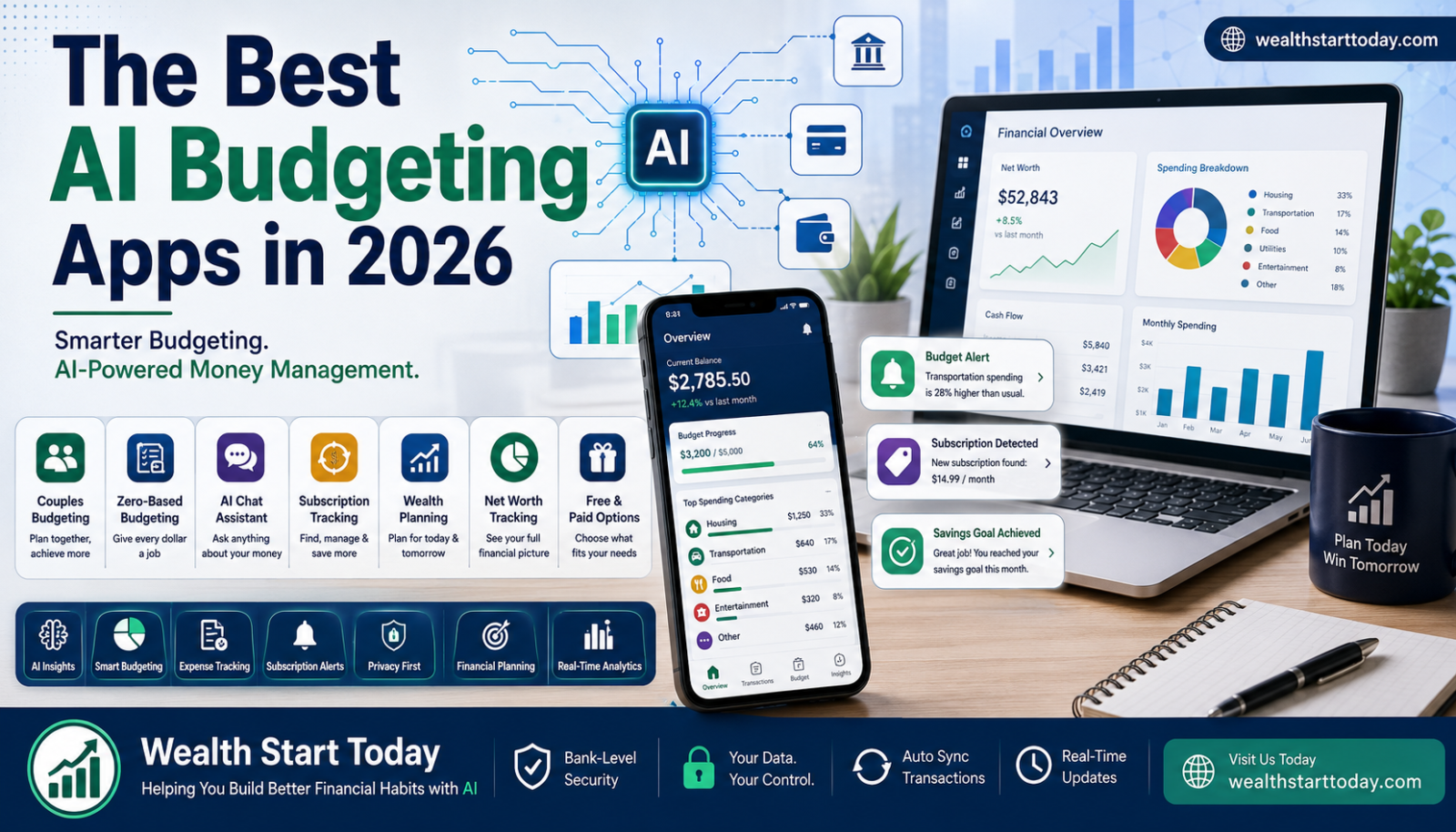
You’re not the only person who has downloaded a budgeting app, used it diligently for two weeks, and then quietly forgotten about it. Conventional budgeting requires you to complete the labor-intensive tasks of manually reconciling every account, classifying every receipt, and recording every cup of coffee. The best AI budgeting apps in 2026 flip that arrangement. Instead of asking you to track your money, they track it for you, learn your habits, and tell you what to do next in plain language.
At Wealth Start Today, we spend a lot of time in our Budgeting category helping readers build systems that actually stick, and AI-powered tools have become one of the biggest shifts in how people manage everyday money. This guide compares the best alternatives available this year, explains what makes an AI budgeting tool truly helpful, and provides you with a step-by-step approach for selecting and configuring one this week.
What Makes an AI Budgeting App Different From a Regular Budgeting App
Not all apps that use the term “AI” in their marketing text do so in a significant way. A true AI budgeting app usually does at least one of three things well: it offers a conversational interface where you can ask questions about your spending in plain English; it uses machine learning to automatically classify transactions and correct itself as you make manual edits; or it proactively flags anomalies—a subscription price hike, an unusual charge, or a category that is trending over budget—before you notice them yourself.
The distinction is important since it alters the true purpose of the app. A chatbot-style app is designed for those seeking certainty and prompt responses. For those who like a simple, automated dashboard and don’t want to worry about the details, a predictive classification app is designed. You can avoid selecting a tool that appears impressive on an app store screenshot but does not align with your true financial philosophy by being aware of the type of AI you are considering.
Why This Distinction Matters for Beginners
If you are completely new to budgeting, whether the software lowers friction is more important than the AI’s workings. Our own budgeting guide for beginners covers this in more depth, but the short version is: the best tool for a novice is not the one with the most functionality, but the one that requires the least amount of willpower to continue using.
Why 2026 Is the Year AI Budgeting Apps Went Mainstream
In a relatively short period of time, the adoption of AI in personal finance has gone from novelty to default. Generative AI usage among US working-age individuals increased from about 45% in 2024 to 55% by 2025, according to McKinsey’s Global Banking Annual Review. McKinsey observes that this adoption rate was quicker than the multi-decade deployment of digital banking (McKinsey & Company). According to rival estimates from McKinsey, the global banking sector may benefit between $200 billion and $340 billion annually from generative AI and advanced analytics, mostly due to productivity advantages that are now permeating consumer-facing technologies like budgeting applications (McKinsey & Company).
Because living expenses continue to rise, this change has an impact on household budgets as well. According to the U.S. Bureau of Labor Statistics, average household expenditures increased from $77,158 to $78,535 in 2024, with housing making up 33.4% of the average household’s total expenditures (U.S. Bureau of Labor Statistics). Automation becomes a necessity rather than a convenience when costs are increasing and household budgets are becoming more constrained.
Rising Household Expenses Make Automation Essential
Small leaks, such as a forgotten subscription, a fee rise, or a category that is going over its limit, quickly mount up when housing, transportation, and food make up around two-thirds of the average household budget. Instead of depending on you to identify it during a monthly review, AI budgeting apps are made to automatically identify this kind of pattern.
How We Evaluated the Best AI Budgeting Apps
Since “best” mostly depends on what you need the app to achieve, it’s important to be clear about the criteria before ranking anything. The depth of the AI (conversational, predictive, or simple rule-based automation), transaction categorization accuracy, support for couples and shared households, pricing transparency, platform availability (iOS, Android, web), data security and privacy practices, and practical usability rather than marketing claims were the seven factors we examined.
Since transparency is a crucial component of reliable financial tools, apps that mainly promote referral-driven items or that were ambiguous about how they monetize user data were given less weight in our evaluation.
The Best AI Budgeting Apps in 2026
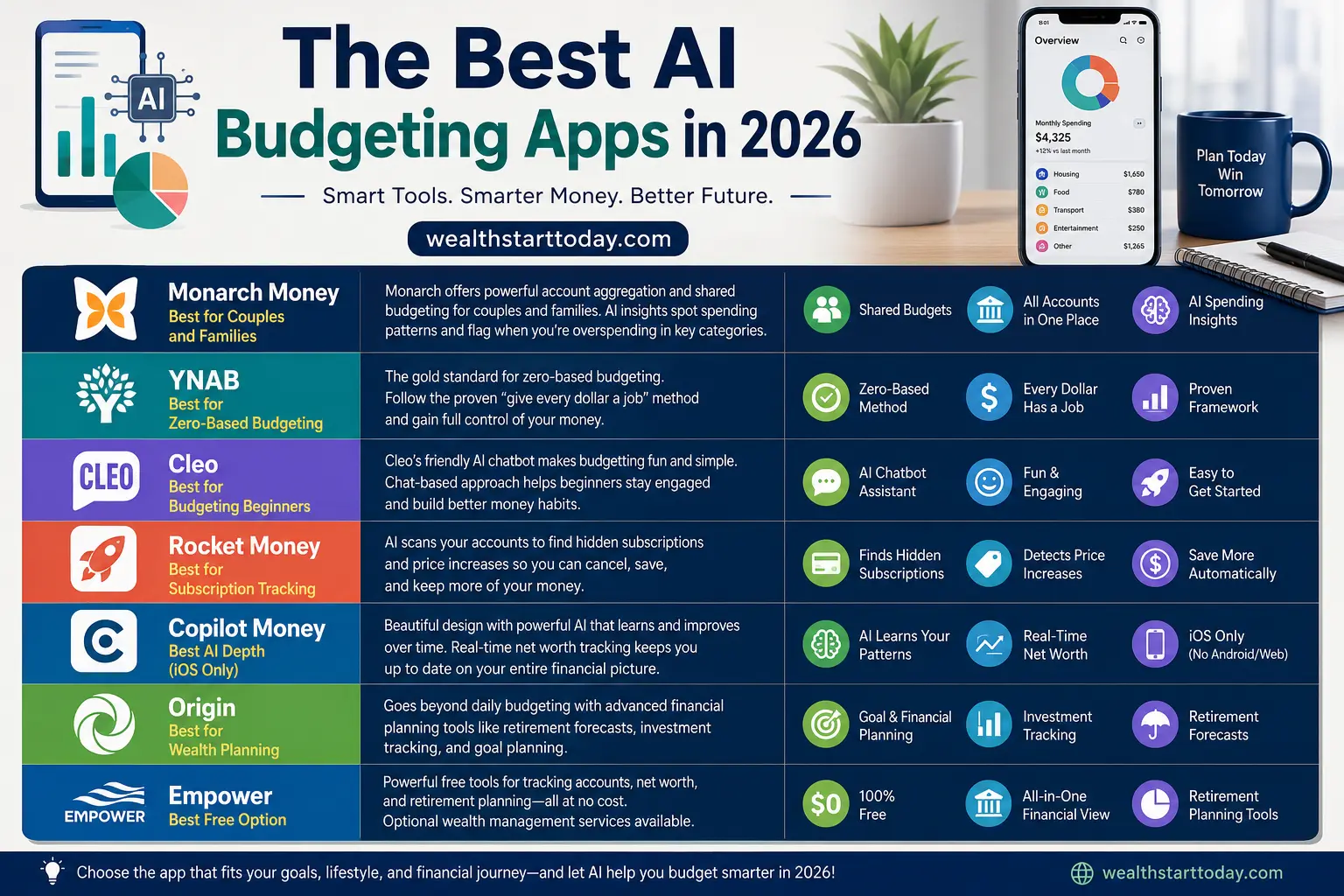
Monarch Money — Best for Couples and Families
With connections to numerous financial institutions, Monarch has developed one of the most complete account-aggregation systems available, providing households with a true comprehensive picture of their financial situation. Its shared budgeting features allow partners to see combined progress without having to reveal every individual transaction, which resolves a common friction point in joint finances, and its AI-driven spending insights reveal helpful, specific patterns, such as flagging when transportation spending is running well above a rolling three-month average.
YNAB (You Need a Budget) — Best for Zero-Based Budgeting
Although YNAB is not primarily an AI tool, it continues to serve as the benchmark for zero-based budgeting’s “give every dollar a job” approach. For those who like the framework of a tried-and-true technique together with less automation, it works well with AI-powered apps. It is worth considering more automatic, hands-off options if the thought of giving each dollar a job seems daunting.
Cleo — Best for Budgeting Beginners
Cleo’s unique selling point is its personality-driven, conversational chatbot, which many novice budgeters find more interesting than a static dashboard. The low-friction, chat-first method can be the difference between starting and not starting at all for someone who has avoided budgeting because spreadsheets feel overwhelming, but it is less appropriate for those who desire in-depth financial analysis.
Rocket Money — Best for Subscription Tracking
The AI at Rocket Money is especially good at bringing up recurring subscriptions that you might have overlooked and spotting service provider pricing increases before they stealthily deplete your account. This targeted strength can recoup the cost of a subscription within the first month of use for households managing an increasing number of streaming, software, and membership subscriptions.
Copilot Money — Best AI Depth (iOS Only)
With machine learning that enhances its transaction classification over time as you make human adjustments, Copilot has one of the most polished, aesthetically pleasing interfaces in the industry. One notable feature is its real-time net worth tracking. The main drawback is platform availability; it is only compatible with iOS and does not have an Android or web app, making it unsuitable for homes with multiple devices.
Origin — Best for Wealth Planning
Origin is a better option for customers who have their basic budget under control and want a single platform that expands with more sophisticated financial goals because it goes beyond daily budgeting into more comprehensive financial planning, such as retirement forecasts and investment tracking.
Empower — Best Free Option
One of the best free solutions is Empower (previously Personal Capital), which combines tools for retirement planning, account aggregation, and net worth tracking without requiring a subscription charge. Instead, it is financed by its optional wealth management services.
Comparison Table: Best AI Budgeting Apps at a Glance
| App | Best For | AI Type | Platforms | Starting Price |
|---|---|---|---|---|
|
Monarch Money |
Couples & families | Predictive categorization + insights | iOS, Android, Web | Paid, free trial |
|
YNAB |
Zero-based budgeting | Minimal AI, strong methodology | iOS, Android, Web | Paid, free trial |
|
Cleo |
Beginners | Conversational chatbot | iOS, Android | Free tier + paid |
|
Rocket Money |
Subscription tracking | Predictive + anomaly detection | iOS, Android, Web |
Free tier + paid |
| Copilot Money | AI depth & design | Predictive categorization | iOS only |
Paid, free trial |
| Origin | Wealth planning | Predictive + planning tools | iOS, Android, Web |
Paid |
| Empower | Free tracking | Predictive categorization | iOS, Android, Web |
Free |
Before subscribing, please check the most recent information directly on each provider’s website as pricing and feature availability are subject to frequent changes.
Action Plan: How to Choose and Start Using an AI Budgeting App This Week
While reading reviews is helpful, creating one is where the true value lies. Make use of this straightforward strategy to transition from study to action without becoming mired in analysis paralysis.
| Step | Action | Timeframe |
|---|---|---|
|
1 |
Identify your “money personality” — do you need coaching, automation, or planning? |
Day 1 |
|
2 |
Shortlist 2 apps that match that personality from the comparison table above |
Day 1 |
|
3 |
Download free trials and connect one primary checking account |
Day 2 |
|
4 |
Review AI categorization accuracy for one week of real transactions |
Days 3–9 |
|
5 |
Set your first budget category limits based on your actual spending, not guesses |
Day 10 |
|
6 |
Turn on proactive alerts for subscriptions, overspending, and anomalies |
Day 10 |
|
7 |
Revisit and adjust after your first full billing cycle |
Day 30 |
AI Budgeting Apps vs Traditional Budgeting Methods
It’s important to acknowledge that AI is an accelerant rather than a substitute for financial literacy. Some people truly appreciate the tactile discipline of manual tracking, and spreadsheets and the traditional envelope method are still effective. AI budgeting apps improve speed and pattern detection by scanning thousands of transactions across several accounts and revealing a trend in a matter of seconds that could take an individual hours to identify by hand.
If you already have a favorite framework, like the popular percentage-based approach we cover in our guide to the 50/30/20 rule in budgeting, an AI budgeting app can often be configured to track and enforce that exact framework automatically, combining the structure you trust with the automation that keeps it going.
Data Privacy and Security: What to Check Before You Connect Your Bank
Security vigilance is just as important as feature comparison because AI budgeting apps usually need read access to your financial accounts. Make sure the supplier supports multi-factor authentication, sells or distributes data with third parties for advertising, and employs bank-level encryption before connecting any accounts. Instead of hiding their data practices in complex legalese, reputable providers will be transparent about them.
OpenAI’s own guidelines on how it handles data use in consumer products are a helpful point of reference for understanding industry norms around AI and personal data for a more comprehensive look at how AI systems manage data ethically (OpenAI). A trend worth keeping an eye on if privacy is your main concern is the promotion of “local-first” architectures, where AI processing takes place without forwarding raw transaction data to external servers.
What to Expect From AI Budgeting Apps Beyond 2026
The field is still developing rapidly, so it’s important to know where things are going so you don’t choose a tool that will seem out of date in a year. There are three notable trends.
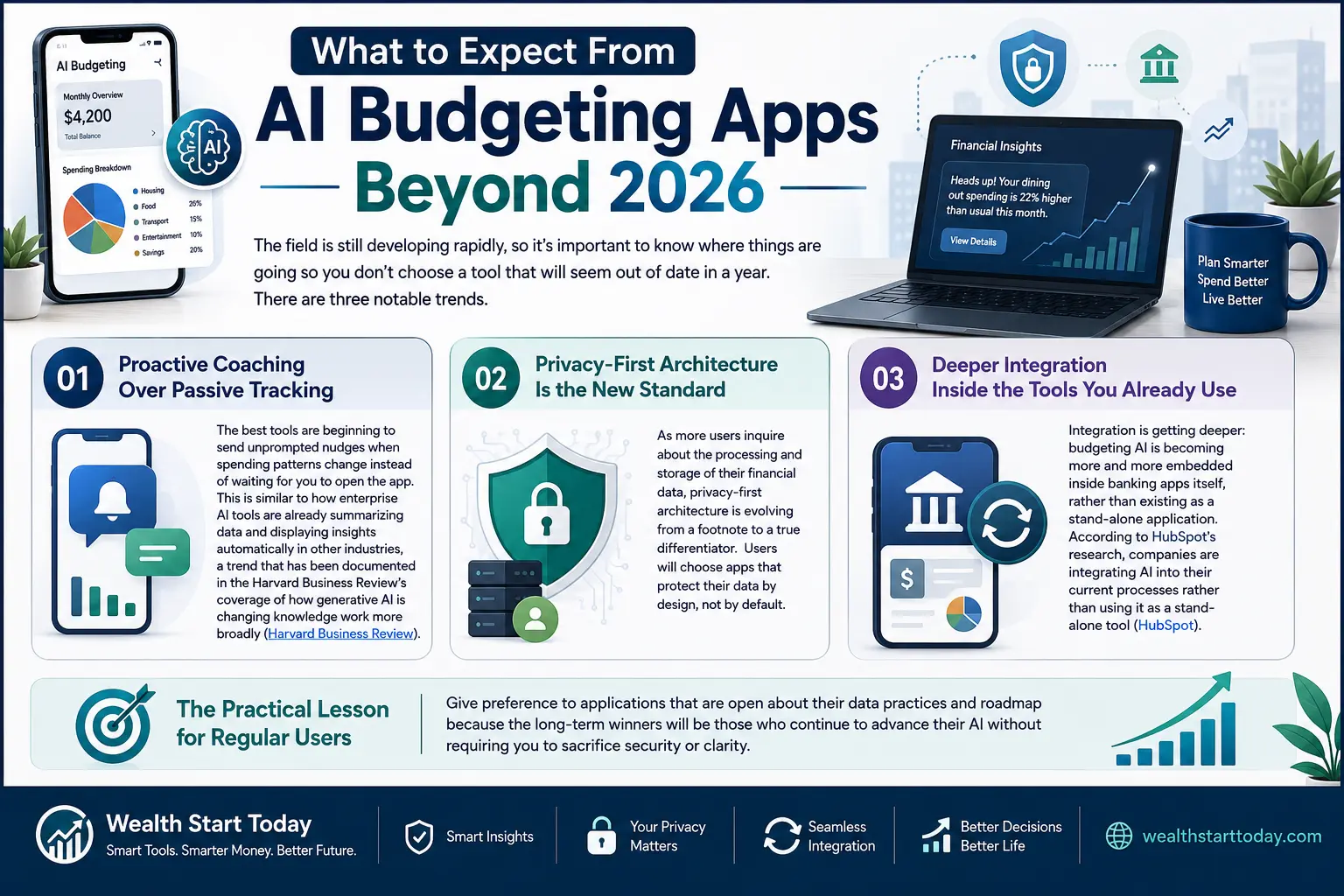
First, proactive coaching is taking the place of passive tracking. The best tools are beginning to send unprompted nudges when spending patterns change instead of waiting for you to open the app. This is similar to how enterprise AI tools are already summarizing data and displaying insights automatically in other industries, a trend that has been documented in the Harvard Business Review’s coverage of how generative AI is changing knowledge work more broadly (Harvard Business Review).
Second, as more users inquire about the processing and storage of their financial data, privacy-first architecture is evolving from a footnote to a true differentiator. Third, integration is getting deeper: budgeting AI is becoming more and more integrated into banking apps itself, rather than existing as a stand-alone application. According to HubSpot’s research, companies are integrating AI into their current processes rather than using it as a stand-alone tool (HubSpot).
The practical lesson for regular users is straightforward: give preference to applications that are open about their data practices and roadmap because the long-term winners will be those who continue to advance their AI without requiring you to sacrifice security or clarity.
About Wealth Start Today and Our Budgeting Category
Wealth Start Today was built around one idea: personal finance advice should be practical enough to use the same day you read it. Our Budgeting category is where we house everything related to building and maintaining a budget that survives real life — not just the first motivated week. This category is intended to be a useful, continuous resource rather than a one-time read, whether you are comparing AI budgeting tools, learning a particular technique, or attempting to fix a budget that keeps breaking apart.
Continue Your Budgeting Journey With These Wealth Start Today Guides
Budgeting Guide for Beginners
If you are just getting started and everything about budgeting still feels overwhelming, our budgeting guide for beginners walks through the fundamentals in plain language — how to determine your actual monthly income, how to distinguish between necessities and wants, and how to create your first budget without thinking you need an accounting degree. This collection of AI budgeting applications goes well with it: read the beginner’s guide to grasp the “why,” then use one of these apps to automate the “how.”
The 50/30/20 Rule in Budgeting
For readers who want a specific, proven framework rather than building a budget from scratch, our breakdown of the 50/30/20 rule in budgeting explains how to split your after-tax income across needs, wants, and savings in a way that is simple enough to remember and flexible enough to adjust. If a percentage-based approach appeals to you, we would suggest reading that guide in addition to this one. A number of the AI budgeting programs discussed above, such as Monarch Money and YNAB, can be set up to track this precise percentage split automatically.
Stay Connected With Wealth Start Today
Budgeting advice works best when it is reinforced consistently, not read once and forgotten. You can follow Wealth Start Today on Facebook and X (formerly Twitter) for regular tips, app updates, and budgeting reminders that go beyond what fits into a single article — it’s a simple way to keep your financial habits on track between visits to the site.
Ready to Put an AI Budgeting App to Work?
You don’t have to completely change your financial situation this week. Before determining whether an app is a good fit, choose one from the comparison table above, link a single account, and let it seven days to understand your spending habits. The households that succeed with the best AI budgeting apps are not the ones with the most complicated setup — they are the ones who start small, stay consistent, and let automation do the repetitive work while they focus on the decisions that actually move the needle.
FAQs
- What are the best AI budgeting apps in 2026?
The best choices are Monarch Money for families and couples, YNAB for zero-based budgeting, Cleo for novices, Rocket Money for tracking subscriptions, Copilot Money for iOS users seeking AI depth, Origin for more comprehensive wealth planning, and Empower for a powerful free option based on current features and user needs.
- How do AI budgeting apps actually work?
The majority of AI budgeting apps employ machine learning to automatically classify transactions, identify spending patterns, and highlight anomalies like subscription price rises or unexpected charges after securely connecting to your bank and credit card accounts. Additionally, some have conversational chat tools that let you ask straightforward inquiries regarding your expenditures.
- Are AI budgeting apps safe to use?
Reputable AI budgeting apps have read-only access to your accounts and employ bank-level encryption, which prevents them from transferring funds without further authorization. Check an app’s privacy statement, make sure multi-factor authentication is supported, and find out how it makes money. Subscription payments are typically more apparent than unreported data-sharing agreements.
- Do I need to pay for an AI budgeting app to get good results?
Not always. Solid fundamental functionality is provided by free solutions such as Empower and the free levels of Rocket Money and Cleo. Once you have established your fundamental budgeting practices, the advanced planning tools, more frequent synchronization, and deeper AI coaching that come with paid tiers may be worthwhile.
- What is the best AI budgeting app for beginners?
Because Cleo’s conversational interface makes it easier to interact with your finances, it is frequently suggested for novices. Any beginner-friendly app that is paired with a foundational resource, like a beginner’s budgeting guide, typically yields better long-term outcomes than the app by itself.
- Can AI budgeting apps replace a financial advisor?
No, AI budgeting apps are great for daily tracking, classification, and habit-building, but they shouldn’t be used in place of individualized financial or investment guidance, especially when it comes to complicated issues like estate planning, tax strategy, or retirement planning. A professional financial advisor is still the best option for those needs.
Conclusion
The best AI budgeting apps in 2026 are not defined by which one has the flashiest chatbot or the most features crammed into a dashboard. They are determined by fit, which is the degree to which an app’s AI aligns with how you personally handle, avoid, or think about your finances. Rocket Money addresses a particular subscription-creep issue, Monarch Money and Empower serve households seeking complete automation, Cleo serves those seeking a more mild entry point, and YNAB continues to be the best option for those seeking a tried-and-true manual approach with modest automation added on top.
Whichever option you decide on, make sure it is supported by a strong foundation, such as knowing your income and expenses, adhering to a structure such as the 50/30/20 rule, and reviewing your setup on a monthly basis rather than considering it as a one-time exercise. For more guides like this one, explore the full Budgeting category on Wealth Start Today, where we’ll keep tracking how AI is changing personal finance throughout 2026 and beyond.
This post does not constitute financial advice; it is merely meant to be informative and educational. The aforementioned apps’ availability, features, and prices are subject to change; before subscribing, confirm the most recent information directly with each supplier.














Leave a comment