


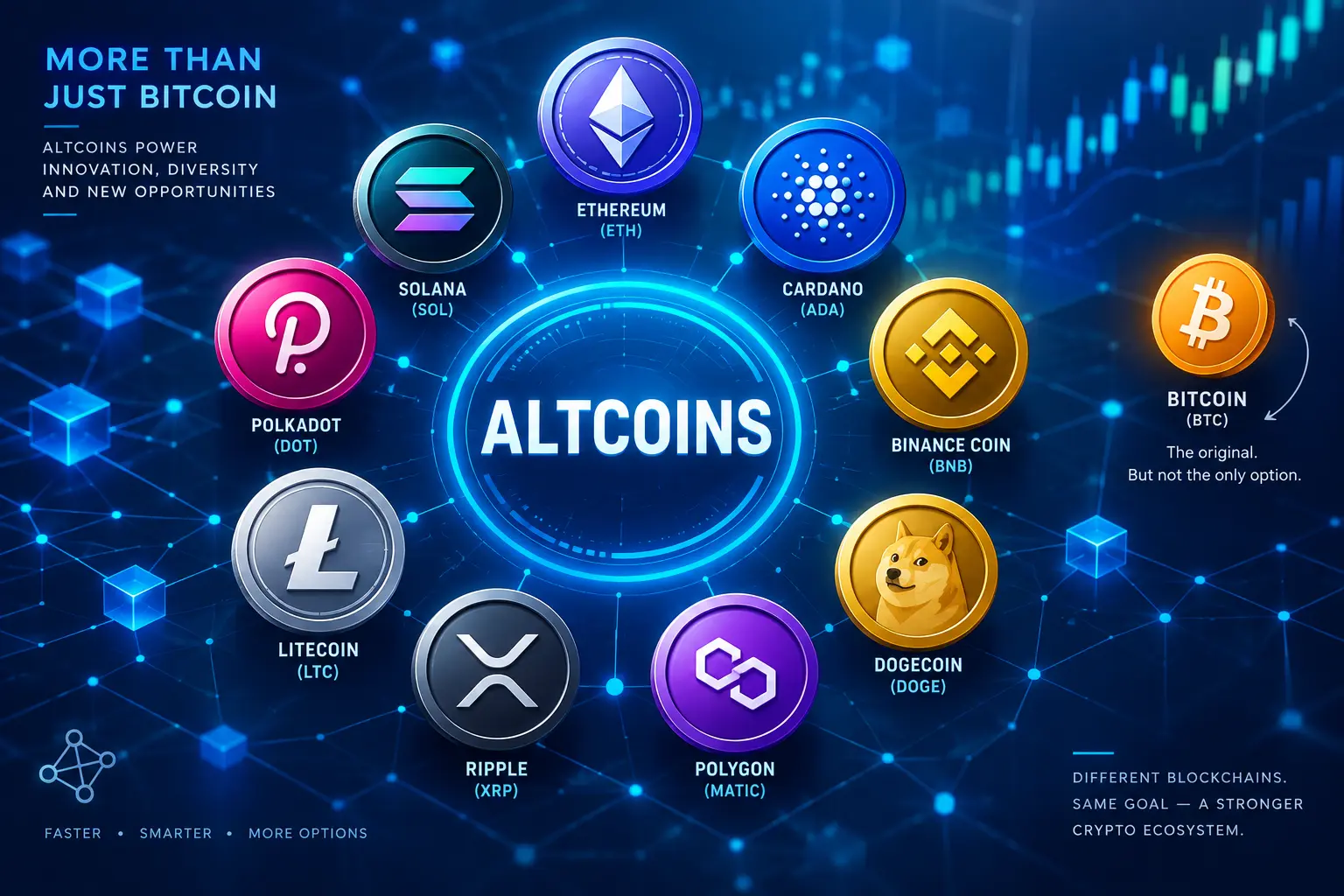
If you have recently started learning about cryptocurrency, you have probably come across the term altcoins. Bitcoin may be the cryptocurrency most people recognize, but the crypto market includes thousands of other digital assets designed for different purposes.
Some altcoins are used to power blockchain networks, some support decentralized applications, some are designed for payments, while others provide governance or other functions within a particular ecosystem. However, not every altcoin has a strong use case, and some projects can carry substantially higher risks than established cryptocurrencies.
So, what are altcoins, how do they work, and what should beginners know before considering them?
This guide explains altcoins in simple terms, including their types, real-world examples, benefits, risks, and practical factors to research before putting money into any crypto asset.
What Are Altcoins?
The word altcoin comes from “alternative coin.” In its broadest and most commonly used definition, an altcoin is any cryptocurrency other than Bitcoin.
For example, Ethereum, Solana, XRP, Cardano, and many other cryptocurrencies are commonly described as altcoins. However, terminology is not completely consistent. Some people use “altcoin” for every cryptocurrency other than Bitcoin, while others exclude Ethereum because of its size and importance within the crypto ecosystem.
CoinMarketCap similarly defines an altcoin as a cryptocurrency other than Bitcoin and notes that the exact definition can vary within the crypto community.
The important point for a beginner is simple: Bitcoin is one cryptocurrency, while altcoins refer to the much larger group of alternative crypto assets.
If you are completely new to blockchain technology, it may help to first understand the broader concept of cryptocurrency. Our guide on what cryptocurrency is explains blockchain networks, digital assets, mining, staking, and other basic concepts before moving into individual crypto projects.
How Do Altcoins Work?
There is no single technology or system that all altcoins use. Different projects can have completely different designs.
Some altcoins operate on their own blockchain. Others are tokens created on an existing blockchain such as Ethereum.
For example, Ethereum is a blockchain network that allows developers to create smart contracts and decentralized applications. Its native cryptocurrency is called Ether, or ETH. Ethereum’s documentation explains that smart contracts are programs deployed on the blockchain that can automatically execute functions when users interact with them.
This means an altcoin can do much more than simply act as digital money.
Depending on the project, a cryptocurrency may be used to:
- Pay blockchain transaction fees
- Secure a network through staking
- Participate in decentralized applications
- Vote on project governance
- Transfer digital value
- Provide access to specific services
- Support decentralized finance applications
- Represent digital or tokenized assets
The underlying technology matters because the value and usefulness of an altcoin can depend heavily on what its network actually does.
Bitcoin vs. Altcoins
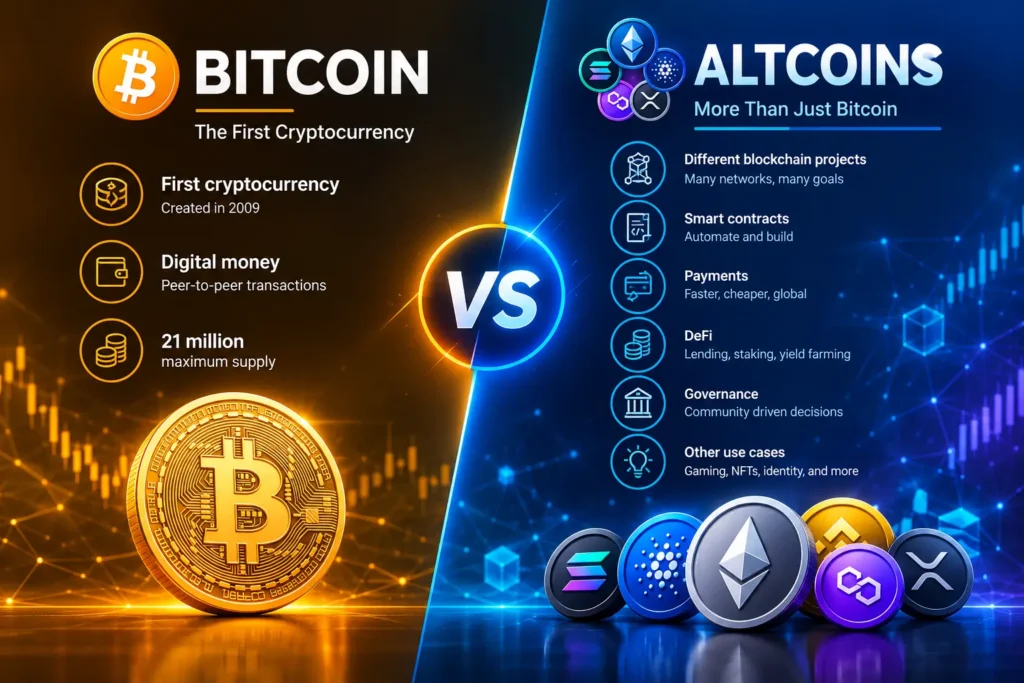
Bitcoin was introduced in 2009 and remains the original cryptocurrency. Its primary design focuses on peer-to-peer digital money and a decentralized monetary network. Click here for more information about what bitcoin is.
Altcoins developed later with different objectives.
Ethereum, for example, expanded the concept by introducing a programmable blockchain capable of running smart contracts. Other networks have focused on transaction speed, scalability, decentralized applications, interoperability, payments, or specialized use cases.
Bitcoin also has a maximum supply of 21 million coins. That fixed supply is one of the characteristics frequently discussed when people compare Bitcoin with other crypto assets.
The difference is therefore not simply that Bitcoin is “old” and altcoins are “new.” The more useful question is what problem does a particular blockchain or token attempt to solve?
A cryptocurrency with a real network, active developers, users, and useful applications has a different profile from a token created primarily around speculation.
Main Types of Altcoins
Altcoins are not one uniform category. Understanding their different functions can help beginners avoid treating every cryptocurrency as if it works in the same way.
1. Layer 1 Altcoins
Layer 1 refers to a base blockchain on which transactions and applications operate.
Ethereum is one of the best-known examples. Other Layer 1 networks include Solana, Avalanche, Cardano, and several others.
These networks can have their own native cryptocurrencies. The native asset may be required to pay transaction fees or participate in network security.
Ethereum, for example, uses proof of stake. Validators stake ETH to participate in securing the network. Ethereum’s documentation states that a validator must deposit 32 ETH to operate a standard validator directly.
Layer 1 projects can therefore be viewed as blockchain infrastructure rather than simply digital currencies.
2. Utility Tokens
Utility tokens are designed to provide a specific function within a blockchain project or digital ecosystem.
For example, a token might be required to access a service, pay certain fees, or use particular features.
The important distinction is that the token’s usefulness is connected to the project behind it.
A beginner should therefore ask:
What can this token actually be used for?
If the answer is unclear, it becomes much harder to evaluate whether the project has meaningful utility.
3. Governance Tokens
Some decentralized projects allow token holders to participate in governance.
A governance token can give holders voting rights over certain decisions, such as protocol parameters, treasury spending, or proposed changes.
However, governance rights vary considerably between projects. Owning a token does not automatically mean that someone has legal ownership of a company.
The actual governance structure should always be examined in the project’s official documentation.
4. Stablecoins
Stablecoins are crypto assets designed to maintain a relatively stable value, commonly by referencing an asset such as the U.S. dollar.
Examples include USDT and USDC.
Stablecoins are different from highly volatile cryptocurrencies because their primary purpose is generally value transfer or maintaining a stable unit of account rather than maximizing price appreciation.
However, “stable” does not mean risk-free. The structure behind a stablecoin, its reserves, redemption mechanisms, issuer, and regulatory environment can all matter.
The collapse of TerraUSD in 2022 demonstrated why assumptions about stability can be dangerous.
5. Memecoins
Memecoins are cryptocurrencies that often originate from internet culture, jokes, memes, or online communities.
Dogecoin is a well-known historical example, while Shiba Inu is another widely recognized memecoin.
Memecoins can attract large communities and significant trading activity, but their prices can also be heavily influenced by sentiment, social media attention, and speculation.
A high level of online attention does not by itself prove that a cryptocurrency has strong fundamentals.
Real Example: Ethereum
Ethereum provides a useful example of why the term altcoin covers projects with very different characteristics.
Ethereum launched in 2015 and introduced programmable smart contracts. This allowed developers to create decentralized applications directly on a blockchain.
One of the biggest technical changes in Ethereum’s history happened in September 2022, when the network moved from proof of work to proof of stake through an upgrade known as The Merge.
Ethereum’s own documentation explains that the change dramatically reduced the network’s energy consumption. Ethereum currently estimates that its annualized electricity consumption fell by more than 99.988% after the transition.
This is a good example of why beginners should look beyond the price of a cryptocurrency.
When researching an altcoin, it can be more useful to understand:
- What technology does it use?
- What problem does it solve?
- Who develops it?
- How many people use the network?
- What applications run on it?
- How is the network secured?
- How is the token supply managed?
These questions provide more information than simply looking at whether a coin has recently increased in price.
Real Example: The Terra and LUNA Collapse
The history of altcoins also provides important lessons about risk.
In early May 2022, TerraUSD, an algorithmic stablecoin associated with the Terra ecosystem, lost its intended $1 peg. Its connected cryptocurrency, LUNA, also collapsed.
The U.S. Office of Financial Research reported that TerraUSD’s market capitalization had reached approximately $18.7 billion before falling to about $220 million by the end of May 2022. The report also documented that LUNA’s price fell dramatically during the same period.
CoinMarketCap’s historical data shows that LUNA was trading above $80 in early May 2022. Here is 2022 collapse documented data.
This example is important because Terra was not an unknown project with no market participation. It had become a significant part of the cryptocurrency market before the collapse.
The lesson for beginners is not that every altcoin will fail. Instead, it demonstrates why market size, popularity, and previous price performance do not guarantee that a cryptocurrency will remain valuable.
Why Do People Buy Altcoins?
People may acquire altcoins for several different reasons.
Some want to use a particular blockchain or decentralized application. Others may believe a project will gain users over time. Some participate in staking or governance, while others trade cryptocurrencies based on market expectations.
There is also a speculative component.
Because some smaller cryptocurrencies have historically experienced very large price movements, investors may be attracted by the possibility of substantial gains.
But the same characteristic works in both directions.
A cryptocurrency that rises quickly can also decline rapidly. Therefore, a large historical gain should not automatically be interpreted as evidence of future performance.
The SEC’s Investor.gov resources describe crypto asset investments as potentially highly volatile and speculative and emphasize that the risk of loss can be significant.
Advantages of Altcoins
Altcoins can offer several characteristics that make them interesting from a technology and financial-market perspective.
Different Use Cases
Unlike Bitcoin’s primary focus on decentralized digital money, many altcoins are designed around specific applications such as smart contracts, decentralized finance, gaming, governance, or blockchain infrastructure.
Blockchain Innovation
Competition between blockchain projects can encourage experimentation with scalability, transaction processing, consensus mechanisms, interoperability, and decentralized applications.
Access to New Ecosystems
Some altcoins function as the native assets of networks that host decentralized applications. Holding or using the native asset may be necessary to interact with those ecosystems.
Potential for Adoption
If a blockchain develops a useful product and attracts users and developers, demand for its ecosystem may potentially increase.
However, adoption is not guaranteed. A technically interesting project can still struggle to attract users, developers, liquidity, or sustainable revenue.
Risks of Altcoins
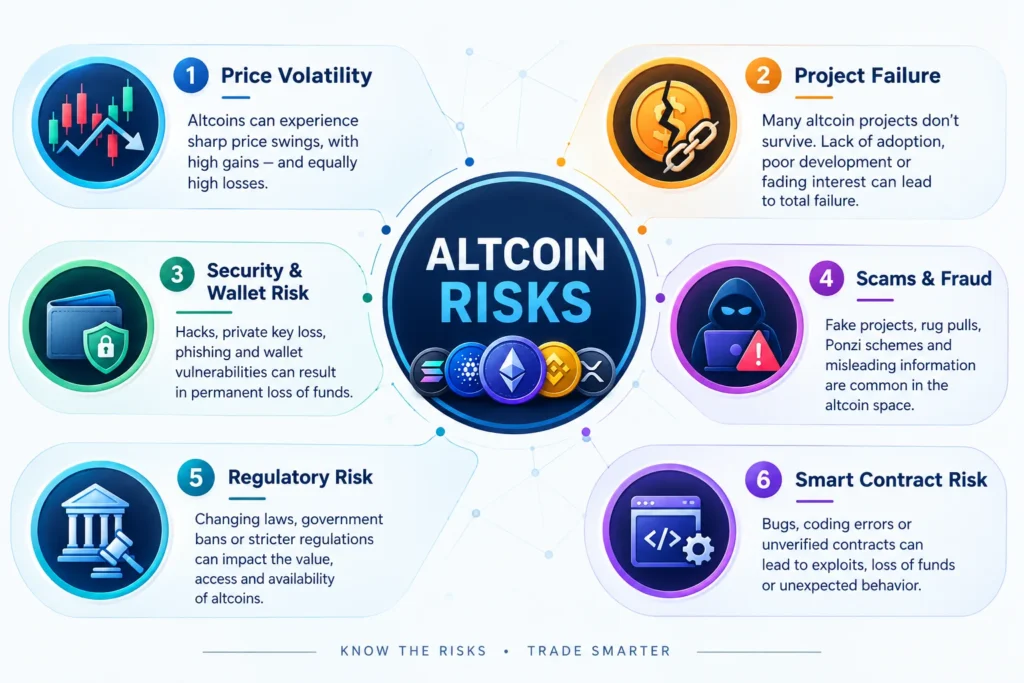
Understanding the risks is just as important as understanding the potential benefits.
High Price Volatility
Altcoins can experience substantial price movements.
Smaller cryptocurrencies may have less liquidity than major assets, meaning relatively large buy or sell orders can have a greater effect on market prices.
Project Failure
A blockchain project can lose developers, users, funding, or community support.
In extreme cases, an asset may become difficult or impossible to trade.
Scams and Fraud
The crypto industry has attracted scammers because transactions can move quickly and may be difficult to reverse.
Investor.gov warns that fraudsters use fake investment opportunities, social media, impersonation, and other techniques to target people interested in crypto assets.
Claims such as “guaranteed returns,” “zero risk,” or “you cannot lose money” should therefore be treated as major warning signs.
Smart Contract Risk
Projects using smart contracts can contain coding vulnerabilities.
Even if a blockchain itself operates correctly, a decentralized application built on it can have security problems.
Regulatory Risk
Cryptocurrency regulations vary between countries and can change over time.
An asset, exchange, service, or token may face different legal treatment depending on where the user lives.
Custody and Private-Key Risk
Crypto ownership introduces an additional security responsibility.
According to Investor.gov’s 2025 crypto custody bulletin, wallets do not actually store crypto assets. Instead, they store the private keys or credentials that allow users to authorize transactions.
If a private key or recovery phrase is lost or exposed, recovering the associated assets can be extremely difficult or impossible.
How to Research an Altcoin Before Buying
Instead of starting with the question, “How much can this coin increase?”, beginners can use a research checklist.
1. Understand the Use Case
Read the project’s official documentation and determine what problem it is trying to solve.
If you cannot explain the purpose of the project in simple language, you may not understand it well enough to evaluate.
2. Research the Team and Development
Look at the project’s developers, public documentation, GitHub activity where relevant, and development history.
A functioning project should provide evidence of ongoing development.
3. Check Market Capitalization
Market capitalization is generally calculated by multiplying the current price by the circulating supply.
Price alone can be misleading.
For example, a token priced at $0.10 is not necessarily “cheaper” than a token priced at $100. The number of tokens in circulation can be dramatically different.
4. Study Token Supply
Look at:
- Circulating supply
- Maximum supply
- Total supply
- Token unlock schedules
- Inflation mechanisms
- Distribution among insiders and other holders
A project with a large amount of future supply entering circulation can face different economic pressures from one with a fixed or tightly controlled supply.
5. Look at Liquidity
A cryptocurrency may appear attractive on a price chart but still have limited trading liquidity.
Lower liquidity can make it harder to buy or sell large positions without affecting the market price.
6. Read the Risk Disclosures
Do not rely entirely on social media influencers or promotional videos.
Read official documentation and independent sources. Look for information about security incidents, token concentration, governance, regulatory issues, and previous failures.
A Simple Altcoin Research Example
Imagine that two hypothetical altcoins both trade at $1.
Coin A has 10 million coins in circulation.
Its market capitalization would be:
$1 × 10 million = $10 million
Coin B has 10 billion coins in circulation.
Its market capitalization would be:
$1 × 10 billion = $10 billion
Both coins have the same price, but their market values are dramatically different.
Now suppose Coin B plans to release another 20 billion tokens over several years. That future supply could affect the economics of the token.
This is why looking only at the coin’s price can lead to a misleading conclusion.
How Beginners Can Approach Altcoins More Carefully
There is no universal strategy that makes altcoin investing safe.
However, beginners can reduce avoidable mistakes by slowing down their research process.
First, understand the technology before purchasing the token. Second, verify information using more than one source. Third, avoid making decisions solely because an influencer says a coin will rise.
It is also important to protect your wallet and exchange accounts. Investor.gov recommends strong passwords, multi-factor authentication, careful selection of custodians, and never sharing private keys or seed phrases.
Most importantly, never assume that a cryptocurrency will recover after a major decline.
A 90% decline requires a 900% gain simply to return to the original price. That mathematical reality is one reason risk management matters so much when dealing with volatile assets.
Are Altcoins a Good Investment?
There is no single answer that applies to everyone.
Altcoins represent a broad collection of assets with very different technologies, purposes, market structures, and risks.
Some projects have developed substantial ecosystems and real-world use cases. Others have disappeared, lost most of their value, or failed to attract sustainable adoption.
Therefore, the more useful question is not simply whether altcoins are “good” or “bad.”
Instead, a person researching a particular altcoin should ask whether they understand the project, its risks, token economics, technology, liquidity, and regulatory environment.
Cryptocurrency should also be considered within the context of a person’s overall financial situation. Money needed for essential expenses or emergency savings should not automatically be exposed to highly speculative assets.
Frequently Asked Questions About Altcoins
What is an altcoin in simple terms?
An altcoin is generally a cryptocurrency other than Bitcoin. Ethereum, Solana, XRP, and many other digital assets are commonly described as altcoins.
Is Ethereum an altcoin?
The answer depends on the definition being used. In the broad definition, Ethereum is an altcoin because it is not Bitcoin. Some people use “altcoin” more narrowly for cryptocurrencies other than Bitcoin and Ethereum.
Are altcoins the same as cryptocurrencies?
Altcoins are a category within the broader cryptocurrency market. Bitcoin is a cryptocurrency but is generally not called an altcoin.
Are all altcoins risky?
No two crypto projects have exactly the same risk profile. However, crypto assets can be highly volatile and speculative, and smaller or less liquid altcoins can carry substantial risks.
Can an altcoin lose all its value?
Yes. Individual crypto projects can fail, lose users, experience security problems, face regulatory restrictions, or become difficult to trade. The Terra/LUNA collapse provides a real historical example of how quickly a major crypto project can lose value.
How do I research an altcoin?
Start by understanding its purpose, technology, development team, token supply, market capitalization, liquidity, security history, governance, and regulatory considerations. Use official documentation and independent sources rather than relying only on social media promotion.
What is the difference between Bitcoin and altcoins?
Bitcoin was the first cryptocurrency and was designed primarily as a decentralized digital payment and monetary network. Altcoins include a wide variety of other cryptocurrencies, many of which are designed for additional functions such as smart contracts, decentralized applications, governance, or specialized blockchain services.
Final Thoughts
Altcoins have expanded the cryptocurrency ecosystem far beyond the original idea of digital peer-to-peer money.
Projects such as Ethereum demonstrated that blockchains could support programmable applications, while other networks have experimented with different approaches to scalability, payments, governance, and decentralized services.
At the same time, the history of the crypto market shows that innovation and risk can exist together.
For beginners, understanding an altcoin should come before considering whether to buy it. Study the technology, examine the token economics, investigate the development activity, understand liquidity and custody risks, and verify claims through reliable sources.
The most important lesson is simple: a low-priced cryptocurrency is not automatically cheap, a popular cryptocurrency is not automatically safe, and a past price increase is not a guarantee of future performance.
Good cryptocurrency research starts with understanding what you are actually buying.
Wealth Start Today aims to make complex financial and cryptocurrency topics easier to understand by focusing on practical explanations, reliable information, and responsible financial education.











Leave a comment