


Starting and running a company is exciting, but it comes with a long list of rules you cannot skip. Understanding small business legal requirements is one of the most important things any entrepreneur can do before opening their doors, hiring a single employee, or accepting their first payment. Skipping even one legal step can lead to fines, lawsuits, or the forced closure of a business that took years to build. This guide breaks down every major compliance obligation for 2026 in plain language, so you can build your company on a solid, legally sound foundation.
This article is published by Wealth Start Today under our Business category, where we regularly publish practical, research-backed guides for entrepreneurs, freelancers, and small business owners who want to grow with confidence and stay on the right side of the law.
What Are Small Business Legal Requirements?
Legal obligations are the laws that any company must follow in order to legally operate a business. These laws include registering a business, paying taxes, respecting employee rights, and protecting consumer data. These obligations apply at three levels:
- Federal level: tax registration, employment law, industry-specific federal regulation
- State level: business registration, annual reports, franchise taxes, licensing
- Local level: city or county permits, zoning rules, health and safety codes
According to the US Small Business Administration, being compliant means that a business is following all government laws and requirements properly. This includes two types of responsibilities:
External responsibilities: Such as filing required paperwork with government agencies and paying taxes on time.
Internal responsibilities: Such as keeping important business records, recording meeting minutes, and maintaining operating agreements and ownership documents.
Corporations have the most internal legal responsibilities, while sole proprietorships and single-member LLCs have relatively few such responsibilities.
Why Small Business Legal Requirements Matter in 2026
According to the SBA Office of Advocacy, there will be more than 36 million small businesses operating in the United States in 2026. These businesses contribute about 43.5 percent of the country’s GDP and about 38.7 percent of private sector payroll. With such a large number of businesses, the government also keeps a close eye on them. Now that government agencies have modernized their systems, it is easier than ever to find out whether a business has submitted the necessary documents or renewed its license on time.
If a business ignores its legal obligations, there can be serious consequences. For example, if an annual report is not filed on time, the company’s registration can be terminated. Similarly, if the franchise tax is not paid, the business owner can be held personally liable, even if it is formed as an LLC or a corporation. That’s why understanding your legal obligations from the start is crucial for your business, your personal assets, and your future growth.
Complying with legal requirements not only helps you avoid fines, but also builds trust. Customers, banks, and business partners often look to see if a company is legally registered, licensed, and insured. Businesses that can easily provide this evidence are seen as more trustworthy. But if a business fails to provide even basic legal information, people may be skeptical. Therefore, complying with legal requirements is not just a responsibility, but also an important part of building a good reputation, trust, and success for your business.
Small Business Legal Requirements by Business Structure
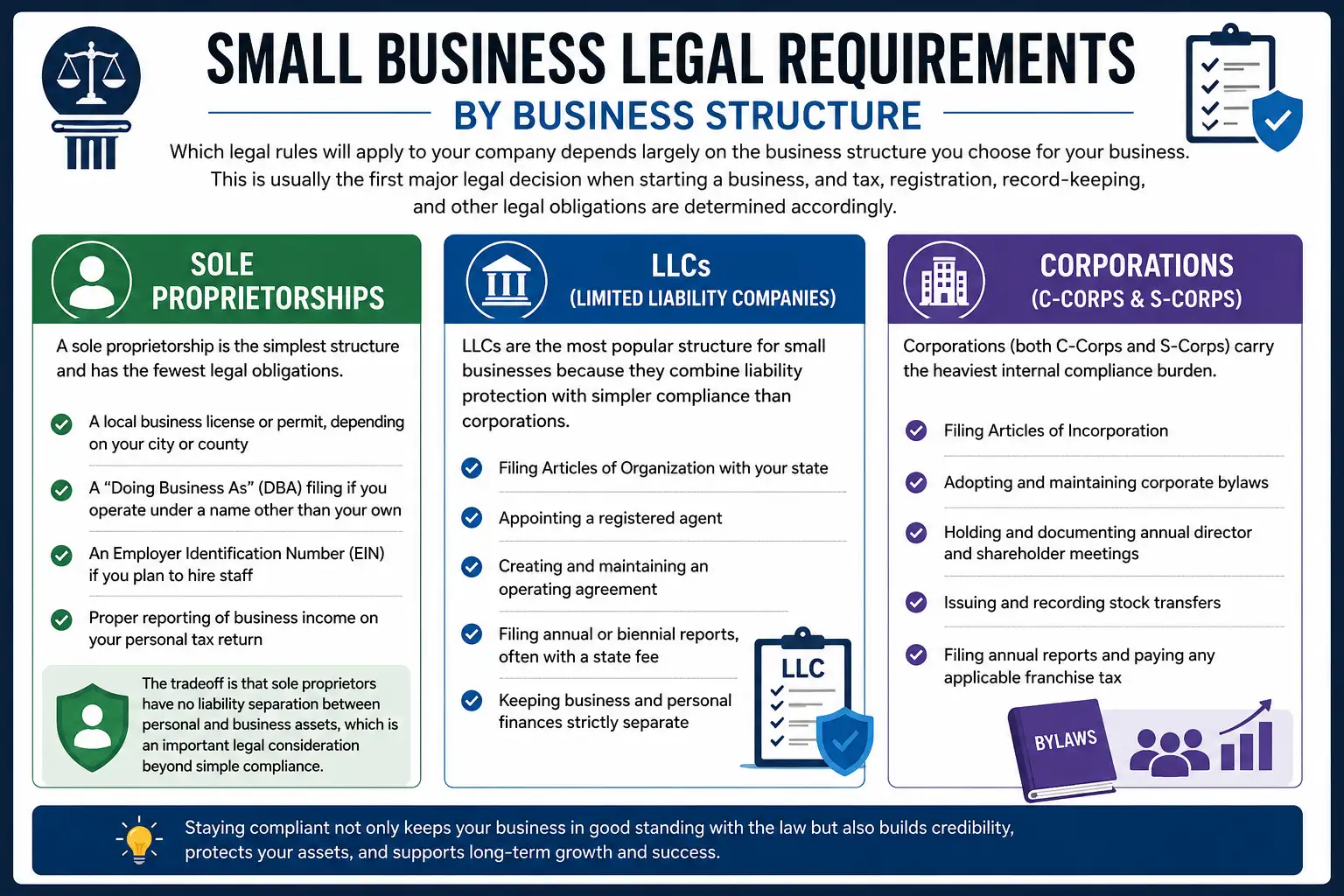
Which legal rules will apply to your company depends largely on the business structure you choose for your business. This is usually the first major legal decision you make when starting a business, and tax, registration, record-keeping, and other legal obligations are determined accordingly.
Legal Requirements for Sole Proprietorships
A sole proprietorship is the simplest structure and has the fewest legal obligations. You typically need:
- A local business license or permit, depending on your city or county
- A “Doing Business As” (DBA) filing if you operate under a name other than your own
- An Employer Identification Number (EIN) if you plan to hire staff
- Proper reporting of business income on your personal tax return
The tradeoff is that sole proprietors have no liability separation between personal and business assets, which is an important legal consideration beyond simple compliance.
Legal Requirements for LLCs
Limited liability companies (LLCs) are the most popular structure for small businesses because they combine liability protection with simpler compliance than corporations. The core legal obligations for LLCs include:
- Filing Articles of Organization with your state
- Appointing a registered agent
- Creating and maintaining an operating agreement
- Filing annual or biennial reports, often with a state fee
- Keeping business and personal finances strictly separate
Legal Requirements for Corporations
Corporations (both C-Corps and S-Corps) carry the heaviest internal compliance burden. Legal requirements typically include:
- Filing Articles of Incorporation
- Adopting and maintaining corporate bylaws
- Holding and documenting annual director and shareholder meetings
- Issuing and recording stock transfers
- Filing annual reports and paying any applicable franchise tax
Federal Small Business Legal Requirements You Cannot Ignore
In addition to state laws, there are also some federal (nationwide) laws that every business must follow, regardless of the state in which it operates.
EIN and Federal Tax Registration
If your business is any type of business other than a sole proprietorship, or if your business has employees, you are required to obtain an Employer Identification Number (EIN) from the IRS. This number is used to open a business bank account, file employee taxes, and obtain a business license.
Beneficial Ownership Information (BOI) Reporting
Many small businesses were previously required to report their beneficial owners to the federal government to prevent money laundering. But because BOI reporting rules have changed several times since 2024, business owners should check with FinCEN or an experienced attorney to verify the current BOI reporting rules before assuming they are exempt.
ACA and Employer Mandates
If your business has 50 or more full-time (or equivalent) employees, you are required by law to provide at least basic health insurance to your employees.
If you don’t and an employee gets a subsidy from the Health Insurance Marketplace, you could be fined up to $2,900 per employee in 2026. This amount can change each year.
If your business has fewer than 50 employees, this law doesn’t apply to you. However, your business may be eligible for health care tax credits available to small businesses.
State and Local Small Business Legal Requirements
State and local governments also have their own laws and requirements in addition to federal laws. Which laws you must follow depends on which state or city your business is located in.
Business Licenses and Permits
Most cities and counties require a general business license to start a business. Some businesses, such as restaurants, beauty salons, contractors, and child care services, also require additional licenses or health permits. The renewal dates for these licenses can vary from place to place, so it’s important to keep track of their expiration dates and renew them on time to keep your business legal.
Annual Reports and Franchise Taxes
Most states require you to file a report every year or every two years to keep your business in good standing. The fee can typically be $300 or more. Some states also charge a franchise tax, the amount of which varies from state to state. If you don’t file this report on time, your business could lose its legal status, and many small businesses find out too late.
Employment Law Requirements for Small Business Owners
The moment you hire your first employee, an entirely new set of legal obligations applies to your company. These generally include:
- Verifying employment eligibility (Form I-9) for every new hire
- Registering for state unemployment insurance and workers’ compensation
- Posting required federal and state labor law notices in the workplace
- Following minimum wage, overtime, and meal-break rules for your state
- Maintaining a safe workplace under OSHA’s general duty clause
- Complying with anti-discrimination laws, including the Americans with Disabilities Act (ADA)
Employment-related legal requirements are among the most frequently audited, so accurate recordkeeping is critical from your very first hire.
Intellectual Property and Contract Requirements for Small Businesses
In addition to registration and taxes, businesses have some other important legal responsibilities. These include protecting your ideas, brand, logo, name, and contracts, as these are the things that make your business stand out from others. If you don’t pay attention to them from the start, major legal and financial problems can arise later, which can cause significant losses to the business.
Trademarks, Copyrights, and Business Names
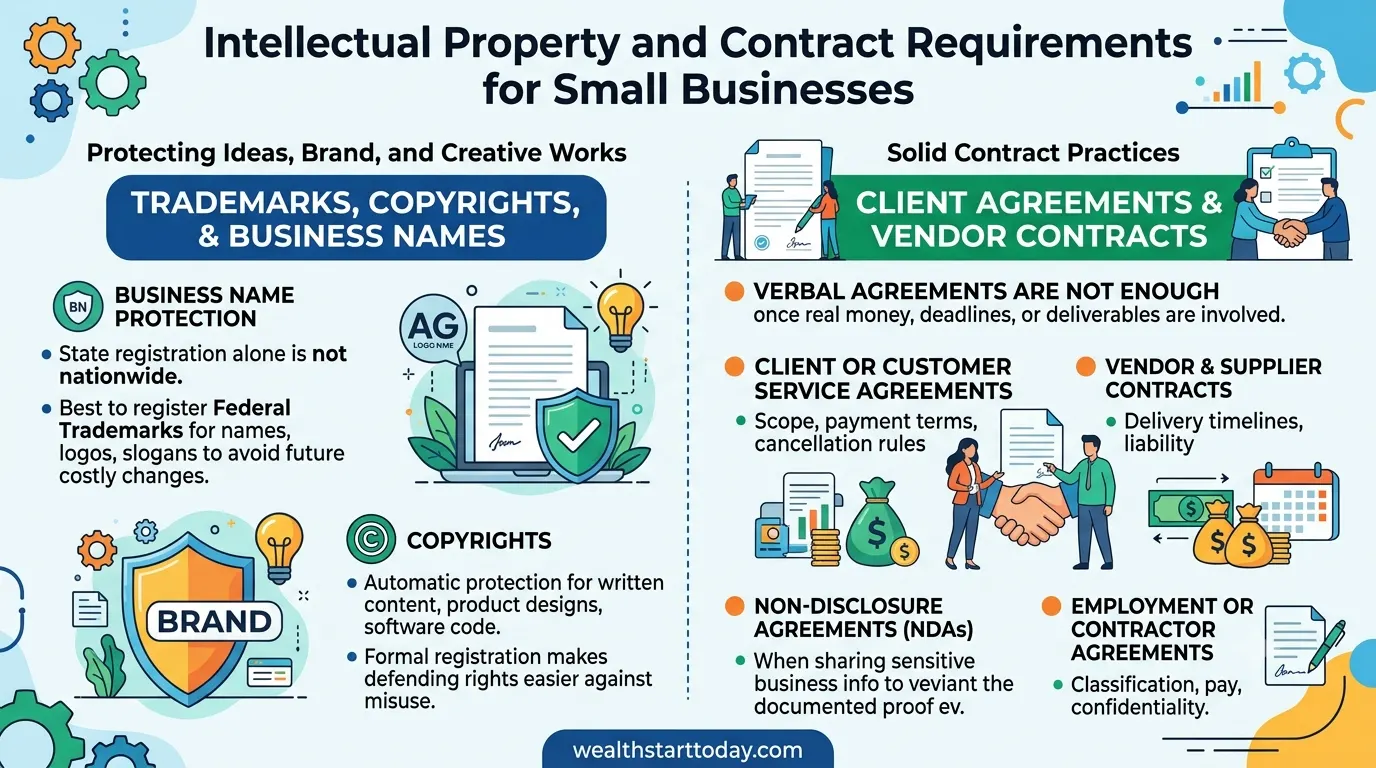
Registering your business name in the state alone does not protect it nationwide. If your business name, logo, or slogan are a hallmark of your brand, it is best to register them as federal trademarks. This can help avoid costly problems in the future, such as having to change the name or logo because someone else claims it.
Similarly, your written content, product designs, software code, and other creative works are usually automatically protected under copyright. But if you also register them formally, it becomes easier and stronger to defend your rights if someone copies or misuses them.
Client Agreements and Vendor Contracts
Verbal agreements are not enough once real money, deadlines, or deliverables are involved. Solid contract practices in this area include:
- Written client or customer service agreements outlining scope, payment terms, and cancellation rules
- Vendor and supplier contracts that clearly define delivery timelines and liability
- Non-disclosure agreements when sharing sensitive business information
- Employment or contractor agreements that define classification, pay, and confidentiality
A well-drafted contract does more than look professional. It reduces the chance of disputes escalating into costly litigation, and it gives you documented proof of the terms both parties agreed to.
Insurance and Risk Requirements Tied to Small Business Legal Requirements
Insurance is often overlooked when people think about legal compliance, but many types of coverage are legally mandatory, not optional.
- Workers’ compensation insurance: Required in nearly every state once you hire employees, even part-time staff in many cases.
- General liability insurance: While not always legally mandated, it’s frequently required by landlords, lenders, and client contracts before you can operate.
- Commercial auto insurance: Required if your business owns or regularly uses vehicles for deliveries or services.
- Professional liability insurance: Often required for licensed professionals such as consultants, accountants, and healthcare providers.
Operating without required insurance doesn’t just expose you to lawsuits, it can also mean automatic non-compliance with state labor laws, which regulators actively enforce.
Small Business Legal Requirements Comparison Table
The table below summarizes how core legal obligations differ across the three most common business structures.
| Requirement | Sole Proprietorship | LLC | Corporation |
|---|---|---|---|
| Formation filing | Usually none (DBA only) | Articles of Organization | Articles of Incorporation |
| Liability protection | None | Yes | Yes |
| Operating agreement / bylaws | Not required | Recommended | Required |
| Annual meetings | Not required | Recommended | Required, with minutes |
| Annual state report | Varies by state | Usually required | Usually required |
| Franchise tax | Rarely applies | May apply | Commonly applies |
| Ongoing recordkeeping burden | Low | Moderate | High |
Data Privacy and Cybersecurity Legal Requirements in 2026
Data privacy has become a key legal responsibility for small businesses. If your business collects customer email, payment information, or website usage data, you may be subject to one or more state privacy laws. Several new laws also went into full effect in 2026, making it more important than ever for businesses to comply with them.
| Area of Compliance | What It Typically Requires |
|---|---|
| Privacy policy | Clear disclosure of what data is collected and why |
| Consumer rights requests | Process for customers to access or delete their data |
| Data breach notification | Timely notice to affected customers and regulators |
| Vendor agreements | Contracts ensuring third-party processors meet the same standards |
Even if your business operates in only one state, you may still be subject to certain privacy laws if you sell your products or services to customers in states with stricter laws, such as California, Colorado, Virginia, or Connecticut. That’s why it’s important to review the ways your business collects, uses, and protects customer data every year. In today’s world, this is no longer optional, but a critical part of complying with legal requirements.
Common Mistakes That Violate Small Business Legal Requirements
Even well-intentioned owners fall into predictable traps. The most common mistakes include:
- Mixing personal and business finances, which can pierce liability protection
- Forgetting to renew a local license or permit before its expiration date
- Misclassifying employees as independent contractors
- Ignoring annual report deadlines until the business falls out of good standing
- Failing to update licenses or registrations after a business address or ownership change
- Assuming an LLC alone eliminates all personal legal risk
It is much easier and less expensive to avoid these mistakes than to fix them later. That is why it is beneficial to plan for legal requirements (compliance) from the beginning. Often, these mistakes are not due to negligence on the part of business owners, but because various legal responsibilities are divided among several government agencies and reminders for everyone are not in one place.
For example, the city’s permit office does not communicate with either the state’s Secretary of State or the IRS. Therefore, it is better to create a simple record or spreadsheet of your own, which includes renewal dates and deadlines for submitting necessary documents. This way, important tasks will be completed on time and it will be much easier to maintain compliance.
Any time your business changes, be sure to re-evaluate your legal requirements.** For example, if you open a new office, add a new product, hire your first remote employee, or your revenue exceeds a certain threshold, you may be subject to new legal and government regulations.
So don’t think of compliance as something you only need to do when you start your business, but review it periodically. This way, your business will continue to operate in compliance and avoid unexpected fines or legal issues in the future.
How Wealth Start Today Helps You Navigate Small Business Legal Requirements
At Wealth Start Today, our mission is to make entrepreneurship approachable without oversimplifying the real work it takes to build a compliant, sustainable company. This article lives in our Business category, where we cover everything from legal foundations and tax planning to marketing and scaling strategy. We believe small business legal requirements should never feel like a mystery, so we break down government guidance, real-world examples, and practical checklists into content you can actually use to protect what you’re building.
Related Reading: How to Start a Small Business
If you’re still in the early planning stages, it’s worth pairing this guide with our earlier article, How to Start a Small Business. That piece walks through choosing a business idea, writing a basic business plan, and taking your first practical steps toward launch, while this guide focuses specifically on the legal and compliance side of running that business once it’s off the ground. Reading both together gives you a complete picture: one covers the “how to start,” and this one covers the “how to stay legal” once you’re operating.
A Trusted External Resource
For official, government-verified guidance on this topic, the U.S. Small Business Administration’s compliance guide is one of the most reliable free resources available. It’s a strong reference point to bookmark alongside this guide, especially when your specific state or industry has rules that go beyond what’s covered here.
Frequently Asked Questions
- What are the basic small business legal requirements every owner needs?
At minimum, most businesses need proper registration with their state, any required local licenses or permits, an EIN if they have employees, and compliance with basic tax filing obligations.
- Do these legal obligations differ by state?
Yes. While federal requirements like EIN registration and employment law apply nationwide, licensing, annual report rules, and franchise taxes vary significantly by state.
- What happens if I ignore compliance obligations?
Consequences can include fines, loss of good-standing status, administrative dissolution of your business, and in some cases personal liability if you fail to maintain separation between yourself and the business.
- Do I need a lawyer to stay compliant?
Not always. Many requirements, like registering for an EIN or filing an annual report, can be handled directly. However, consulting an attorney is wise for entity formation, contracts, and any industry with heavy regulation.
- How often do these rules change?
Fairly often. Federal reporting rules, state privacy laws, and tax thresholds are regularly updated, so reviewing your obligations at least once a year is strongly recommended.
- Are legal requirements different for online-only businesses?
Online businesses still need proper registration and tax compliance, but they often face additional rules around data privacy, sales tax collection across states, and consumer protection disclosures.
- What obligations kick in as soon as I hire my first employee?
Hiring even one employee typically triggers I-9 verification, state unemployment insurance registration, workers’ compensation coverage, workplace poster requirements, and payroll tax withholding obligations, so it’s worth reviewing employment-related rules before your first offer letter goes out.
- How can I keep track of ongoing small business legal requirements without missing deadlines?
Many owners maintain a compliance calendar that lists license renewal dates, annual report due dates, and tax filing deadlines in one place, and some rely on a registered agent service or accountant to send reminders before deadlines pass.
Conclusion
Meeting your small business legal requirements isn’t just about avoiding penalties, it’s about building a company that can grow without legal landmines waiting beneath the surface. From choosing the right business structure to staying current on licensing, employment law, and data privacy rules, compliance is an ongoing responsibility rather than a one-time checklist. Treat it as part of your business strategy, not an afterthought, and revisit your obligations regularly as your business and the regulatory landscape both evolve.
You can also follow us on Facebook and X.com for regular updates, tips, and new articles designed to help you start and grow your business the right way.












Leave a comment